Fort Kochi and Mattancherry get sold as two separate mornings. Fort Kochi is the European quarter — churches, cemetery, parade ground, colonial bungalows. Mattancherry is Jew Town — the synagogue, the spice godowns, the antique shops. Guides move you between them and the two histories stay tidily apart.
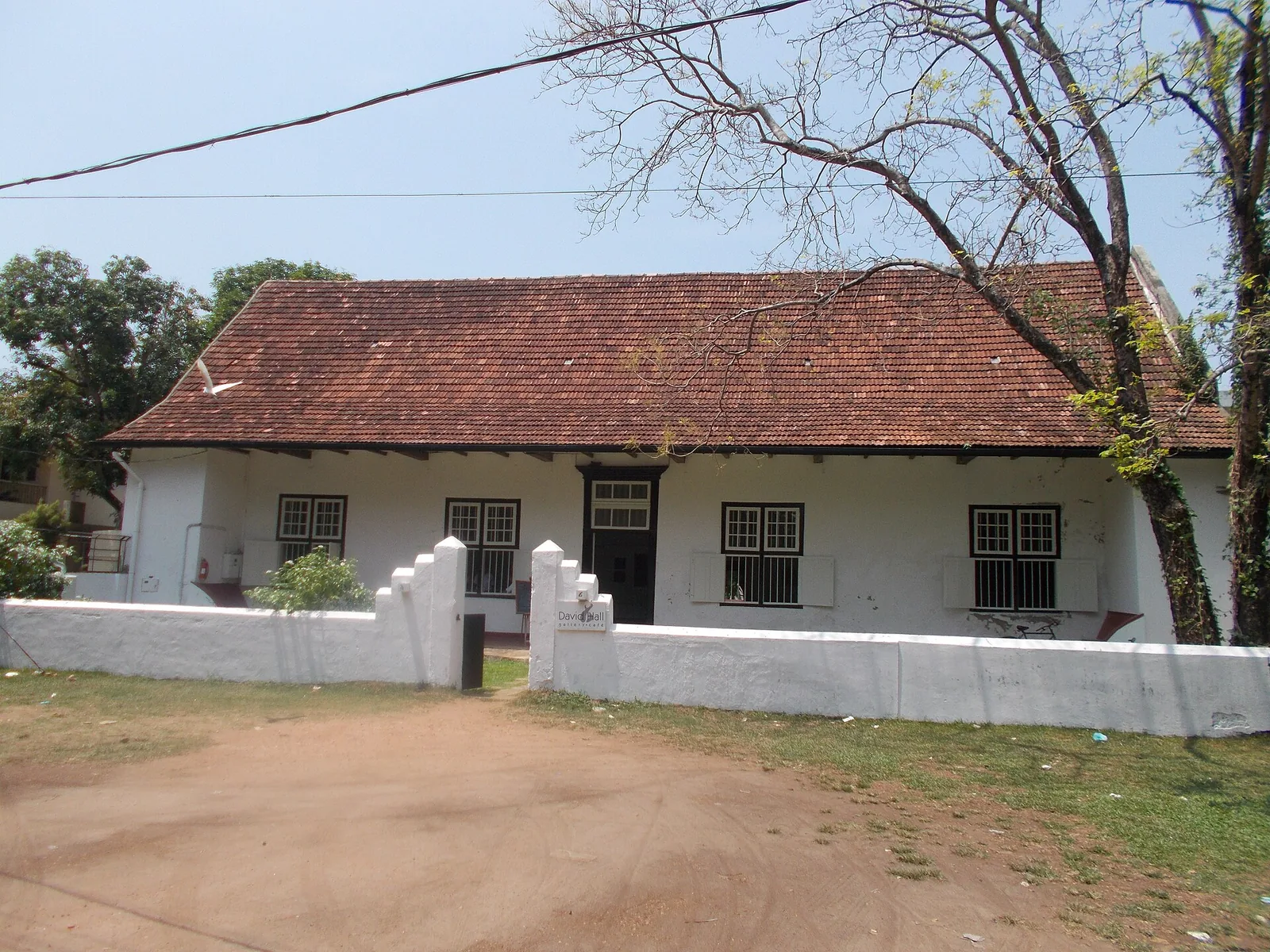
David Hall is where they meet, in one building, and almost nobody points it out.
The Company half
The house is credited to the Dutch East India Company and usually dated to about 1695, though 1665 has also been proposed and the true date is not established. It is described as the survivor of a group of three houses the Company built in Fort Kochi in the later seventeenth century — houses said to have been raised partly from the material of churches demolished after the Dutch took Cochin from the Catholic Portuguese in 1663.
It faces the parade ground, the drill and assembly space of the European quarter, and during the Dutch period it is reported to have accommodated military personnel. So the first half of the building’s life is straightforwardly institutional: a Company house on the Company square, possibly built out of a Company demolition.
The Jewish half
Its later history belongs to Jewish Kochi. The house passed into the hands of a prominent Cochin Jewish family and takes its name from them. The last Jewish owner is given as Gladys Koder, wife of S. S. Koder of Koder House, and daughter of E. D. David, who died in 1958.
That is also, incidentally, where the popular story about the name falls apart. You will read almost everywhere that David Hall is named after a David Koder. The Koder family record names Samuel Koder’s sons as Elias, Shabdai — the S. S. Koder of Koder House — and Cecil. There is no David among them. The David in the name appears to come from the other side of the marriage, from Gladys’s father’s family.
- Dutch East India Company, later seventeenth century — one of three houses, possibly built with material from demolished Portuguese churches.
- Dutch period — reported to have housed military personnel, consistent with its position on the parade ground.
- Later — owned by a prominent Cochin Jewish family; the name comes from them.
- Last Jewish owner: Gladys Koder, wife of S. S. Koder, daughter of E. D. David (d. 1958).
- Today — contemporary art gallery and garden café; a venue of the first Kochi-Muziris Biennale in 2012 and of exhibitions since.
Why the transfer happened at all
Because the community that owned it left. Fort Kochi and Mattancherry held one of the oldest Jewish communities in the world, and its near-complete emigration in the twentieth century — overwhelmingly to Israel — is the reason houses like this one changed hands. The Paradesi synagogue still stands and is still shown to visitors; the congregation that filled it does not exist any more in any meaningful sense.
That is the fact underneath the pleasant story about a heritage building with a gallery in it. Property changes hands for reasons, and the reason here is a community that is no longer there.
What that gives you as a visitor
A rare thing: a single address that carries the Dutch takeover of 1663 and the emptying of Jewish Kochi three centuries later, in a building you can walk into for nothing and sit behind with a coffee. Most of Fort Kochi tells you one century at a time. This one is layered, and its layers are in the wrong parts of town according to the standard itinerary.
It takes twenty minutes, entry to the gallery is generally free, and there is no interpretation on site at all — which is a pity for the building and, if you have read this far, an advantage for you.
Frequently asked questions
Who owned David Hall?
It is credited to the Dutch East India Company in the later seventeenth century, and is reported to have housed military personnel during the Dutch period. It later passed to a prominent Cochin Jewish family, from whom it takes its name; the last Jewish owner is given as Gladys Koder, wife of S. S. Koder and daughter of E. D. David, who died in 1958.
Who is the David in David Hall?
Probably not the David Koder of the popular story. The Koder family record names Samuel Koder’s sons as Elias, Shabdai (S. S. Koder) and Cecil — no David. The name most likely comes from the David family, through Gladys Koder’s father E. D. David. We publish this as the better-supported reading rather than a closed case.
Why did the house change hands?
Because the Cochin Jewish community — one of the oldest Jewish communities in the world, centred on Fort Kochi and Mattancherry — emigrated almost completely during the twentieth century, overwhelmingly to Israel. Houses like this one changed hands as a consequence.
Was it really built with stone from demolished churches?
It is reported that the group of Dutch East India Company houses David Hall belongs to was raised partly from the material of churches pulled down after the Dutch took Cochin from the Portuguese in 1663. The report is secondary rather than documented, but it fits what the Dutch did to Portuguese religious building in the town.
Is David Hall connected to Koder House?
Through the same family. S. S. Koder — Shabdai Koder — is the Koder of Koder House, and his wife Gladys was the last Jewish owner of David Hall. The two buildings sit in different quarters and are usually shown on different itineraries.
Can I visit?
Yes. Entry to the gallery is generally free and a visit takes about twenty minutes, with a garden café behind. There is no reliably published timetable — hours move with the current exhibition — so check locally rather than assuming.