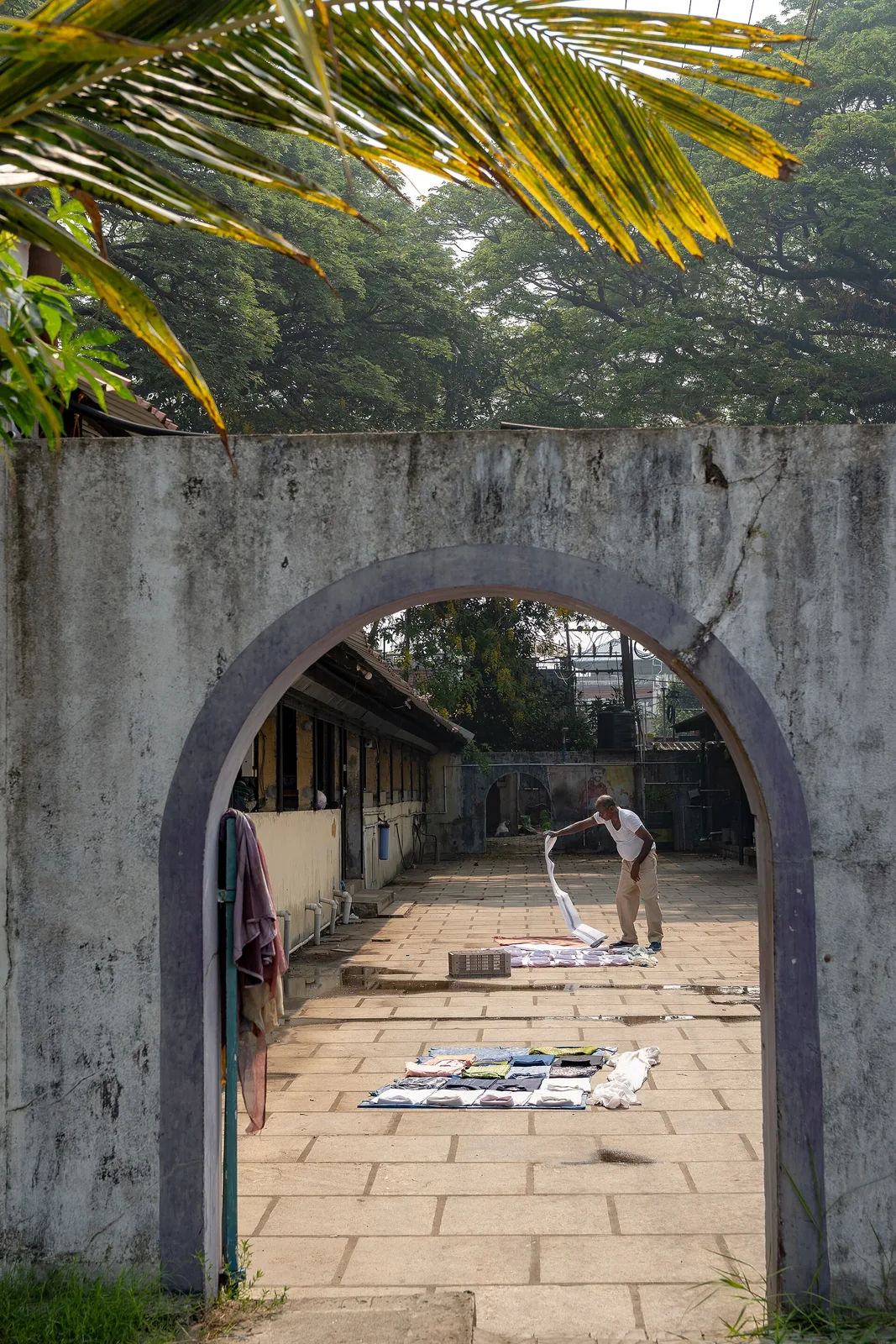
Walk out of the washing pens at the Dhobi Khana and you are on the edge of a large flat open field. Veli Ground. Children play cricket on it. Visitors glance at it and see a park.
It is not a park. It is a receipt.
What used to be there
The ground the field occupies was the community’s working land. Accounts of the older arrangement describe something in the region of eighty ponds dug across it — one for each Vannar family — which is a startlingly different picture from the one you see today. Not a laundry building with shared pens, but a dispersed field of family water, each household with its own.
Hold that image next to what stands there now: a three-acre compound with roughly forty wash pens in a row, and an open playing field where the ponds were.
The exchange
Around ten acres went, given up as part of a city improvement scheme. That land became Veli Ground. In compensation, the Greater Cochin Development Authority built the present Dhobi Khana in 1976.
So the building visitors come to photograph as a piece of colonial heritage is fifty years old, and it exists because the community lost ten acres. That is the single most concrete fact about the site, and it is not on any sign.
- Then: reportedly around 80 ponds across the land now occupied by Veli Ground — one per Vannar family.
- Given up: roughly ten acres, under a city improvement scheme.
- Received: the present Dhobi Khana, built 1976 by the Greater Cochin Development Authority.
- Now: about 40 wash pens in a compound of roughly three acres.
- Families still using it: around forty, by recent reporting, and falling.
Why the numbers matter more than the pretty version
The story usually told about the Dhobi Khana is a colonial one: the Dutch brought Tamil washermen to launder military uniforms, and here they still are. That version has real problems — three different origin accounts circulate and none is settled — and it also has a subtler defect. It puts the interesting part four hundred years ago and turns the people currently working there into a survival.
The land exchange puts the interesting part in living memory. Someone in that compound remembers the ponds. Someone signed for the ten acres. The building went up in 1976 within the working lives of people who are still there.
What is squeezing it now
Not the state — the economy. Every apartment block in Kochi has a washing machine. Every hotel of any size has an industrial laundry. What is left is domestic work and contracts that hand-washing can still hold, and the margins on that thin every year. Reporting over the last decade has returned repeatedly to the same question about how long the khana can last, and the honest answer from inside is usually that the next generation is studying for office jobs.
That is not a tragedy to be photographed. It is a family deciding sensibly. But it does mean that the forty families are unlikely to be forty in a decade.
Going, without making it worse
Mid-morning, when the place is actually working. No ticket, no counter, no official guide. Someone will usually show you round, and the small tip goes to that person, not to whoever met you at the gate. Ask before every photograph and accept a no — people are working and living here, and the objection is almost never to being photographed, it is to not being asked.
Then go and stand on Veli Ground for a minute before you leave.
Frequently asked questions
What is Veli Ground next to the Dhobi Khana?
The open playing field beside the laundry — roughly ten acres the Vannan community gave up under a city improvement scheme. The present Dhobi Khana was built in 1976 by the Greater Cochin Development Authority as compensation for that land. The two are directly connected.
How old is the Dhobi Khana building?
It was built in 1976 by the Greater Cochin Development Authority. Whatever the community’s origins — and three different accounts circulate — the structure you visit is fifty years old, not colonial.
How many wash pens and families are there?
Roughly forty wash pens in a compound of about three acres, with around forty families reported to be using the khana in recent coverage. Older accounts describe something like eighty ponds across the land that is now Veli Ground, one per family.
Why is the trade shrinking?
Domestic washing machines and hotel industrial laundries have taken most of the work, and the margins on what is left are thinning. The younger generation is largely moving into study and office work, which is a reasonable decision rather than a loss of tradition.
Is there an entry fee?
No ticket — it is a working community laundry, not an attraction. The custom is a small tip to whoever actually shows you round, given to that person directly.
Can I take photographs?
Ask first, every time, and accept a refusal. The washing pens, the drying lines and the coal-heated irons are the subjects worth asking for. Most people are happy to be asked; the objection is to being photographed without being asked.