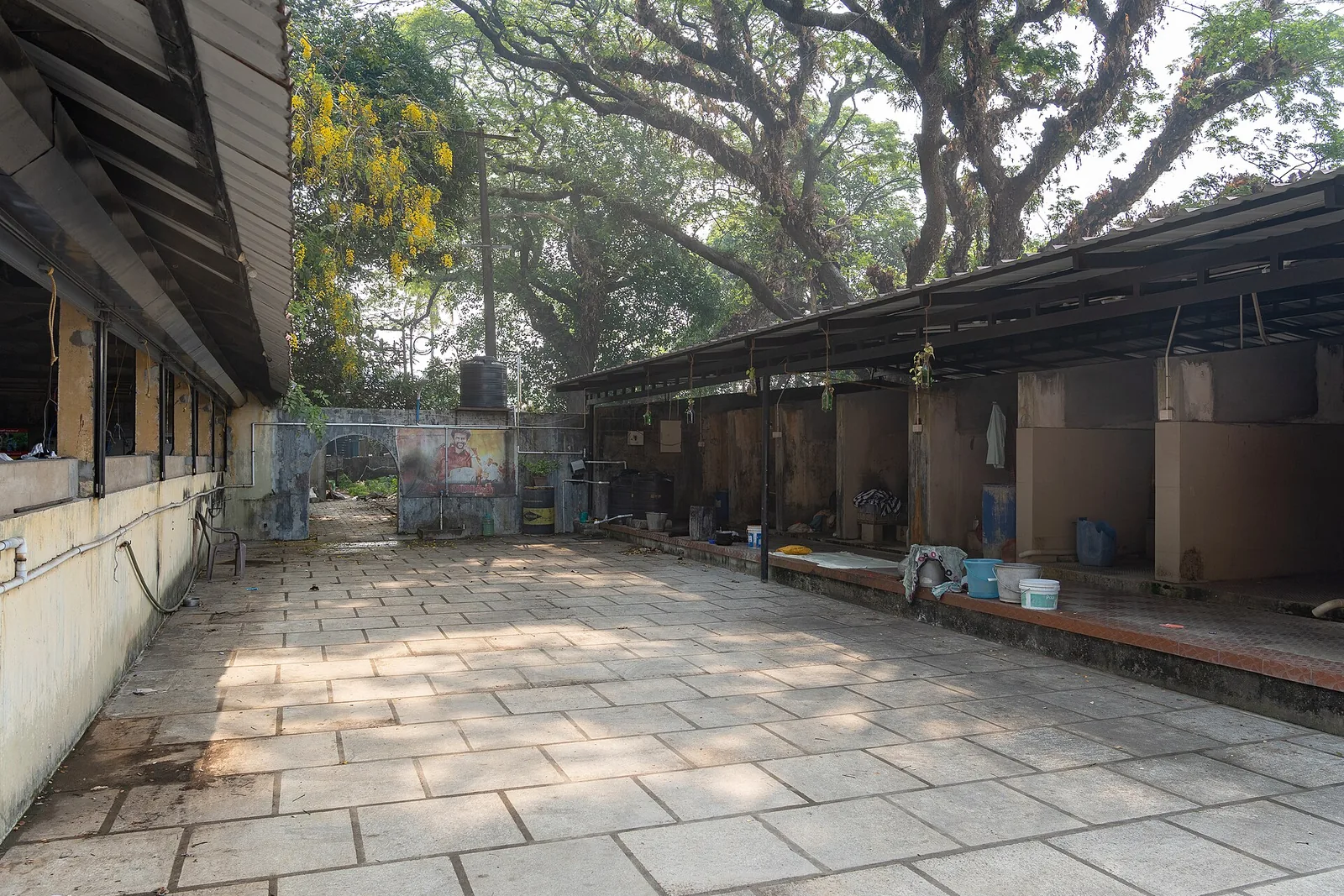
Everything written about the Dhobi Khana argues about who brought the Tamil washermen to Kochi — the Portuguese, the Dutch, the British, or the King of Kochi in the 1720s. Almost nothing asks the prior question, which is the more interesting one. Kerala already had washermen. It had them organised, hereditary and everywhere. So why import any?
The washing that was not laundry
In traditional Kerala society, washing cloth was a ritual office before it was a service. Several communities held it. The Veluthedathu Nair — the name itself carries the sense of whitening, of purifying — washed for Brahmins, for rulers and for temples. In other regions and communities the same function belonged to the Mannan and the Velan.
Their central product was not a clean shirt. It was mattu: a freshly washed cloth handed to a household at the exact moment a period of ritual pollution ended. Colonial-era ethnography of southern India records the schedule with some precision — a woman received it on the fourth morning after her period began; a woman who had given birth on the fifth, ninth, eleventh and sixteenth days; every member of a family under death pollution on the sixteenth day. The cloth was worn to bathe in and handed straight back afterwards.
Read that again and notice what is being sold. Not cleanliness. Validity. The rite did not complete without the cloth, and the cloth was only good if it came from the right hands.
- Ritual washing: hereditary, tied to named client families, low volume, non-transferable.
- The product is mattu — the cloth that ends a pollution period, worn to bathe and returned.
- Commercial laundry: bulk, to a deadline, for anyone who pays — garrisons, offices, hotels, hospitals.
- The first cannot be scaled into the second without destroying what makes it work.
- Fort Kochi ended up with both, running side by side.
Why that could not become a laundry
A hereditary ritual obligation is the opposite of a business you can grow. The relationship runs between particular families, in both directions. The volume is set by births, deaths and cycles, not by demand. And the value depends entirely on the washer being the right person — which is precisely the thing a contract laundry cannot promise, because a contract laundry sells to strangers.
What a garrison wanted was different in every respect: a large quantity of uniforms, cleaned to a standard, by a fixed day, for money, with no question of who was serving whom ritually. Later the same demand came from a port city — its offices, its hospitals, its hotels. That is a volume business with deadlines, and it needed people whose work was not already spoken for.
Which is where the Vannan come in
A Tamil-speaking washing community, brought to Kochi and settled there, fits that demand exactly — and, crucially, without displacing anybody. The newcomers were not competing for inherited clients, because they were not in the ritual business at all. Two washing trades could run in the same city indefinitely without colliding, which is a good part of why both survived so long.
It also explains something visitors find strange: that the community stayed Tamil. A group doing commercial work for a general clientele has no structural reason to be absorbed into local caste relations, and every reason to hold together. The language survived because the trade did not require giving it up.
None of this settles which coloniser or king did the bringing. Three accounts circulate — Portuguese and Dutch military laundry, British officers, and the King of Kochi in the 1720s — and we have not found a source that decides between them. What is documented is that the community was formally organised here in the 1920s under the Madras Presidency.
What is left of it
Recent reporting puts around forty families still using the khana. The ground is divided into allotted pens rather than worked as a common pool, so the same family is in the same bay each day. Clothes are soaked, beaten on stone, boiled, wrung and dried on long lines in the open; the ironing hall runs on heavy coal-heated irons, and usually on Tamil film television.
The building itself is not old, whatever the tours imply — it went up in 1976, built by the Greater Cochin Development Authority as compensation after the community gave up around ten acres of land in a city improvement scheme. That land is the open field next door, Veli Ground. The laundry exists because the community lost the ten acres.
How to see it properly
Go mid-morning, when it is working. There is no ticket and no guide service; somebody will usually walk you round, and the tip goes to that person rather than to whoever met you at the gate. Ask before photographing anyone, every time, and take a refusal without negotiating — this is a workplace, and for many of these families it is also home ground.
And look for the division of the space, because it is the thing the photographs never explain. Nothing here is labelled in a way an outsider can read, and almost nothing goes astray, because the system holding it together is people and long habit rather than paperwork. That is also, in the end, what a ritual washing tradition and a commercial one had in common — both ran on knowing exactly whose cloth was whose.
Frequently asked questions
What is mattu?
A freshly washed cloth supplied by a washer caste to mark the end of a period of ritual pollution. It was worn to bathe in and returned immediately afterwards. Colonial-era ethnography records the timings: the fourth morning after a woman’s period began; the fifth, ninth, eleventh and sixteenth days after childbirth; the sixteenth day for a family under death pollution.
Who were Kerala’s traditional washermen?
Several communities held washing offices, including the Veluthedathu Nair — whose name carries the sense of whitening or purifying, and who washed for Brahmins, rulers and temples — and, in other communities and regions, the Mannan and the Velan. Their role was ritual as much as practical.
So why was a Tamil washing community brought to Kochi?
Because the two kinds of washing are not the same work. Ritual washing is hereditary, bound to named client families, and does not scale. What a garrison and later a port city needed was bulk laundry to a deadline for anyone who paid. A commercial washing community met that demand without competing for anyone’s inherited clients, which is why both trades could coexist.
Who actually brought them — the Dutch, the British or the King of Kochi?
Unresolved. All three accounts are in print, sometimes in the same guidebook, and we have not found a source that settles it. What is documented is that the community was formally organised in Kochi in the 1920s under the Madras Presidency, and that the present building dates only from 1976.
Why do people at the Dhobi Khana speak Tamil?
Because the community came from what is now Tamil Nadu and never had a structural reason to be absorbed. Commercial work for a general clientele does not require entering local caste relations, so the language, the trade and the social identity held together across generations inside a Malayalam-speaking city.
Is the Dhobi Khana a museum?
No. It is a working community laundry with around forty families using it, and it is somebody’s workplace every day of the week. There is no ticket, no counter and no official guide. Treat it accordingly: ask before photographing, tip the person who actually showed you round, and go mid-morning if you want to see work rather than full lines.