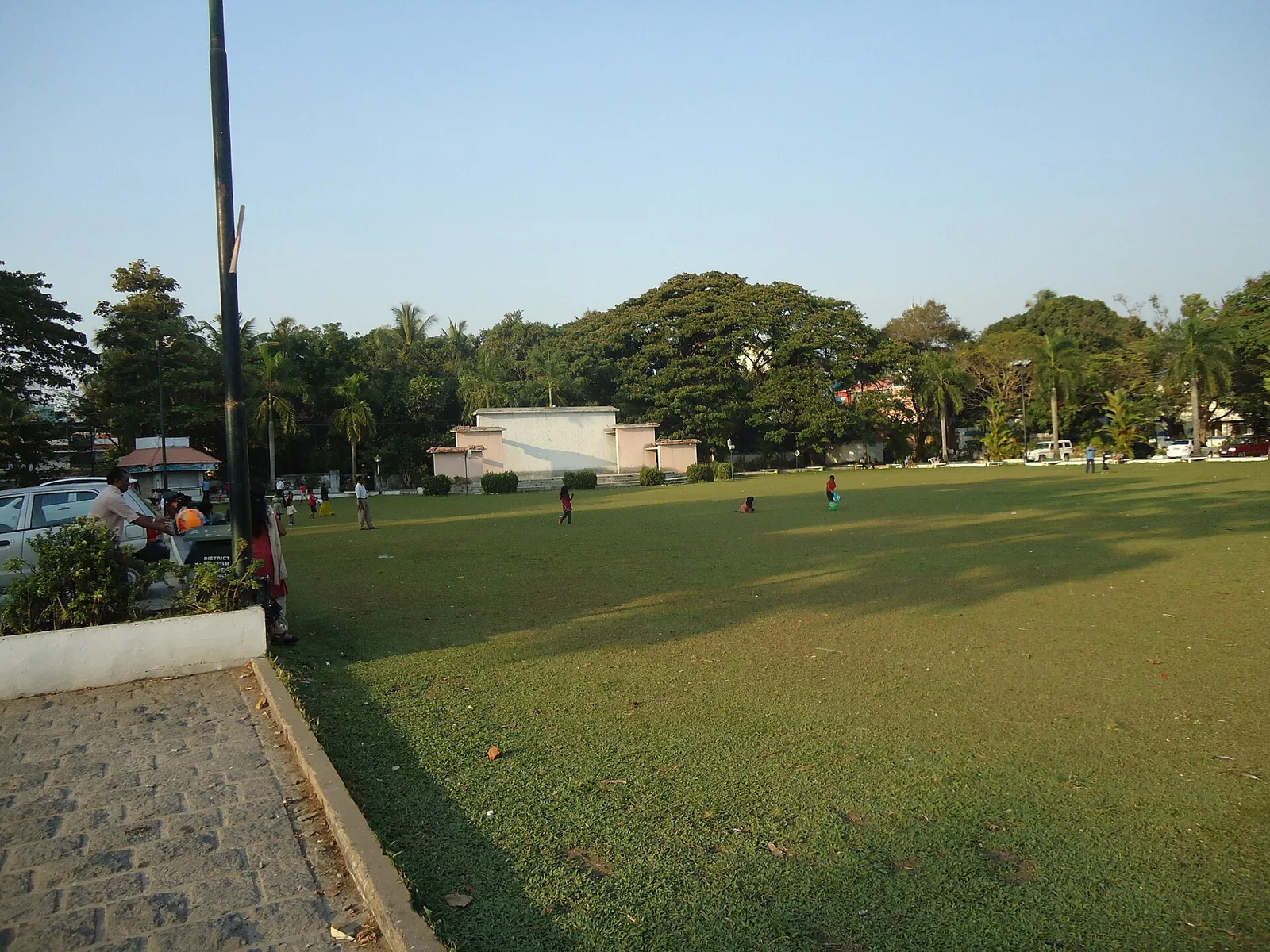
The most common mistake about the Durbar Hall Art Centre is treating the hall and the ground as one thing. They are not, and almost everything of consequence that happened at this site happened outdoors.
The arrangement was straightforward. The Maharaja of Cochin built the hall in the 1850s as his audience chamber and held his durbar inside it. The public assembled on the open ground beside it. The building was where the ruler sat; the ground was where the ruled stood. Once you see the site that way, the history stops being about architecture.
Three proclamations
This ground was the Cochin state’s public stage, and three dates from a three-year window show what that meant. On 4 January 1938 the administrative reforms were proclaimed here. On 17 June 1938 the new constitution of the Cochin State was proclaimed here. On 28 June 1940 the Cochin State Central War Committee was formed here.
That is a princely state announcing its own modernisation from a field, to a crowd, rather than through a gazette. It is worth holding alongside the fact that eleven years after the 1938 constitution, Cochin voted itself out of existence into the Travancore–Cochin union — and seven years after that, into Kerala.
During the Second World War the war committee staged a large war exhibition on the site, remembered locally as one of the finest spectacles of its time. The ground did propaganda as readily as it did proclamation.
Who was allowed to walk on it
The hardest fact about this ground is the one no signage carries. The ground itself, and the path leading from it to the nearby Ernakulam Shiva temple, were out of bounds to people of the lower castes. That restriction lifted only with the opening of temple entry.
It is worth being precise about what that means physically. This is not an abstraction about ritual purity in a sanctum. It is a public open space in the middle of a city, and a road running from it, on which certain people could not set foot. The distance from the ground to the temple is a few minutes’ walk. For a large share of the population it was, for generations, uncrossable.
Cricket, football and a literary magazine
Alongside the official use, this was simply the city’s main open space, and its sporting history is well remembered. It was for years the principal cricket venue in Kochi, with a small band shed at the north-east corner serving as the pavilion and the low walls around the edge packed with spectators. The local Town Club played football here against British army sides. Swantons Cricket Club was based here until the recent renovation pushed them elsewhere.
At one end of the ground stands the Kulapuramalika, where Appan Thampuran and Kunjukuttan Thampuran launched Rasikaranjini — a literary magazine that mattered a great deal to Malayalam letters. The building is still there and almost nobody looks at it.
What was taken away
The two-acre compound you see is a survivor’s figure, not an original one. Close to half of the original ground went to residential quarters for the District Collector and for judges of the Kerala High Court. More was lost to the widening of Durbar Hall Road and to parking for the Rama Varma Club. Anyone describing the site as a two-acre historic compound is describing what is left after a century of subtraction.
The ground later fell into neglect and was used partly as a dumping area before the District Tourism Promotion Council restored and beautified it at a cost of around ₹49.94 lakh, adding an open-air auditorium, a band stand, light towers and pay-and-park. It is now held by the Revenue Department. That restoration is not universally admired: it involved demolishing the old band house and putting car parking inside the ground, and local accounts record it as a loss of character rather than a recovery of it.
Frequently asked questions
What is the difference between the Durbar Hall and the Durbar Hall Ground?
The hall is the building — the 1850s audience chamber, now the Durbar Hall Art Centre gallery. The ground is the open maidan beside it. The durbar was held inside the hall with the public assembled outside on the ground, and most of the site’s recorded history belongs to the ground rather than the building.
What was proclaimed at Durbar Hall Ground?
The Cochin administrative reforms on 4 January 1938, the new constitution of the Cochin State on 17 June 1938, and the formation of the Cochin State Central War Committee on 28 June 1940. The ground was the state’s public stage for announcements of this kind.
Was Durbar Hall Ground closed to lower castes?
Yes. The ground and the path running from it to the nearby Ernakulam Shiva temple were out of bounds to people of the lower castes, and the restriction lifted only with the opening of temple entry. Nothing on the site records this today.
How big is the Durbar Hall compound?
About two acres — but that is what survives. Close to half the original ground was taken for residential quarters for the District Collector and High Court judges, with further land lost to the widening of Durbar Hall Road and to club parking.
Was Durbar Hall Ground a cricket ground?
For many years it was the principal cricket venue in Kochi, with a band shed at the north-east corner as its pavilion, and it also hosted football between the local Town Club and British army sides. Swantons Cricket Club was based here until the recent renovation.
Can you visit the Durbar Hall Ground?
Yes — it is a public open space in central Ernakulam beside Durbar Hall Road, separate from the gallery and with its own opening pattern, so you can walk it even when the art centre is shut. Look for the Kulapuramalika at one end, where the literary magazine Rasikaranjini was launched.