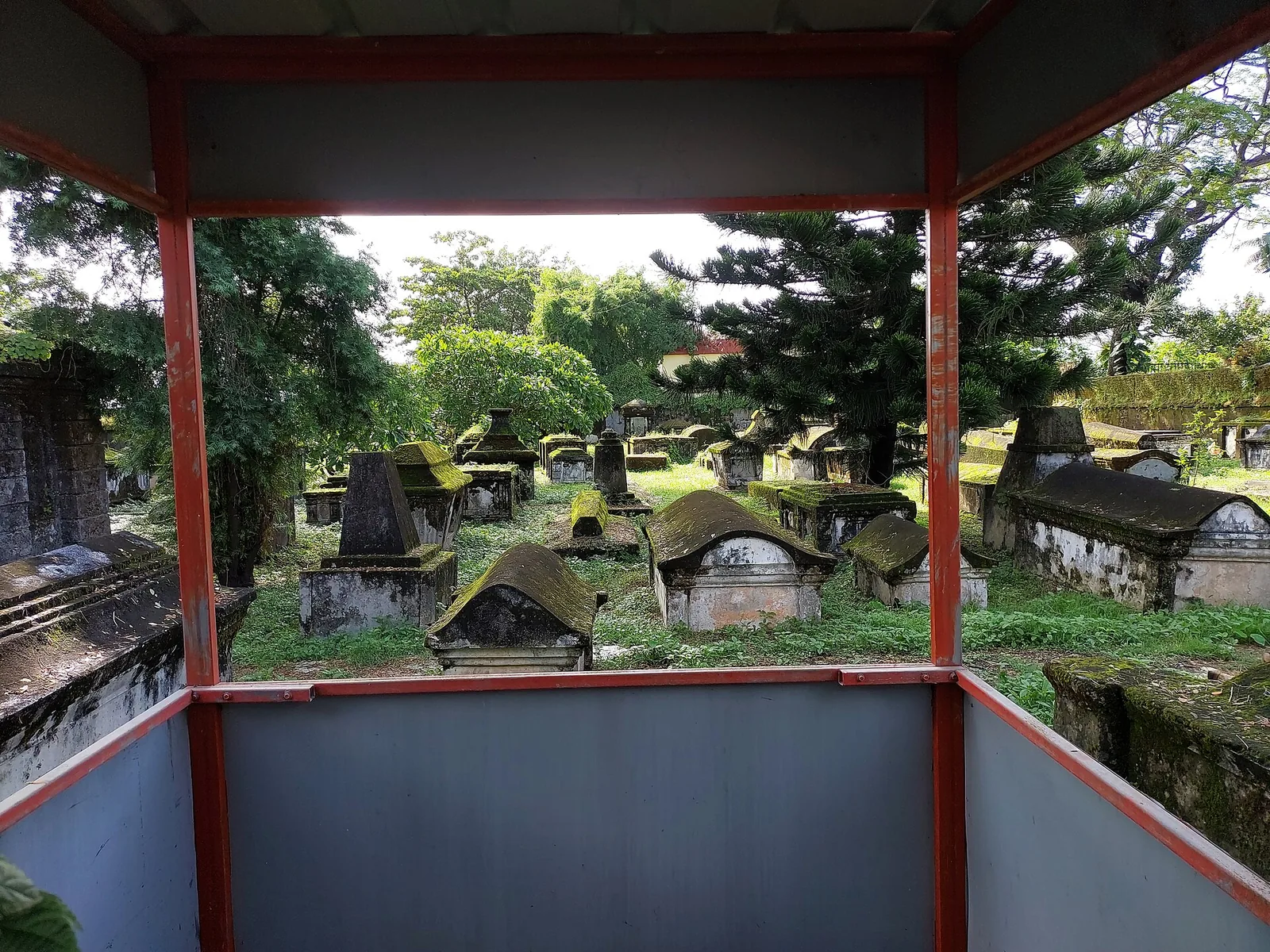
The Dutch Cemetery is the least visited significant site in Fort Kochi, largely because the gate is usually locked. What most people get is a low wall and a pillar with 1724 cut into it. It is worth knowing what is on the other side, because the stones say something the rest of the quarter does not.
The two stones
Inside are roughly a hundred and four tombs and epitaphs. Two materials repeat: dark grey granite hauled from inland Kerala, and rusty red laterite, the soft iron-rich stone that hardens on exposure to air and that half of coastal Kerala is built from — the same rock as the walls of the churches and godowns you have been walking past all morning.
A Dutch burial ground on the Malabar coast, cut out of Malabar rock, lettered with Dutch names. The whole colonial transaction is legible in a single slab.
What is missing, and why
Many of the tombs carry no cross at all, and almost none carry carving of any ambition. That is not neglect and it is not poverty. It is Dutch Reformed doctrine made visible in rock: no saints, no imagery, and — crucially — no burial inside the church.
That last point is the reason this ground exists. Catholic Portugal had buried its dead under the floor of the nave at St Francis, as close to the altar as rank and money allowed. The Protestant Dutch, sixty years after taking Cochin in 1663, consecrated separate ground outside a church instead. Walk from the ledger stones inside St Francis to this wall and you have walked the length of a theological argument in about four minutes.
- Consecrated 1724, the date cut into the entrance pillar.
- About 104 tombs and epitaphs survive — Company officials, garrison officers, merchants and their families.
- Materials: inland granite and coastal laterite. Inscriptions in an older Dutch, weathered close to illegible.
- Last burial usually given as Captain Joseph Ethelbert Winckler, 1913 — long after the Dutch had gone.
- ASI-protected, managed by the Church of South India, restored in 2020–21 with Dutch embassy funding.
The attrition
Here is what the inscriptions actually record, and it is not a heroic story. This was a posting people did not come home from. Men in their twenties and thirties. Wives. Children. One after another, on a shoreline eight thousand miles from the Netherlands.
Tropical disease did the work that the Portuguese, the Zamorin and the sea had all failed to do. The Dutch East India Company held this coast for a century and a half and its establishment at Cochin was emptied and refilled continuously by fever. When people describe the VOC as a machine, this ground is the maintenance log.
It is also why the plainness lands harder than any monument would. There is no rhetoric on these stones. There is a name, a date, and often an age that stops you.
Getting in, and what to do if you cannot
The enclosure is normally locked and there are no published visiting hours. Access is granted case by case, usually arranged in advance through the nearby St Francis CSI Church, which manages the site and holds the burial registers. Plan on seeing the wall and the 1724 gate pillar, and treat entry as a bonus rather than the plan.
If you do get in, fifteen minutes is enough — it is a small plot, not a landscaped cemetery — and you will almost certainly have it to yourself. If you do not, stand at the gate anyway, then walk two minutes to St Francis and look at the floor. The argument works from either side.
Frequently asked questions
What does the Dutch Cemetery actually record?
Mortality from disease rather than from battle. The roughly 104 surviving stones record Dutch East India Company officials, garrison officers, merchants and their families — many of them young, many of them women and children — dying of tropical fever across a century and a half of Dutch Cochin.
Why do so many tombs have no cross?
Because the Dutch here were Protestant, and Dutch Reformed practice avoided both religious imagery and burial inside the church. The plain, uncarved slab is a doctrinal choice, not a sign of a poor or neglected grave.
What are the tombstones made of?
Two local stones: dark grey granite brought from inland Kerala, and rusty red laterite, the iron-rich stone that hardens on exposure to air and that much of coastal Kerala is built from — the same material as the churches and godowns around the cemetery.
When was the cemetery consecrated, and when was the last burial?
Consecrated in 1724, the date cut into the entrance pillar. The last burial is generally given as Captain Joseph Ethelbert Winckler in 1913, well over a century after Dutch rule on this coast had ended.
Can I get inside the Dutch Cemetery?
Often not. It is walled, normally locked, and has no published visiting hours. Access is granted case by case, usually arranged in advance through the nearby St Francis CSI Church, which manages the site and holds the burial registers. Plan on seeing only the wall and the dated gate pillar.
Who maintains it?
It is protected by the Archaeological Survey of India and managed by the Church of South India, and it was restored in 2020–21 with funding from the Dutch embassy — which is why the stones look better cared for than the access arrangements suggest.