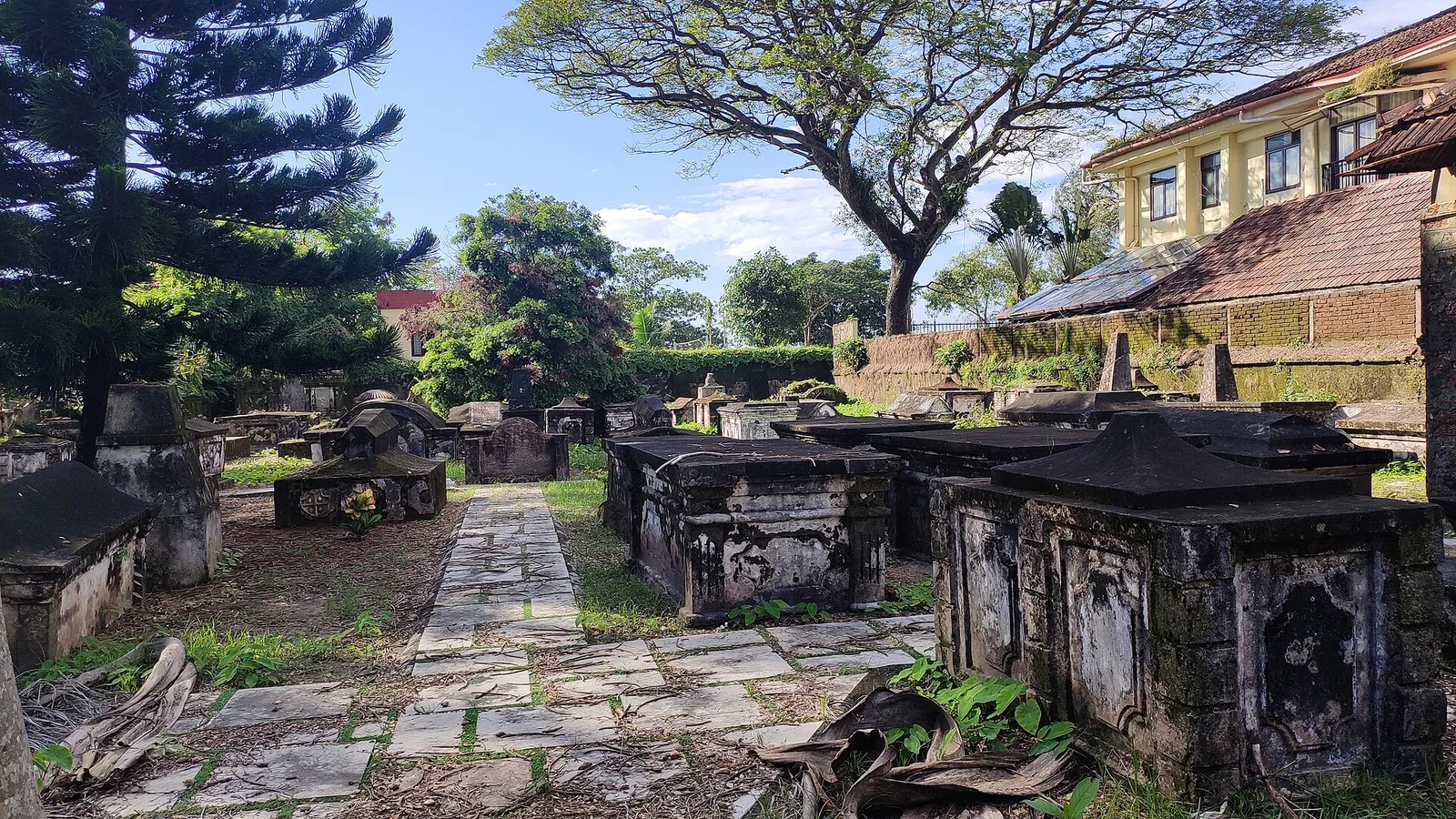
The Dutch Cemetery is easy to walk past. It is a small walled enclosure near the seafront, usually locked, with perhaps a hundred or so weathered tombstones inside and no ticket office. It is also, by the usual reckoning, the oldest European cemetery in India — consecrated in 1724, when Dutch Cochin was at its height.
Why it exists at all
The Dutch took Cochin from the Portuguese in 1663 and spent the following decades reshaping it, demolishing a great deal of the Portuguese town and running the pepper trade from what remained. A permanent burial ground was a statement of intent: a trading post expects to bury its people elsewhere, a settlement buries them where it stands.
The ground served the Dutch Reformed community of Cochin — Company servants, soldiers, merchants and their families. After the British took Cochin in 1795 and the Dutch presence wound down, responsibility for the cemetery passed on, and it is today generally maintained under the Church of South India rather than by any Dutch body.
What the stones record
The most striking thing about the inscriptions is not the names but the ages. Europeans on this coast in the seventeenth and eighteenth centuries died young and died fast, and the reason is not romantic: malaria, cholera, dysentery and the fevers of a monsoon coast, in an era with no germ theory and no effective treatment. Postings to the tropics carried a mortality risk that people at the time understood perfectly well and accepted as the price of the trade.
That is the real content of the cemetery, and it reframes the rest of Fort Kochi. The forts and the churches record what Europeans built here; this ground records what it cost them to stay. Reading the stones is a slower and more sobering fifteen minutes than the seafront a few hundred metres away.
Two things worth being careful about
The first is the "oldest in India" claim. It is very widely repeated and is probably defensible for a European cemetery of this kind, but "oldest" claims about colonial-era sites in India are contested more often than the signage suggests, and it is worth holding lightly rather than repeating as settled fact.
The second is access. The cemetery is frequently locked, and there is no reliable published opening time. Visitors regularly find themselves reading the stones through the gate. Enquire locally, or at the church that holds it, rather than assuming you can walk in — and treat it as consecrated ground, because it is.
Where it sits in the walk
It is a short walk from St Francis Church, which is a century and a half older and tells the Portuguese half of the same story, and from the seafront and the Chinese fishing nets. Doing the three together, in that order, gives you the coast’s European history in about an hour and a half of walking.
Frequently asked questions
How old is the Dutch Cemetery in Kochi?
It was consecrated in 1724, during the Dutch period at Cochin, and is generally described as the oldest European cemetery in India. Claims of this kind are contested more often than signage suggests, so treat it as the usual reckoning rather than a settled fact.
Who is buried in the Dutch Cemetery?
The Dutch Reformed community of colonial Cochin — Dutch East India Company servants, soldiers, traders and their families. Roughly a hundred weathered tombstones survive.
Can you go inside the Dutch Cemetery?
Often not. The enclosure is frequently locked and there is no reliably published opening time; many visitors view it through the gate. Ask locally or at the church that maintains it, and treat it as consecrated ground.
Who looks after it now?
It passed out of Dutch hands after the British took Cochin in 1795 and is today generally maintained under the Church of South India.
Why did so many Europeans die young in Cochin?
Malaria, cholera, dysentery and other fevers of a wet tropical coast, in a period before germ theory or effective treatment. The ages recorded on the tombstones are the clearest surviving evidence of it.