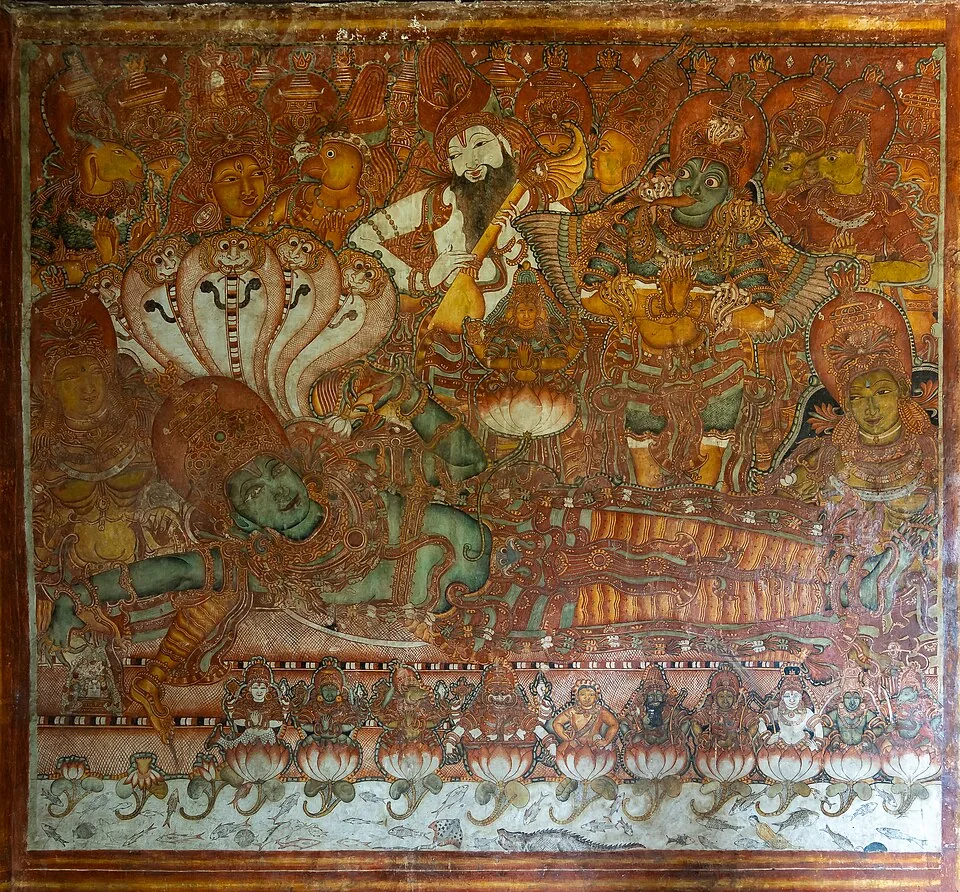
Stand in front of the Anantashayana panel at the Dutch Palace — Vishnu reclining on the coils of the cosmic serpent, gods stacked above him, a row of lotuses along the bottom with fish swimming under it — and something is missing that you will not immediately identify.
There is no blue. Not in the water, not in the sky, not on Vishnu. The classical Kerala mural palette does not contain one.
The five colours
The scheme is called panchavarna, the five colours: red, yellow, green, black and white. Each is a material rather than a pigment bought in a shop. Red comes from laterite, the iron-rich rock the whole coast is built on. Yellow from ochre. White from lime, or from conch shell ground to powder. Black from collected soot. Green from a combination that includes Garcinia morella and Indigofera tinctoria, the indigo plant — mixed to green rather than used as blue.
Five colours is a hard constraint, and it produces the two things everyone notices about these walls without knowing why. The paintings run hot, because there is no cool colour to rest the eye. And they are packed edge to edge with almost no empty ground, because a palette this narrow needs pattern and line rather than atmosphere to build depth. What reads as horror vacui is a technical answer to a material problem.
It is not a fresco
Or rather, it is not an Italian one, and the difference matters for how the walls have survived. In true fresco, pigment is laid into wet plaster and becomes chemically part of the wall as it cures. Kerala murals are dry fresco: the wall is built up in layers of lime, sand and water and left to set completely hard first, and the pigment goes on afterwards, bound with vegetable gum.
That makes the paint layer thin and comparatively fragile — it sits on the wall rather than in it — which is exactly the wrong property to have in a humid coastal climate a few hundred metres from a harbour. The compensating strength is in the ground: a triple-layered lime plaster, left to harden properly before anyone touched it, which is why the surface underneath has lasted three or four centuries when the paint on it had every reason not to.
How much is original?
A fair question, rarely asked at the site. The palace was restored and declared a centrally protected monument in 1951, and the Archaeological Survey of India carried out a second major conservation programme beginning in 2007 and completed in 2009.
Two documented interventions on a fragile paint surface of this age in this climate is a great deal of careful work, and it is a better fact to hold than the vague assurance that the murals are simply very old. What you are looking at has been kept alive, not merely left alone. The dating itself is a range rather than a point: sources place the murals variously from the sixteenth to the eighteenth centuries, with the seventeenth and eighteenth the most commonly cited.
What to look at, in order
The bedchamber first, and slowly. The Ramayana runs across roughly a hundred square metres of wall in small continuous panels, which is a narrative you read rather than a picture you take in. Find one figure and follow it rather than trying to see the room.
Then the large single compositions elsewhere — Vishnu on the serpent, Krishna lifting Govardhana, Shiva and Parvati fused as Ardhanareeshwara, Lakshmi on her lotus, scenes from the Kumarasambhavam. Look at the bottom registers, which is where the painters put the small things: fish, animals, minor attendants, the parts of the wall nobody was commissioning.
Then look down. The floors are a near-black polished surface made, by tradition, from burnt coconut shell, charcoal, lime, plant juices and egg white, worked until it passes for dark marble. It is the same instinct as the murals — an expensive-looking result assembled entirely out of what the coast already had.
And look up, in the Coronation Hall, at the wooden ceilings carved with rosettes and cupolas. The palace was built by the Portuguese, renamed for the Dutch who repaired it after 1663, lived in by neither, and used by the Rajas of Cochin to make kings in front of a goddess in the courtyard. The walls are the only part of it that were made here by people from here, and they are the reason anyone comes.
Frequently asked questions
Why is there no blue in the murals?
Because the classical Kerala palette is the panchavarna, five colours — red, yellow, green, black and white — all made from local materials: laterite for red, ochre for yellow, lime or powdered conch for white, soot for black, and a combination including Garcinia morella and Indigofera tinctoria for green. Indigo is present as an ingredient of green rather than used as a blue.
Are these frescoes?
Dry frescoes, not Italian-style wet ones. The wall is built up in layers of lime, sand and water and left to set hard, and pigment is applied afterwards with a vegetable-gum binder. The paint sits on the wall rather than curing into it, which makes it thinner and more vulnerable to humidity — and makes their survival on a harbour-side building genuinely remarkable.
Why are the paintings so crowded?
Partly convention and partly technique. With five colours and no atmospheric blue, depth has to be built from line, pattern and the interlocking of figures rather than from recession into space. The packed surface is a solution, not a mannerism.
How old are the murals, and how much is original?
Sources place them variously from the sixteenth to the eighteenth centuries, with the seventeenth and eighteenth most commonly cited. The palace was restored and declared a centrally protected monument in 1951, and the Archaeological Survey of India carried out a second major conservation programme from 2007, completed in 2009.
What are the floors made of?
By tradition, burnt coconut shell, charcoal, lime, plant juices and egg white, polished to a near-black lustre that imitates dark marble. It is a traditional Kerala technique and it is worth thirty seconds of looking down.
Can I photograph the murals?
No — photography is not permitted in the mural chambers. Allow about an hour for the palace. It is closed on Fridays and on national holidays, so check before travelling.