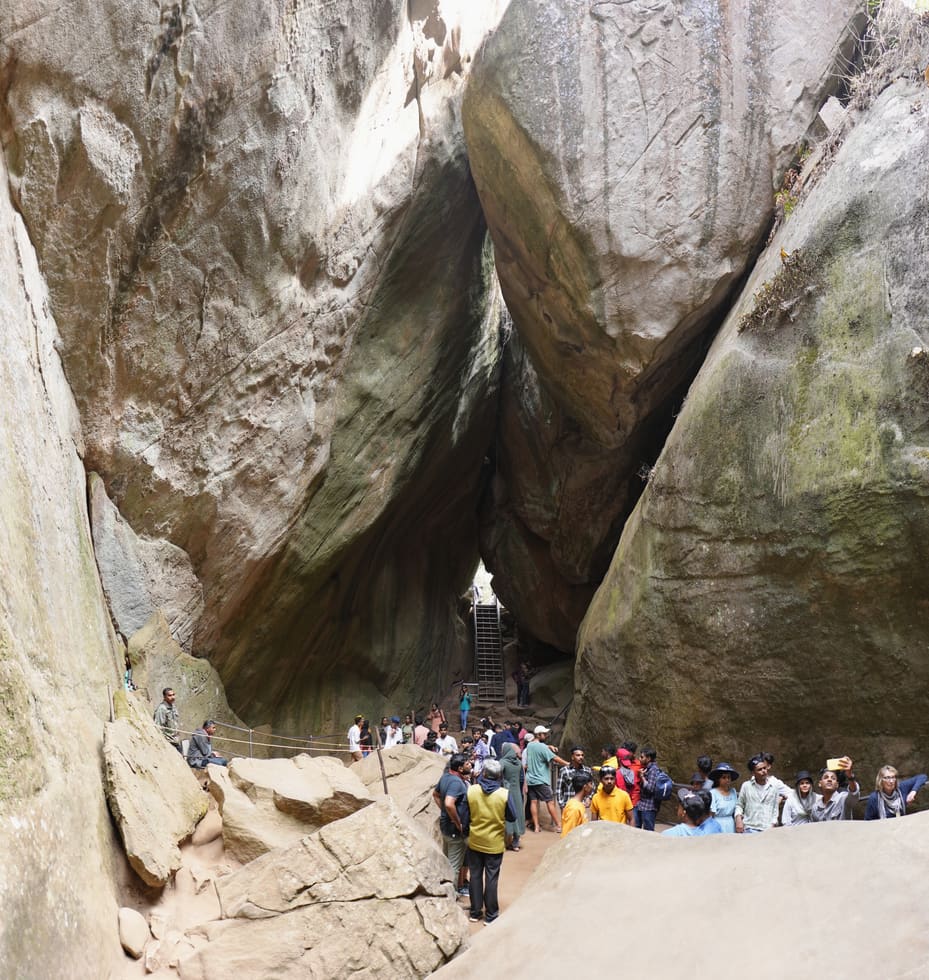
High on Ambukuthi Hill, roughly 1,200 metres above the plains of Wayanad, a slab of rock split away from the mountain sometime in the deep past and fell across a narrow fissure. It wedged there — a natural roof over a stone corridor — and the shelter it made became a canvas. For thousands of years, people climbing this ridge stopped to scratch and hammer figures into the walls. The result is one of South India’s most remarkable prehistoric galleries, and its name says it plainly: Edakkal, in Malayalam, means roughly “a stone in between”.
This is not a cave in the geological sense at all. There is no hollow bored by water or lava. Edakkal is a rock-shelter, formed when the fallen boulder bridged the gap between the cliff walls, leaving a fissure some 30 feet deep beneath it. The effect from inside is startling — a shaft of daylight pours down through the gap where the roof-stone doesn’t quite meet the walls, lighting the carved surfaces like a natural skylight.
How a police officer stumbled on the Stone Age
The petroglyphs had never truly been forgotten by the people of the hills, but they entered the record of modern archaeology almost by accident. In 1890, Fred Fawcett — a superintendent of police in the erstwhile Malabar district — came upon the shelter, reportedly while on a hunting expedition through the Wayanad forests. Fawcett had an amateur’s eye for antiquities, and he grasped at once that the carvings around him were extraordinarily old. He wrote them up in an article, and the attention of scholars followed.
That single visit is why Edakkal is often called one of the earliest sites of its kind studied in India. Fawcett recognised the anthropological weight of the walls long before anyone could date them with any precision — and precise dating, as it turned out, would remain difficult for well over a century.
What the walls actually show
The carvings are not a single scene but layers of them, cut over an enormous span of time. Archaeologists reckon the drawings range across periods from the Neolithic — with the oldest possibly reaching back over 8,000 years — down to roughly 1,000 BCE, meaning generations of very different hands added to the same walls. Estimates commonly place the bulk of the engravings in the window between about 6,000 BCE and 1,000 BCE.
The subjects are a catalogue of early life: human figures with elaborate headdresses, animals, wheels and tools, and a crowd of geometric symbols that no one has convincingly read. Some human forms are strikingly stylised, with square or masked faces. Layered over these prehistoric marks are later additions — including inscriptions in early scripts, one associated with a Kadamba-era ruler, which show the shelter stayed in use long after the Stone Age carvers had gone.
- The Edakkal marks are engravings — cut and pecked into the rock — not pigment paintings, which is why they have survived millennia in an open shelter.
- The site is a fissure roughly 96 ft long, formed by a fallen boulder, not a hollowed cave.
- Carvings span from the Neolithic (possibly 8,000+ years ago) down to around 1,000 BCE, with later historic-era inscriptions added on top.
The Indus Valley claim — and why it is contested
The detail that pushed Edakkal into national headlines came in 2009. Raghava Varier, a historian then with the Kerala State Archaeology Department, reported that one of the later motifs on the walls resembled a “man with a jar cup” — a figure long treated as a signature image of the Indus Valley (Harappan) civilisation of the far north-west. The suggestion was that Edakkal might carry an echo, or a cultural link, of a civilisation more than 2,000 kilometres away.
The claim drew serious attention; the noted Indus-script scholar Iravatham Mahadevan is reported to have called the identification a significant discovery. But it should be read as exactly that — a reported and debated interpretation, not a settled fact. A visual resemblance between motifs is not proof of contact between cultures, and the idea of a Harappan connection this far south remains contested among specialists. It is one of the questions that makes Edakkal fascinating, not one it has answered.
A shelter on an old road
Part of what makes the site plausible as a long-used gathering place is its position. Ambukuthi Hill sat near an ancient trade route linking the highlands of Mysore to the ports of the Malabar coast. A shelter with water, a commanding view and a natural roof would have been a natural waypoint — a place where travellers, herders and pilgrims paused, century after century, and where more than a few felt moved to leave their mark on the stone.
Frequently asked questions
Who discovered the Edakkal Caves?
Fred Fawcett, a superintendent of police in the erstwhile Malabar district, is credited with bringing the site to scholarly attention in 1890, reportedly during a hunting trip. Local people, of course, had long known the shelter existed.
How old are the carvings?
Estimates place the oldest engravings in the Neolithic — possibly over 8,000 years old — with the range of carvings spanning roughly 6,000 BCE to 1,000 BCE. Later historic-era inscriptions were added on top over the following centuries.
Is the Indus Valley connection proven?
No. A 2009 report by historian Raghava Varier identified a motif resembling an Indus Valley “man with jar cup” image, and it drew notable scholarly interest, but the idea of a genuine cultural link remains a contested interpretation rather than an established fact.
Is Edakkal really a cave?
Not in the usual sense. It is a rock-shelter — a deep fissure roofed by a large boulder that fell across the cleft — which is exactly what the name Edakkal, “a stone in between”, describes.