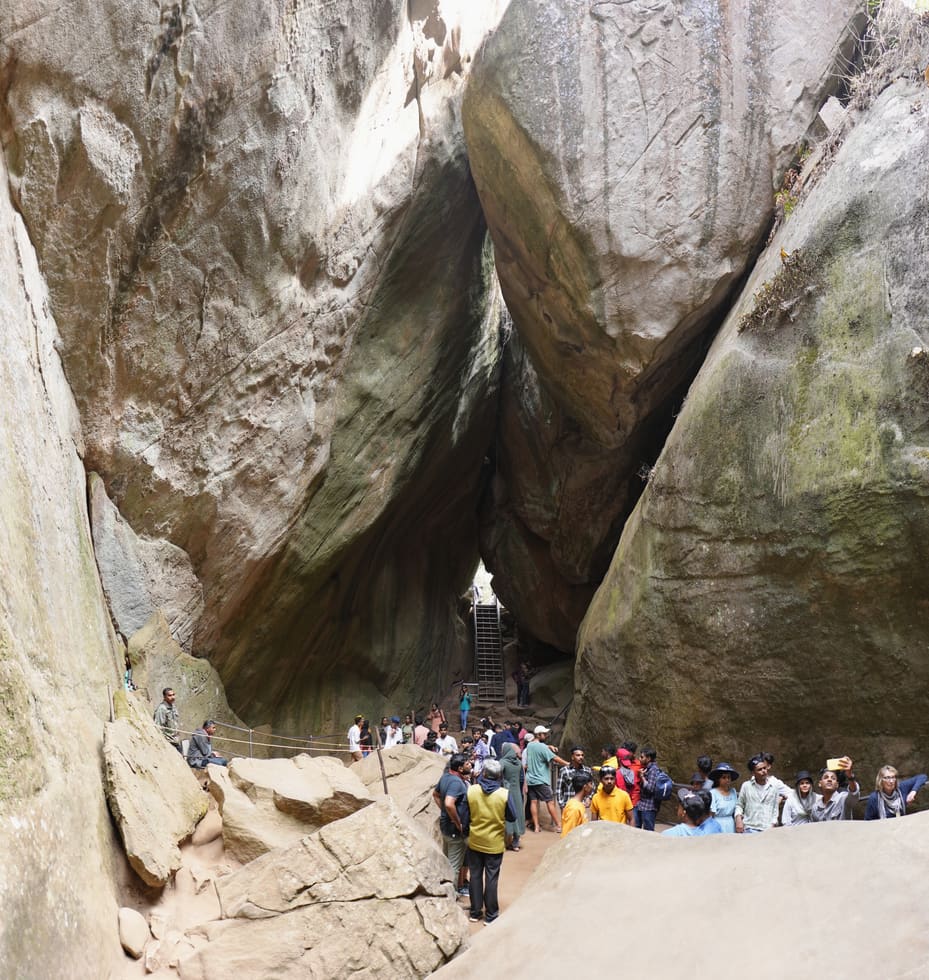
High on Ambukuthi hill near Sultan Bathery in Wayanad, a great slab of rock split away long ago to leave a deep cleft — and on the walls of that cleft, people carved images thousands of years ago. The Edakkal Caves are not really caves at all but this natural rock shelter, and their prehistoric petroglyphs make them one of the most important early rock-art sites in South India.
The carvings
The walls are covered with engravings of human and animal figures, tools and symbols, some still undeciphered. Estimates of their age vary, but the oldest carvings are thought to run back thousands of years, into the Neolithic and perhaps beyond, with later layers added over long periods. That so many phases of prehistoric people left their mark in one place is what makes Edakkal so significant.
The “man with the jar” and the Indus question
One motif — often described as a “man with a jar cup” — has drawn particular attention for its resemblance to symbols associated with the Indus Valley civilisation, raising much-debated questions about ancient cultural contact across the subcontinent. Scholars disagree, and nothing is settled, but the very possibility gives the carvings an outsized fascination.
Rediscovery and reaching the caves
The site was brought to wider attention in 1890 by Fred Fawcett, a British police official in the old Malabar, who at once grasped its importance. Reaching the caves today still takes effort: a climb up the hill and a set of steep steps and ladders leads to the cleft. It’s a rewarding scramble, but come prepared for the ascent.
- Getting to the carvings means a hill climb and steep steps/ladders — wear good shoes and carry water.
- Check opening days and hours before you go; the site is often closed on Mondays.
- Go early to beat both the heat and the crowds at the narrow cleft.
- It pairs well with Sultan Bathery’s Jain temple and the wider Wayanad heritage trail.
Frequently asked questions
What are the Edakkal Caves?
A natural rock cleft on Ambukuthi hill in Wayanad whose walls carry prehistoric petroglyphs — engravings of human and animal figures, tools and symbols — making it one of the earliest and most important rock-art sites in South India.
How old are the Edakkal carvings?
Estimates vary, but the oldest engravings are thought to date back thousands of years, into the Neolithic and possibly earlier, with more added in later periods. The exact dating is still studied and debated.
Is it hard to reach the Edakkal Caves?
It takes a climb — a walk up Ambukuthi hill followed by steep steps and ladders to the rock cleft. Wear good shoes, carry water, and check opening days, as the site is often closed on Mondays.