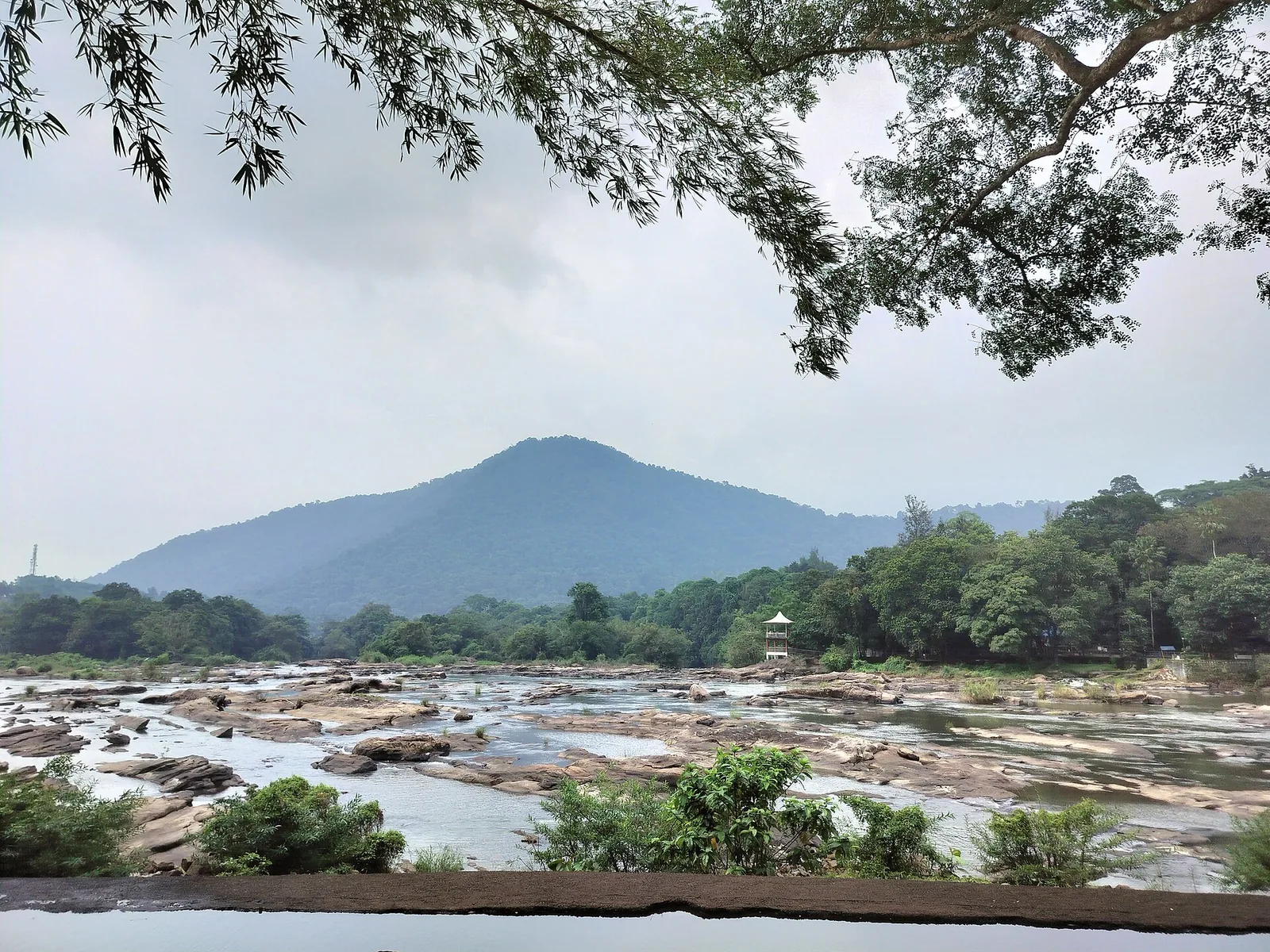
Ezhu is seven. Mugham is face. Fold them together and you get Ezhattumugham — the seven faces, or seven mouths — which is a name that describes a place so exactly that once you have heard it you cannot look at the river any other way.
Where a river stops being one river
The Chalakudy comes down out of the Anamalai hills, gathers the Sholayar and the Parambikulam and other tributaries, drops over Vazhachal and Athirappilly, and then reaches a broad, gently graded, rocky reach — and loses the plot. The single thread breaks up around low islets and rounded granite and becomes a braid of shallow channels that peel away from one another and rejoin downstream.
Stand on the bank in the dry months and you can count the shining streams. Whether you get to exactly seven depends on the water level, the year and how generous you are feeling, which is entirely in the spirit of the thing.
Local lore gives it a reading: the river shows seven faces here because it chose to divide and dance around the rocks rather than force its way through — seven streams, seven moods, one water. That is a poetic gloss on a straightforward piece of geomorphology, and villagers repeat it as the village’s own signature. Both descriptions are correct and only one of them is any fun.
The dry-season river
From roughly September through February the Chalakudy here runs low and clear, baring a bed of sun-warmed granite. People pick their way across the boulders and islets in ankle-deep water, almost to the far bank. Children swim in the natural rock pools, families spread out on the flat stones, and the loudest sound is usually birds.
This is the whole appeal and it is deliberately unspectacular. Ezhattumugham is not a sight; it is somewhere to spend three unhurried hours doing very little a short drive downstream from a waterfall that everyone is shouting at.
- Best for wading and rock-pool swimming roughly September to February, when the river is low and clear.
- The braided channels are the point — count them from the bank before you go down.
- This is an upstream-dammed river. Levels are managed and can change; do not treat a shallow channel as permanently shallow.
- Granite under moving water is slippery even when it looks dry. Grippy footwear, not flip-flops.
- Early morning and late afternoon give the best light on the water and the quietest riverbank.
The serpents in the quiet corners
Ezhattumugham sits in a landscape shaped by one of Kerala’s most characteristic traditions: the sarpa kavu, the serpent grove. Across this part of the state, ancestral homesteads and riverside villages have long kept a small patch of forest deliberately untouched and set aside for the naga, the serpent deities.
As legend has it, these groves are the abode of the snake gods, who guard the family and the land, and to cut a tree or disturb the grove is to invite the serpents’ displeasure. So the kavu is left wild — undergrowth, old trees and stone naga idols, undisturbed across generations.
Whether or not you go looking for a specific grove, it is worth carrying the belief as you walk the banks: in the Kerala imagination the quiet, shaded, water-fed corners of a village like this are exactly where the serpents are thought to live. And the tradition of leaving them alone is credited — by folklore and increasingly by ecologists — with preserving pockets of native forest along with the springs and soil they shelter. The reverence is legend. The surviving greenery is not.
Getting the visit right
Come at dawn or in the low gold of late afternoon, when each of the river’s faces catches the light a little differently — the reason this stretch of the Chalakudy has turned up on film, including work tied to Mani Ratnam’s Raavan. Bring shoes you can get wet, do not rely on the water staying where it was an hour ago, and treat a low river as a low river rather than a safe one.
Frequently asked questions
What does Ezhattumugham mean?
Seven faces, or seven mouths, from the Malayalam ezhu (seven) and mugham (face). It describes what the Chalakudy river does here: it loses its single channel and splits around low islets and boulders into a braid of shallow streams that rejoin downstream.
Are there really seven channels?
It depends on the water level and the year. The name is descriptive rather than a count you can audit, and local lore reads it as the river choosing to divide and dance around the rocks rather than force through — seven streams, seven moods, one water.
Can you walk across the river at Ezhattumugham?
In the dry season, roughly September to February, people wade across the boulders and islets in ankle-deep water almost to the far bank. The Chalakudy is dammed upstream and its level is managed, so conditions change — do not assume a shallow channel will stay shallow.
What is a sarpa kavu?
A serpent grove: a small patch of forest deliberately left untouched and set aside for the naga, or serpent deities, kept by ancestral homesteads and villages across Kerala. Tradition holds the grove is the serpents’ abode and that cutting a tree there invites their displeasure — which is credited with preserving pockets of native forest.
When is the best time to visit?
The dry months, roughly September to February, for a low clear river you can actually get into — and within the day, early morning or late afternoon for the light on the water and the quietest riverbank.
Is Ezhattumugham safe for swimming?
People swim in the natural rock pools in the dry season, but treat it as an unsupervised river rather than a pool. Granite under moving water is slippery even where it looks dry, there are no lifeguards, and the level is managed upstream and can change. Watch what local families do and stay well within it.