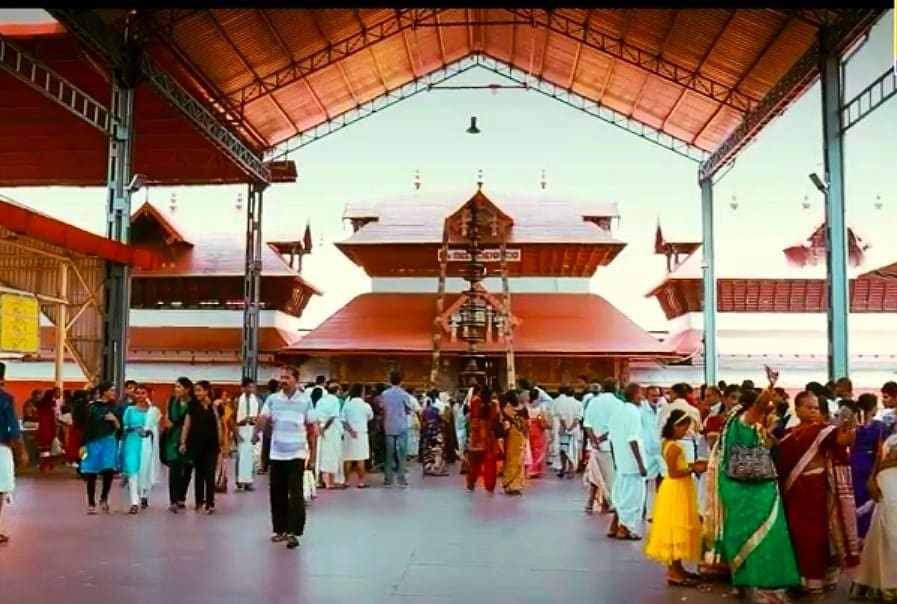
The story of the Guruvayur temple begins with a city going under the sea. Kerala Tourism tells how Krishna asked sages to carry his idol out of Dwaraka while that city was being destroyed, so that the image would not be lost with it. Two of them saw it safely to a new home in Kerala. They were Guru, also called Brihaspati, the teacher of the gods, and Vayu, the god of the wind. The place where they set it down took both their names, which is why the town is called Guruvayur.
Because the idol came from Krishna's own city, the temple is known as the Dwaraka of the South. Kerala Tourism counts it among the oldest and most revered temples in India, and the legend gives the idol an age of 5,000 years. The building itself has a more recent date, since Kerala Tourism records that the central shrine was rebuilt in 1638 CE. So the story of the image is very old, while the shrine that holds it today was raised in the 17th century.
That 17th-century rebuilding shaped what pilgrims see now. The temple faces east in the traditional Kerala style, with gateway towers on the east and the west, and the walls of the sanctum carry murals from the same century. In front of the eastern entrance stands a lamp pillar 24 feet high with thirteen round rings for oil lamps. Beyond it rises the flagstaff, 70 feet tall and covered entirely in gold. The idol stands in the innermost chamber of the square sanctum, which Kerala Tourism describes as having two stairs and three other rooms.
The way into that chamber is reserved for the faithful. The Guruvayur Temple place page records that only Hindus are admitted inside. Men enter in a white mundu without a shirt while women wear a saree, set mundu, churidar or salwar kameez. Phones and cameras stay at the counters near the entrance, so the inside of the temple is something people carry away only in memory.
Memory is also what the earliest hour of the day is about. Kerala Tourism lists the temple's hours as 3 am to 12.30 pm and 4.30 pm to 9.15 pm. At 3 am the doors open for the Nirmalya darshan, the first sight of the deity each morning. Pilgrims queue in the dark for that moment, which is why the streets of Guruvayur are already busy long before sunrise.
Many of those pilgrims come with an offering in mind. In the ritual called Thulabharam, a devotee sits on one side of a great balance and is weighed against jaggery, coconuts, sugar or bananas. That same weight is then given to the god. Others come to be married, because Kerala Tourism names Guruvayur as one of the most popular wedding venues in the state. Around the main shrine stand smaller shrines to Ayyappa, Edathedathu Kavil Bhagavathy and Ganapathy, so a family's day here often includes more than one prayer.
The temple's calendar adds its own crowds. The annual festival falls in February and March and opens with the Aanayottam, an elephant race whose winner carries the replica of the idol for the year. Guruvayur Ekadasi, in the month of Vrishchikam, comes with an eleven-day Carnatic music festival in memory of the singer Chembai Vaidyanatha Bhagavathar. Kerala Tourism also names Ashtamirohini, Krishna's birthday, and Vaishakam among the temple's festivals.
On Ekadasi the temple also remembers an elephant. Kerala Tourism describes how the leader of the temple's herd lays a wreath at the statue of Guruvayur Kesavan in front of the Sreevalsam guest house. The other elephants stand before it while he does. Kesavan lived at the old palace of Punnathur, about 3 km from the temple, where nearly 60 elephants given by devotees now live. That palace has its own story, told in the Punnathur Kotta elephants story, and the race that opens the festival is told in the Guruvayur Aanayottam story.
For a visit that ties these threads together, the Guruvayur pilgrimage guide covers timings, the elephant camp and stays, and the top hotels in Guruvayur list the rooms near the gates. Further south, the Rama of the same epic tradition waits at the Thriprayar temple, the first stop of the four-temple pilgrimage told in the Koodalmanikyam story.
Frequently asked questions
Why is it called Guruvayur?
The legend says Guru (Brihaspati) and Vayu, the wind god, brought Krishna's idol from Dwaraka and installed it here, so the place took both their names.
How old is the Guruvayur temple?
The legend gives the idol an age of 5,000 years, and the central shrine was rebuilt in 1638 CE.
What are the Guruvayur temple timings?
Kerala Tourism lists 3 am to 12.30 pm and 4.30 pm to 9.15 pm.
Can non-Hindus enter Guruvayur temple?
No. Only Hindus are admitted inside, under a dress code.