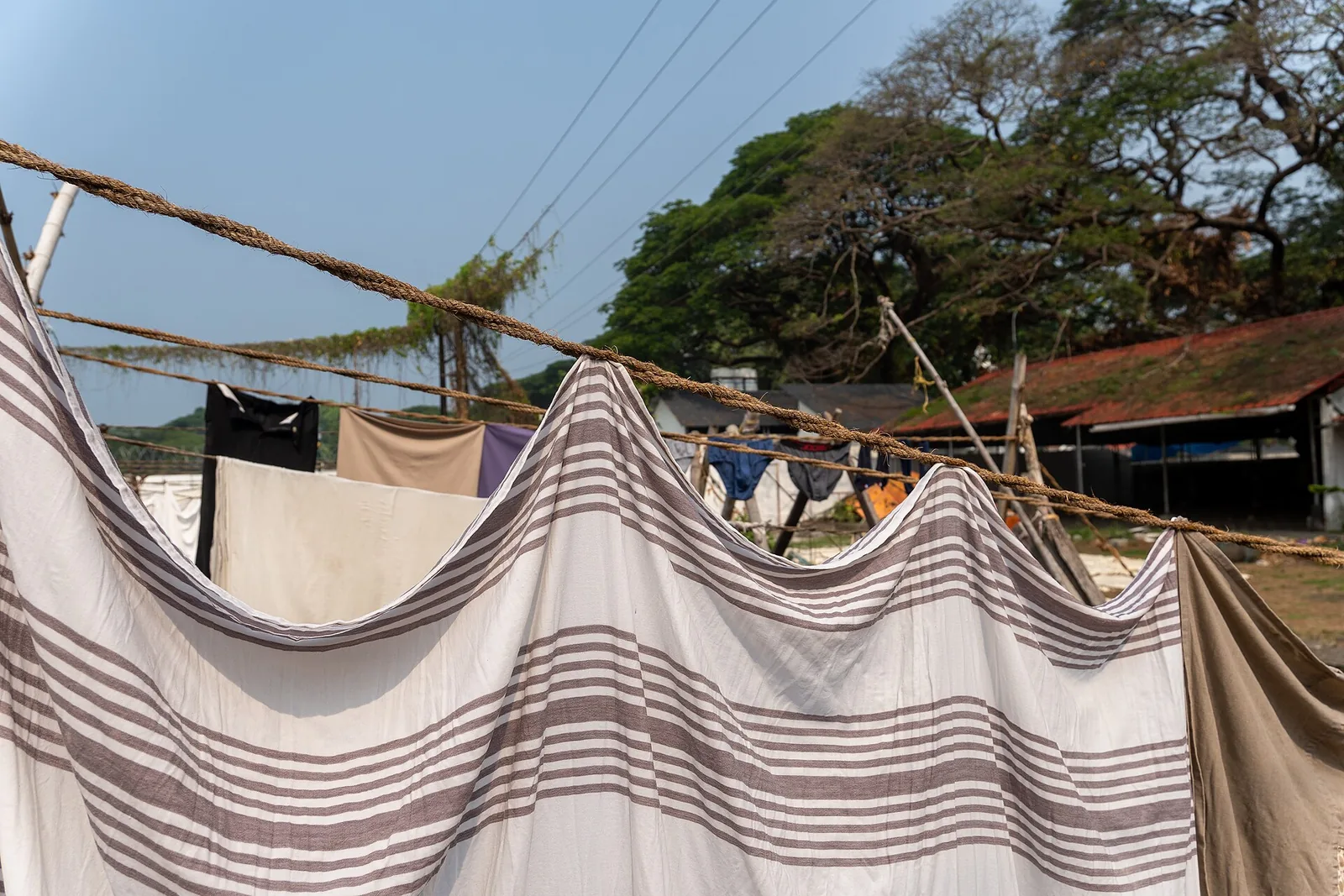
The Dhobi Khana in Fort Kochi is usually presented to visitors as a photogenic curiosity: rows of washing pens, bright lines of drying cloth, coal irons. It is more useful to understand it as one surviving outpost of a trade that has organised a whole category of Indian labour for centuries — and that is now, fairly quickly, ending.
A trade, not a job
Across India, washing clothes for other households has historically been hereditary work, carried out by communities identified with the trade — dhobi in much of the north, and regionally distinct groups elsewhere, including the Vannan community in the south. This is caste in its working sense rather than its ritual one: an occupation you were born into, married within, and passed on. Many of these communities are formally recognised as Scheduled Castes today, which is a fair indication of where the trade sat in the social order.
The work itself is genuinely skilled and genuinely brutal. Clothes are sorted, soaked, beaten against stone, boiled in coppers, wrung, dried, and pressed with heavy coal-heated irons — and, crucially, returned to the right household without labels, tracked by marks and memory across hundreds of garments. The output is often better than a machine achieves. The cost is paid in backs, hands and lungs.
The same trade, three cities
The best-known example is Mumbai’s Mahalaxmi Dhobi Ghat, an open-air laundry of many hundreds of washing pens that has become a fixture on the city’s tour circuit and is regularly described as the largest of its kind. Chennai, Delhi and most large Indian cities have their own ghats, generally smaller and much less visited.
Fort Kochi’s is at the opposite end of the scale — a few dozen families rather than a few thousand people — and that difference matters for a visitor. At Mahalaxmi you look down at the work from a bridge, at a distance, as spectacle. At the Kochi khana you are standing in it, close enough to talk to the person doing it. That is the better experience and the greater obligation.
Why it is disappearing
Nothing dramatic is killing the dhobi trade. It is being closed out by ordinary economics, in three directions at once. Domestic washing machines are now standard in Indian apartment blocks, removing the household customer. Hotels and hospitals — the bulk institutional work — have moved to industrial in-house laundries. And app-based laundry and dry-cleaning services have taken the middle of the market, offering collection and delivery that an open-air ghat cannot match.
What remains is a shrinking base of loyal customers and, increasingly, visitors. Reporting on the Kochi khana has carried the same worried question for years — how long can it last — and the number of working families is smaller than it was. Younger members of these communities are, understandably, taking steadier and less punishing work.
How to visit a workplace
This is the part worth getting right, because a working laundry is not a heritage site and the people in it are not staff on a visitor attraction.
Ask before photographing anyone. A wide shot of drying lines is one thing; a close portrait of someone at a wash pen, taken without a word, is another, and the difference is obvious to the person being photographed. There is no ticket and no counter — the custom is a small tip to whoever actually shows you round, given directly to that person rather than handed to whoever meets you at the entrance. Go mid-morning, when the work is genuinely underway, rather than at the end of the day. And buy the service if you have laundry: paying for the work is a better contribution than paying to look at it.
Frequently asked questions
What is a dhobi khana?
A communal open-air laundry where clothes are washed by hand in fixed pens, dried on lines and pressed with heavy irons. The work has historically been done by hereditary washing communities — dhobi in much of India, and the Vannan community in the south, including at Fort Kochi.
Is the Fort Kochi Dhobi Khana the same as Mumbai’s Dhobi Ghat?
Same trade, very different scale. Mumbai’s Mahalaxmi Dhobi Ghat has many hundreds of washing pens and is usually viewed from a bridge at a distance. Fort Kochi’s is a few dozen families and you stand among the work, which makes it more personal and raises the obligation on the visitor.
Is hand laundry dying out in India?
It is shrinking steadily. Domestic washing machines removed the household customer, hotels and hospitals moved to industrial in-house laundries, and app-based laundry services took the middle of the market. Fewer families work the Kochi khana now than in the past.
How should I behave when visiting the Dhobi Khana?
Treat it as a workplace. Ask before photographing people, go mid-morning when the work is actually happening, and give a small tip directly to whoever shows you round rather than to whoever greets you. If you have laundry, paying for the service is the most useful thing you can do.
Is there an entry fee at the Dhobi Khana?
There is no ticket counter or fixed fee. The custom is a small tip to the person who shows you around.