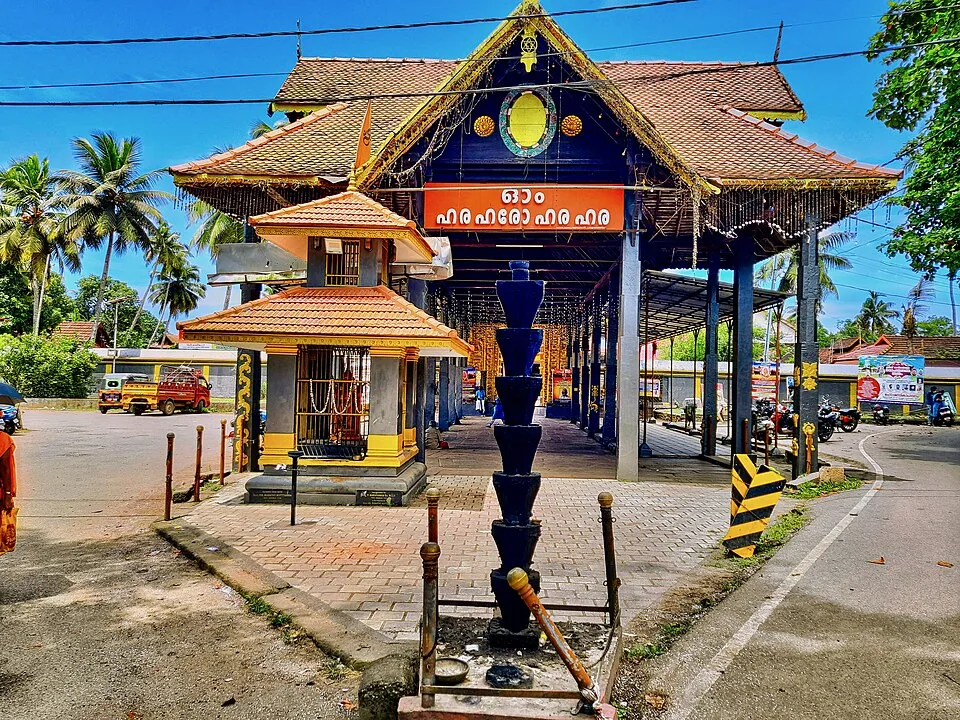
On the north side of the Haripad temple lies the Perumkulam — the great tank. It covers roughly five acres. It has seventeen ghats set around its four sides. And by local account it holds its water even through the dry months, when a good deal of Kerala’s surface water does not.
Most visitors walk past it on the way in.
What a tank that size is for
A temple tank is never only ornamental, and one of five acres is doing several jobs at once. The obvious one is ritual: bathing before darshan, and the water needed for the temple’s own observances. Seventeen ghats is a number that tells you about volume of people rather than about aesthetics — you build seventeen sets of steps because you expect a great many bathers at once, which in practice means festival days.
The second job is storage. A tank is a reservoir, and in a landscape where the water table swings hard between monsoon and dry season, a large body of standing water recharges the ground around it and keeps nearby wells viable. A tank that stays full through the dry months is doing that work whether or not anybody is thinking about it.
The third is climate, at a small scale. Five acres of water beside a walled compound moderates the temperature and the humidity around it, which is not a trivial matter in Onattukara in April.
Why the water keeps turning up
Once you have noticed the tank, the rest of Haripad’s tradition reads differently. This is a temple whose idol came out of a lake, which is remembered at a landing place called Nelpurakadavu, and whose largest structure is a body of water. Haripad sits on the flat country between the Kayamkulam lake and the Pamba system, where movement historically happened by boat rather than by road.
That gives the famous epithet an edge that is usually missed. Haripad is called the Dakshina Palani — the Palani of the south, after the great Murugan hill temple in Tamil Nadu. The comparison is meant as a statement of rank. But read it as geography and it inverts: Palani is a shrine you climb to, and Haripad is a shrine that arrived by water and is built beside more of it. Two temples to the same god, one defined by height and the other by depth.
It is worth resisting the next step, which many accounts take. Because Haripad is called the Palani of the south, the Palani legends get imported wholesale — the fruit, the quarrel between the brothers, the god as renunciate on the hill. Those are Palani’s stories. Haripad has its own, and they are wetter.
Seeing it properly
Give the Perumkulam ten minutes before you go into the temple rather than after. Walk a side of it, look at how the ghats are placed, and note how far the far bank is. Then go in. The compound makes more sense once you have understood that the water is not an amenity attached to the temple — in this tradition, the water is where the temple came from.
Frequently asked questions
How big is the Haripad temple tank?
The Perumkulam is roughly five acres, with seventeen ghats around its four sides, on the north side of the temple. Local accounts say it holds its water through the dry season.
Can visitors bathe in the tank?
It is a working ritual tank rather than a swimming place, and practice varies by day and by festival. Observe what others are doing and ask at the temple before entering the water.
Why is Haripad compared to Palani?
The epithets Kerala Palani and Dakshina Palani mark its standing among Subrahmanya shrines. Read as geography the comparison is really a contrast: Palani is a hill temple, while Haripad’s whole tradition is aquatic. The Palani legends belong to Palani and should not be transplanted here.