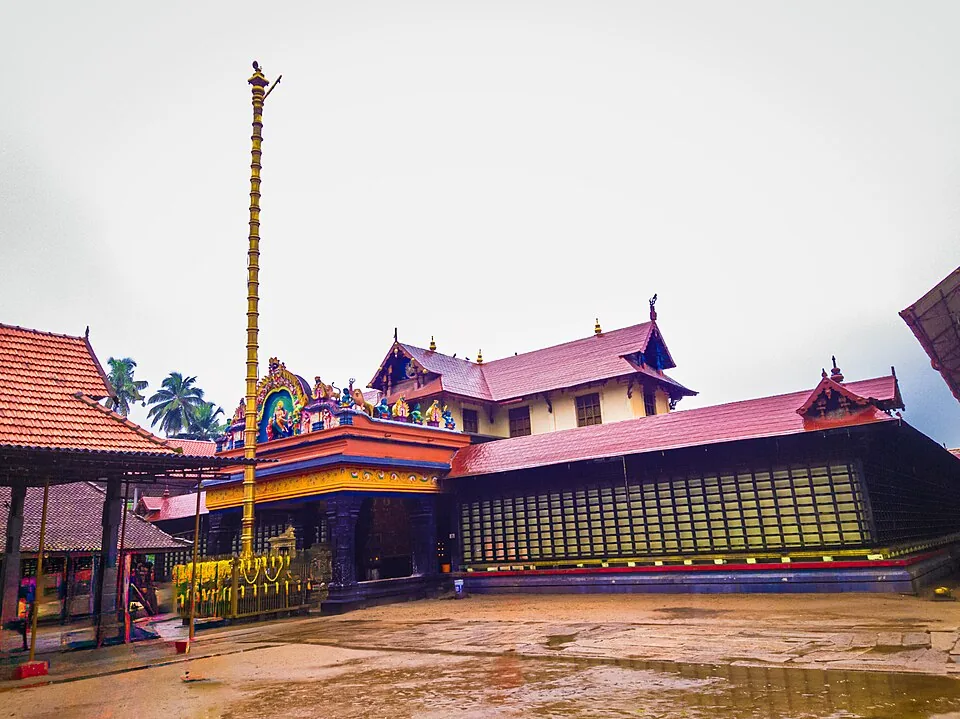
Haripad’s tradition holds that the temple predates the beginning of the Kali Yuga — that is, that it is older than the current age of the world. Set against that, the single best-documented event in its history is oddly precise: a fire, on the night of 7 December 1920, at around ten o’clock.
A date recorded to the hour
In the Malayalam reckoning it was Vrischikam 22 in the year 1096, and the Malayalam sources give both the Gregorian and the Kollavarsham dates along with the approximate time. That level of specificity is worth noticing. It suggests the event was written down while people still remembered the evening, rather than reconstructed afterwards — which is not the case for most of what is said about this temple.
The fire is described as severe. In a Kerala temple, where the structure is timber-framed, tile-roofed and full of carved wood, a serious fire is close to total.
Who rebuilt it — and who did not
Here the record splits, and this page was on the wrong side of the split until August 2026. English-language sources commonly state that the temple was rebuilt during the reign of Sree Chithira Thirunal Rama Varma, and we repeated it.
The Malayalam account gives something different: the reconstruction was undertaken under the patronage of Moolam Thirunal, carried out by an architect of Idavangad, and completed with the re-consecration on 27 May 1926, on the Anizham nakshatra.
The dates settle it. Chithira Thirunal acceded in 1931. A rebuilding re-consecrated in 1926 cannot have happened in his reign. Moolam Thirunal was on the throne when the fire occurred, and the work spanned the years that followed. The English version is not a small slip of attribution; it moves a major reconstruction into the wrong reign and out of the period it actually belongs to.
What that means for what you are looking at
It means the building is younger than almost everyone visiting it assumes. The koothambalam, the roofs, the compound as it stands — this is substantially a structure of the first half of the 1920s, put up in a Travancore that was building a great deal, by a named craftsman identified by his village rather than by a company.
None of which makes the site less old. The practice, the idol, the tank and the festival calendar all run back far beyond 1920. But it is a useful corrective to the way heritage is usually presented. A temple can be ancient as an institution and modern as a building, and Haripad is both at once. The thing that claims to predate the Kali Yuga was re-consecrated within the lifetime of people whose grandchildren are alive now.
It is also a reminder of how much of Kerala’s temple architecture is, in fact, twentieth-century work standing on much older ground — rebuilt after fire, after termites, after the simple failure of timber in a wet climate. The continuity is real; it is just not the continuity of the physical fabric.
Frequently asked questions
When did the Haripad temple burn?
On the night of 7 December 1920 — Vrischikam 22 in the Malayalam year 1096 — at around ten o’clock. The Malayalam sources give both calendars and the approximate hour.
Who rebuilt it?
The reconstruction was undertaken under the patronage of Moolam Thirunal, by an architect of Idavangad, and the temple was re-consecrated on 27 May 1926 on the Anizham nakshatra. Sources that credit Chithira Thirunal are wrong: he acceded in 1931, five years after the re-consecration.
So how old is the building?
Substantially a rebuilding of the 1920s, completed in 1926, standing on a site whose ritual life is far older. The institution is ancient; the fabric largely is not.