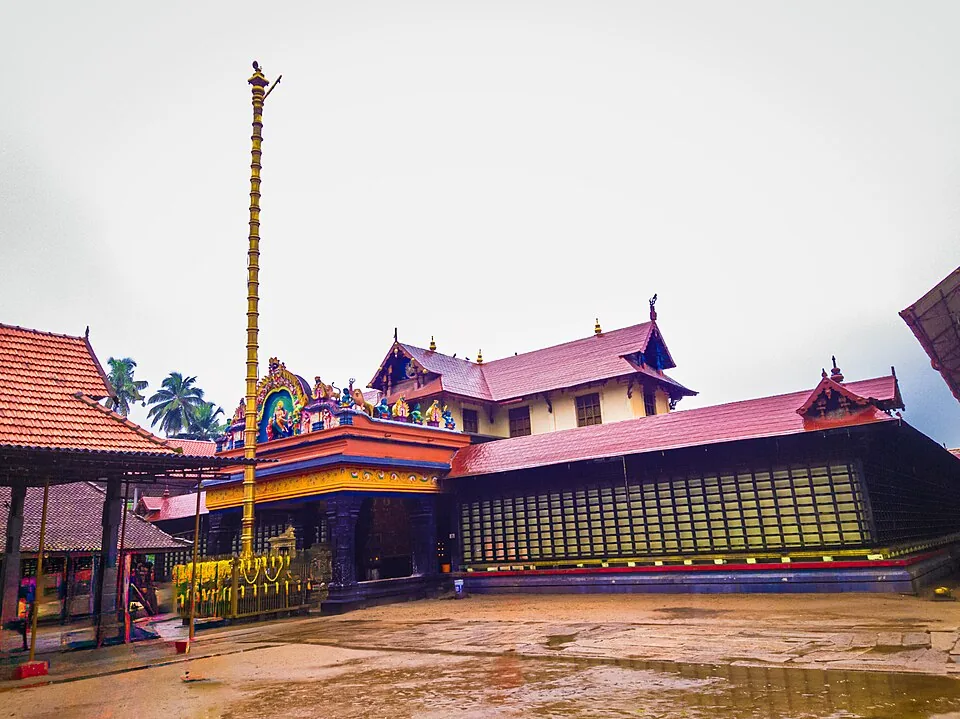
Most temple origin legends in Kerala involve a person with authority: a sage who performed tapas, a king who granted land, a Brahmin who received a vision. Haripad’s does not. In Haripad’s account of itself, the god was lost in a lake and the people of the locality went and got him back.
The dream and the dive
The tradition runs that the idol is older than the temple by an age. It is said to have been worshipped by Parasurama himself in the Treta Yuga, and that when he had finished with it he placed it in the Kayamkulam lake, where it stayed.
The finding is the part that gets told. The devotees of the area are said to have shared a dream — collectively, on the same night — showing where the god lay. They went down to the water in the morning. At the place they had been shown they saw whirlpools turning and flowers floating on the surface, and they dived there, and brought up a four-armed Subrahmanya.
We spent some time on the whirlpool, because our own headline for this story has always featured it and English-language sources do not mention it. The Malayalam account does: whirlpools and flowers together, as the sign. It is a good example of why an English-only check is not a check at all.
Two place names that are the legend
What lifts this above the general run of finding-legends is that it left names behind. The place where the idol was recovered became known as Kandanalloor — the place where it was found — which is the village of Kandalloor today. The idol was brought ashore at Nelpurakadavu, and the kadavu, the landing place, still carries that name.
So the story is anchored at both ends: the water it came out of and the bank it was carried up. You can go to both. Whatever you make of the events, the toponymy is real, and a legend that has left two place names on the map has been believed by a large number of people for a long time.
And the town’s own name
Haripad belongs to the same cluster of derivations. Hari is Vishnu; padam is the foot. Parasurama was an avatar of Vishnu, and the ground where his foot fell is said to have become Harippadapuram, and by contraction Haripad.
Folk etymologies rarely stand up as philology and this one should not be pressed. What it tells you is something else: the extent to which the town narrates itself entirely through this temple. It is not that a settlement acquired a shrine. In the local account the settlement is a consequence of the shrine — right down to what it is called.
What was actually found
The idol is four-armed, which is itself unusual for Subrahmanya in Kerala, and stands over six feet — described in the Malayalam sources as the largest Subrahmanya image in the state. It carries a spear at the left shoulder and holds the right hand in blessing, and it is read as showing both Shaiva and Vaishnava characteristics rather than sitting neatly in one tradition. Consecration is traditionally dated to the Thrikkarthika asterism in the month of Vrischikam, and Parasurama is said to have appeared at the installation and led the rites. That day is still kept as the anniversary.
You will also see it said that the temple predates the beginning of the Kali Yuga. That is devotional tradition and belongs in the same category as the rest of this: worth knowing, not worth dating.
Frequently asked questions
Where was the Haripad idol found?
In the Kayamkulam lake, by tradition. The place of recovery took the name Kandanalloor — “the place where it was found” — now the village of Kandalloor, and the idol was landed at Nelpurakadavu, which still carries the name.
Is the whirlpool part of the story real?
It is in the Malayalam sources, which describe the spot being marked by whirlpools and floating flowers after a collective dream showed the devotees where to look. English-language accounts generally omit it, which is why we checked the Malayalam before keeping it.
What makes the idol unusual?
It is four-armed, over six feet tall, and described in Malayalam sources as the largest Subrahmanya image in Kerala. It carries a spear at the left shoulder with the right hand in blessing, and is read as bearing both Shaiva and Vaishnava characteristics.