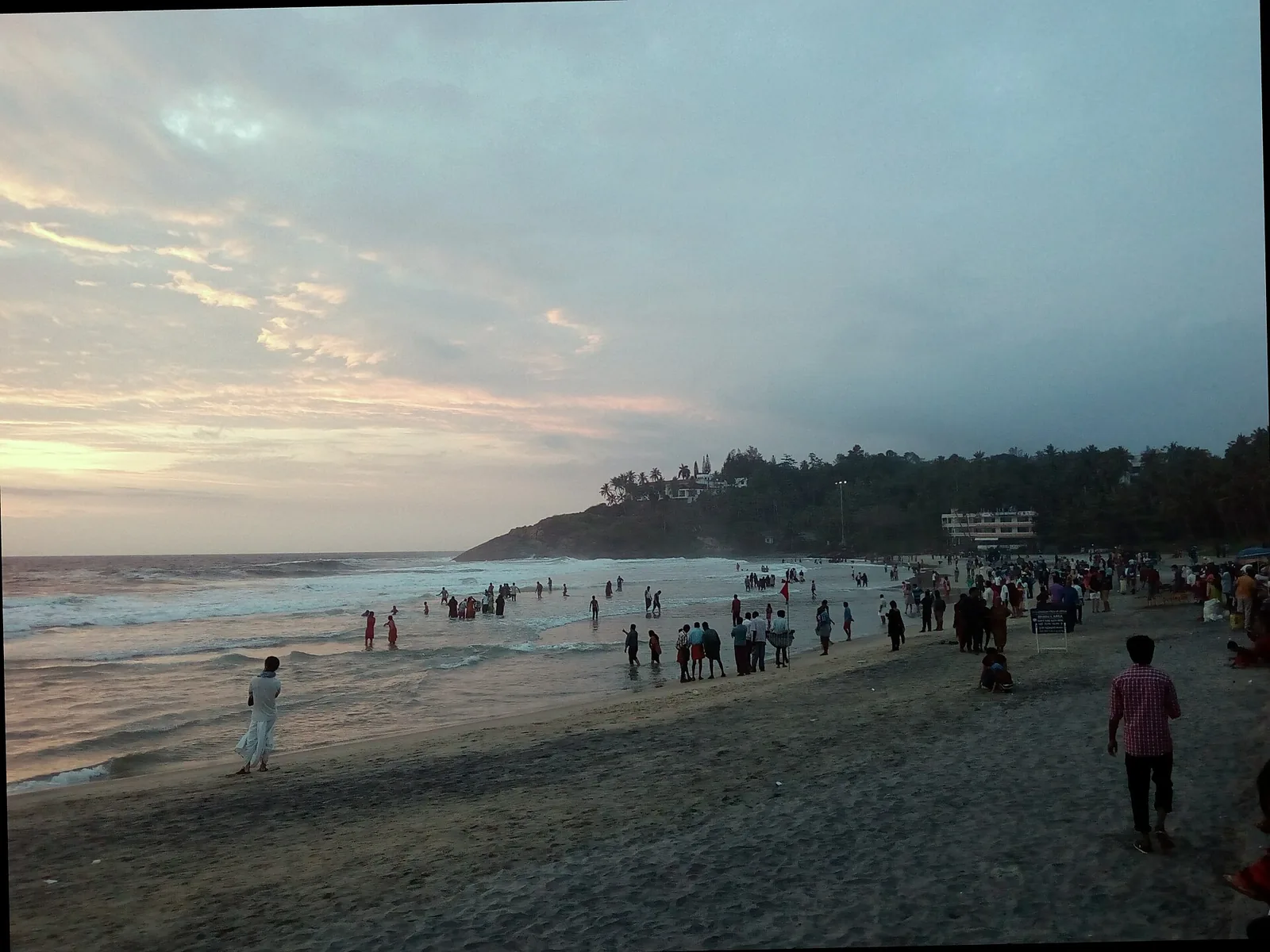
On Kovalam’s middle crescent, the name changes without the place changing. Kerala Tourism’s 2021 guide writes “Hawa Beach or Eve’s beach.” Its district guide uses Hawah, while a 2005 tourism notice calls the same shore Eve’s Beach. The names are real. Their origin is less clear.
What the official record actually says
Tourism material treats the names as alternatives for the middle beach between Lighthouse and Samudra. That is useful if you are trying to find the shore or explain a meeting point to a driver. The documents do not date either name’s first use or say who coined it.
The 2005 notice is a useful marker: Eve’s Beach was already a working name when Kerala Tourism discussed a proposed offshore reef there. It is evidence of usage, not an explanation of the name. The tourism brochure later prints Hawa and Eve’s together.
A tempting language clue is still only a clue
“Hawa” can mean air or wind in Hindi and Urdu; “Hawwa” is also a rendering of Eve’s name in Arabic and Urdu. That resemblance makes a translation story plausible, but resemblance alone cannot establish how this particular Kerala beach acquired either label. It would take an older map, local account or dated travel record to trace the name properly.
The beach behind the name
The naming question is interesting because the shore also serves people whose day is not organised around tourism. Kerala Tourism’s Kovalam guide describes beach activities, including catamaran rides, while its Samudra guide describes fishing along this coast. On a visit, leave space for boats and gear and treat crews at work as people, not a scheduled attraction.
For practical orientation, use Hawa and Eve’s interchangeably for the middle cove. For the name’s history, the most accurate account ends with an open question: the official tourism record shows both labels in use, but does not show how they came to be paired.
A useful name is not always an explained name
For visitors, Hawa and Eve’s reliably point to the cove between Lighthouse and Samudra. That is enough to navigate. The historical reason for the double name is a harder question. A resemblance between words across languages is interesting but cannot, by itself, prove when a beach received a name or what its first users meant.
The Kovalam history follows the resort’s growth, but a general tourism timeline does not solve this naming puzzle. Dated local signs, maps or residents’ testimony could help. Until then, the two names should be listed as alternatives without turning an attractive etymology into fact.
A name also frames what visitors expect. “Eve’s” may invite one reading, “Hawa” another; the people working and enjoying the shore are not obliged to fit either story. Let the dual label help you find the beach, then let the beach itself be more than its label.
Frequently asked questions
Are Hawa Beach and Eve’s Beach the same place?
Yes. Kerala Tourism uses both names for Kovalam’s middle beach.
Why is it called Eve’s Beach?
The official tourism sources used here do not establish the origin. A possible link between Hawa and Hawwa is a language clue, not a proven place-name history.
Is the beach called Hawah too?
Yes. Kerala Tourism’s district guide spells the name Hawah; other official material uses Hawa.