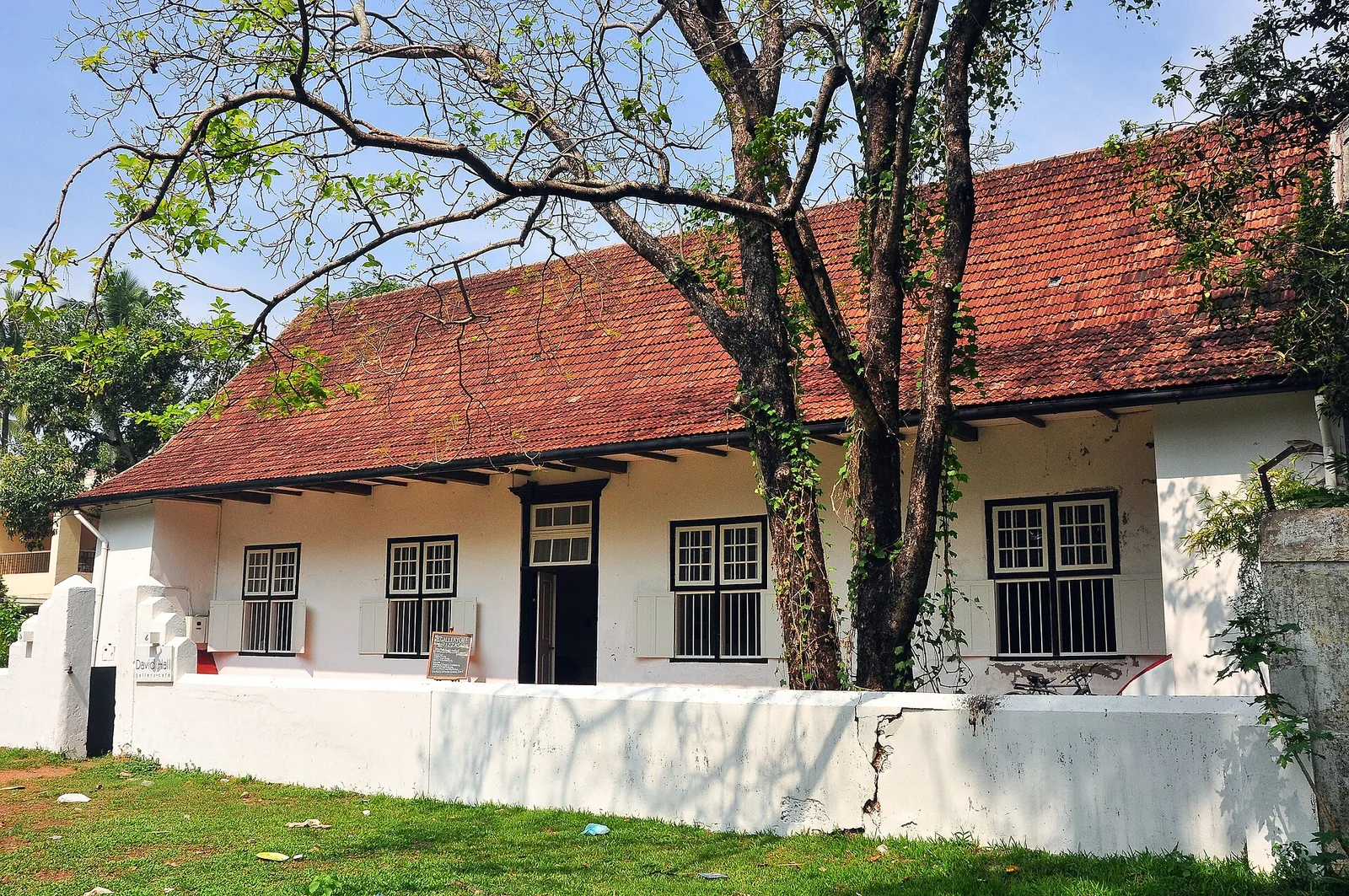
Walk past David Hall on the Fort Kochi parade ground and you will almost certainly be told it was the home of Hendrik van Rheede, the Dutch commander who produced the great botanical work of this coast. The building’s own dates make that difficult, and the place page sets out why. The book, though, is entirely real — and its story is better than the one attached to the bungalow.
What Hortus Malabaricus is
Hendrik Adriaan van Rheede tot Drakenstein was the Dutch East India Company’s governor of Malabar in the 1670s. Under his direction, a survey of the region’s plants was compiled and sent to Amsterdam, where it was published in twelve folio volumes between 1678 and 1693 as Hortus Indicus Malabaricus — the garden of Malabar.
It described several hundred plant species of the Malabar coast — commonly given as 742 — with detailed engravings, and it recorded their names in more than one script, including Malayalam. It is generally regarded as the earliest comprehensive printed work on the flora of Asia, and it mattered scientifically: Linnaeus used it, and a number of species names still trace back to it.
Where the knowledge actually came from
A European governor did not know which Malabar plant treated which condition. The information came from people who did, and the book is unusually explicit about who they were.
The central figure is Itty Achuden, a physician of the Ezhava community, a caste then placed low in the regional hierarchy and excluded from Sanskrit learning. His family practised medicine from an inherited body of knowledge held in Malayalam, and it was that knowledge — which plants, which parts, which preparations — that gave the work its substance. Three Konkani Brahmin physicians, named in the volumes as Ranga Bhat, Vinayaka Pandit and Appu Bhat, also contributed.
What makes this remarkable is that the book contains signed certificates from these collaborators attesting to their part in it, including a statement in Malayalam from Itty Achuden. A seventeenth-century European scientific work naming a low-caste Indian practitioner as its source, in his own language, is not what the period usually produces.
The part that is often overstated
Two claims tend to get inflated in retellings. The first is that Hortus Malabaricus contains the first printing of Malayalam script anywhere; the safer statement is that its Malayalam is among the earliest to appear in print, and the question of absolute priority is one for book historians rather than a travel page. The second is the idea that van Rheede simply took credit for Itty Achuden’s work — the certificates in the book argue against the strongest version of that, even though the naming on the title page and the direction of the project were unambiguously Dutch.
Both the crediting and the imbalance are true at once. The knowledge was Malabar’s, the compilation and the printing press were Europe’s, and the book has carried the governor’s name for three hundred years while Itty Achuden’s remained known mainly to specialists until relatively recently.
Why it belongs to Fort Kochi
The survey was directed from Dutch Cochin, drawing on the plants and the practitioners of this coast, in the same decades that the Dutch were rebuilding the town they had taken in 1663. The Dutch Cemetery, consecrated in 1724, holds the generation that followed. The bungalow on the parade ground may not be van Rheede’s house — but the book was a Cochin project, and that much needs no qualification.
Frequently asked questions
What is Hortus Malabaricus?
A twelve-volume illustrated treatise on the plants of the Malabar coast, compiled under the Dutch Malabar governor Hendrik van Rheede and published in Amsterdam between 1678 and 1693. It described several hundred species — commonly given as 742 — and is regarded as the earliest comprehensive printed work on Asian flora.
Who was Itty Achuden?
An Ezhava physician of the Malabar coast whose inherited medical knowledge of local plants was a principal source for Hortus Malabaricus. The work contains a signed certificate from him, in Malayalam, attesting to his contribution — unusual crediting for a seventeenth-century European scientific publication.
Did Hendrik van Rheede live at David Hall?
The popular claim is doubtful. Van Rheede’s association with the building is repeated almost universally in Fort Kochi, but the dates do not sit comfortably together — see the David Hall place page, which sets out the problem.
Why does Hortus Malabaricus still matter?
Scientifically, because Linnaeus drew on it and species names still trace back to it. Historically, because it documents Kerala’s own medical and botanical knowledge in the seventeenth century and names the Indian practitioners it came from.