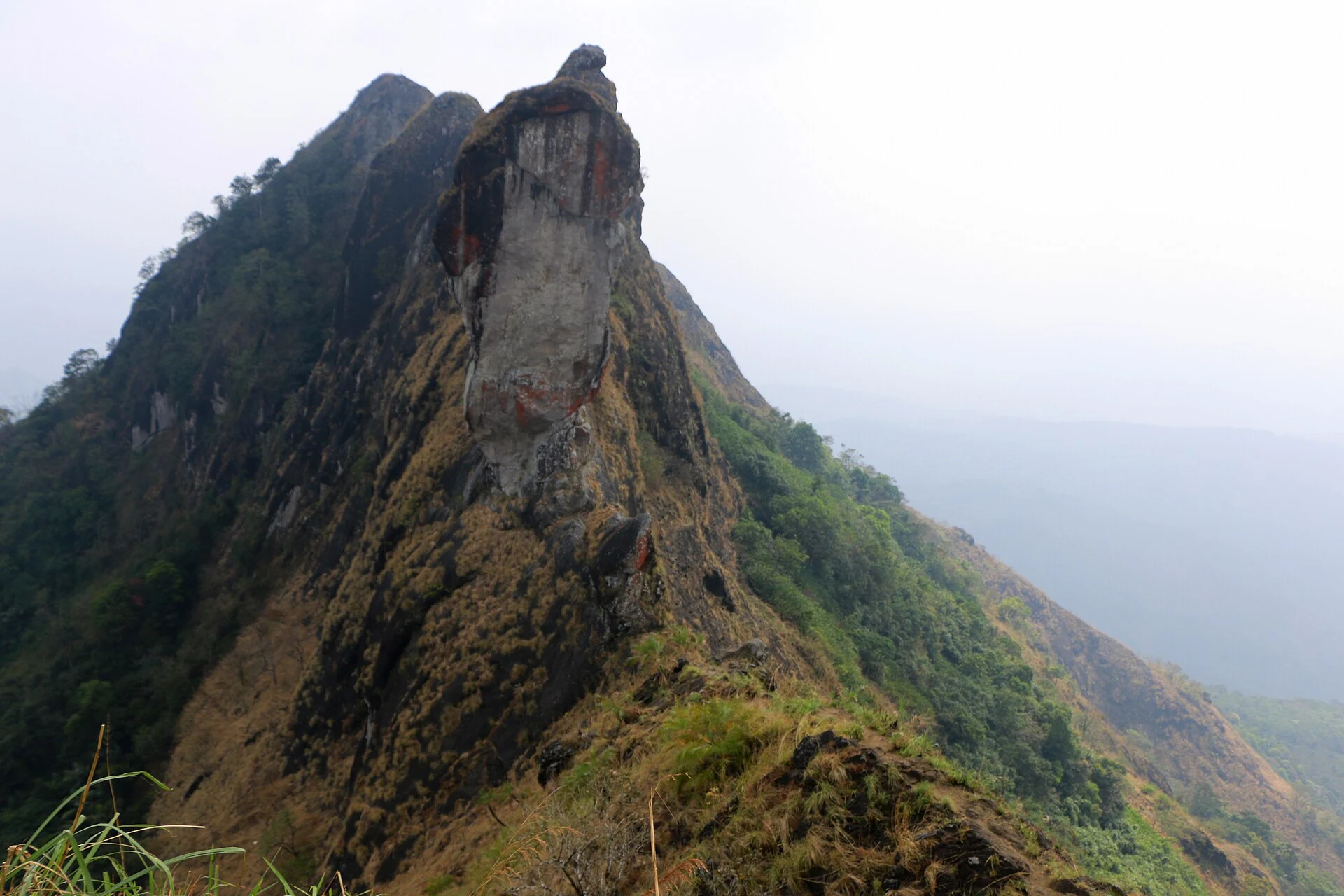
The close view of Illikkal Kallu shows pale rock, darker streaks and a cap that projects above the face. Grass and shrubs occupy the adjoining steep ridge. The skyline invites comparison with familiar shapes, and the local names recorded by DTPC do exactly that: Kuda Kallu evokes an umbrella, while Koonan Kallu evokes a hunched form.
Names give the skyline a vocabulary
The district guide places the main rock within a larger formation on Illickal Mala. Its account describes neighbouring shapes weathered into distinctive outlines. A visitor can begin by looking at the silhouette and asking how those comparisons arise from the actual forms.
Do not assume that the most prominent projection in one photograph must carry a particular name. Viewpoint and angle change the relationships between rocks. A local identification is more useful than transferring labels from a differently composed image.
The names also show that a landscape can be interpreted without a monument being built on it. A shape, a resemblance and a remembered story can give a rock a place in local language. That cultural interest is real even when there is no inscription to read.
The plant belongs to a legend
DTPC records a tale about Neela Koduveli growing in a pond on Kuda Kallu and bringing good fortune to someone who finds it. The authority presents the account as a legend, not a field identification of a botanical specimen.
Keep that distinction intact. Repeating a scientific-sounding plant claim would give the story a certainty its source does not establish. A traveller should not identify an unfamiliar blue flower as the legendary plant simply because it grows in the same broad highland region.
The tale’s appeal is partly in the imagined difficulty of reaching what is desired. Looking at the abrupt faces helps explain that appeal without requiring anyone to test it. The story can remain interesting precisely because it belongs to the landscape’s traditions rather than to an actionable treasure map.
Listen without leaving the visitor route
An account of a pond high on a rock does not create a safe route to it. The ordinary walk approaches the viewpoint, and admission does not authorise scrambling onto the pinnacles or collecting vegetation from the slopes.
Ask about the tale while standing on permitted ground. Notice the rock forms that make the name and story memorable, then let the group continue through the actual visitor arrangement. Folklore and a responsible walk can coexist without the former becoming an excuse to ignore the latter.
Read the DTPC account for the recorded names and legend. Treat it as an introduction to how people have imagined the skyline, while the visible terrain and current access rules determine how the visit is made.
Plan the visit: Illikkal Kallu trek.