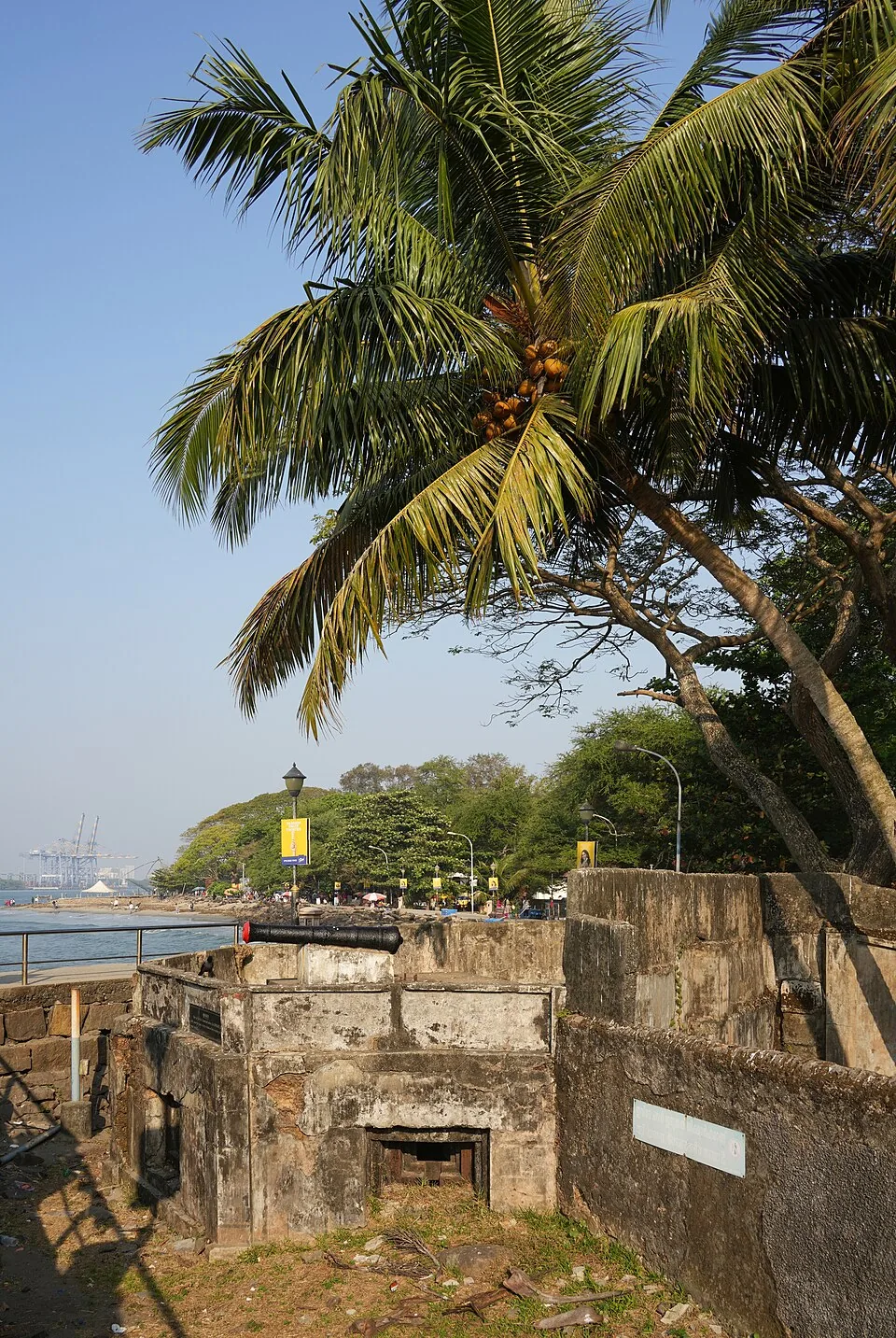
Fort Kochi is named after a fort. Ask most visitors where it is and they will tell you it is gone — which is roughly true and entirely misleading, because a piece of it is preserved in the basement of the Indo-Portuguese Museum, in the garden of the Bishop’s House, and you can go down and stand over it.
What Fort Immanuel was
The Portuguese reached the Malabar coast with Vasco da Gama in 1498 and Pedro Álvares Cabral soon after. Kochi, with a sheltered harbour and a Raja willing to ally against rival Calicut, became the foothold. In 1503 they built a fortified base beside the harbour, later strengthened and named Fort Emmanuel — Fort Immanuel — after the reigning Portuguese king, Dom Manuel I.
Around and inside its walls grew the settlement that became Fort Kochi: St Francis Church, where da Gama was first buried in 1524; the forerunner of Santa Cruz; the streets you are walking on. The fort was the reason for all of it.
Then Kochi passed to the Dutch in 1663 and to the British at the end of the eighteenth century, and the fortifications were largely dismantled. What is left is fragmentary — some stonework on the seafront, and the excavated remains preserved beneath this museum.
Standing on it
The basement is the most atmospheric thing in the building, and it takes people by surprise, because the museum above it is a bright, compact, well-lit collection of church silver and carved saints and nothing prepares you for a cool dim room with foundations in it.
What makes it worth the two minutes is not that the stone is impressive. It is not especially. It is that this is the physical starting point of the European presence in India — the ground on which the whole subsequent five hundred years is built — and it is under a garden in a small diocesan museum that most people skip in favour of the Chinese nets.
- The museum sits in the garden of the Bishop’s House, seat of the Diocese of Cochin, a short walk from Santa Cruz Basilica and St Francis Church.
- Generally open Tuesday to Sunday, closed Mondays and often on public holidays. Confirm locally — diocesan timings change.
- A small entry ticket applies, with a separate camera charge typically.
- Allow forty-five minutes to an hour for the whole collection including the basement.
- It is a museum, not a church. For Mass, Santa Cruz and St Francis are a few minutes away.
Why the museum exists at all
It is worth knowing that this is not a state museum. It was created by the Diocese of Cochin, on the initiative of the late Bishop Dr Joseph Kureethara, to gather sacred art from parish churches across the region that was sitting unregarded and vulnerable to neglect and theft. The Calouste Gulbenkian Foundation of Lisbon supported the building and its layout, and the museum opened in 2000.
So the whole thing is an act of custodianship by a community over its own inheritance, rather than a national collection assembled by outsiders. That shows in what is here and how it is arranged — five sections covering the Altar, the Treasure, the Procession, Civil Life and the Cathedral, which is a diocese’s way of organising the world rather than an art historian’s.
The best twenty minutes in Fort Kochi that nobody takes
Go through the gate off the busy lane, into a walled garden under old trees, and the noise stops. That alone is worth the ticket in a quarter that gets very loud. Do the five sections, go down to the fort, come back up, and sit in the garden for a few minutes before you rejoin the crowd.
Frequently asked questions
Is there really a Portuguese fort inside the museum?
Yes. The basement preserves the excavated remains of Fort Immanuel, the fort the Portuguese built beside the harbour from 1503 and later named after King Dom Manuel I. It is the structure that gave Fort Kochi its name, and it is one of the museum’s most memorable features.
What happened to Fort Immanuel?
Kochi passed from the Portuguese to the Dutch in 1663 and to the British at the end of the eighteenth century, and the fortifications were largely dismantled over that period. What survives is fragmentary — some stonework on the seafront and the excavated remains preserved in the museum basement.
Who set up the Indo-Portuguese Museum?
The Diocese of Cochin, on the initiative of the late Bishop Dr Joseph Kureethara, to gather and protect sacred art from parish churches across the region. The Calouste Gulbenkian Foundation of Lisbon supported the building and its museological layout, and it opened in 2000.
What are the five sections?
Altar, Treasure, Procession, Civil Life and Cathedral. Between them they hold altarpieces, chalices, ciboria, a silver-gilt monstrance, processional crosses, vestments and wooden and marble saints — several drawn from Santa Cruz Cathedral and the Bishop’s House chapel.
When is it open and what does it cost?
Generally Tuesday to Sunday, closed Mondays and often on public holidays, with a small entry ticket and a separate camera charge typically applying. Diocesan timings and fees change, so confirm locally.
How long should I allow?
Forty-five minutes to an hour covers the five sections and the basement unhurried. It sits in the middle of the Fort Kochi heritage circuit, within an easy walk of Santa Cruz Basilica, St Francis Church and the Chinese fishing nets.