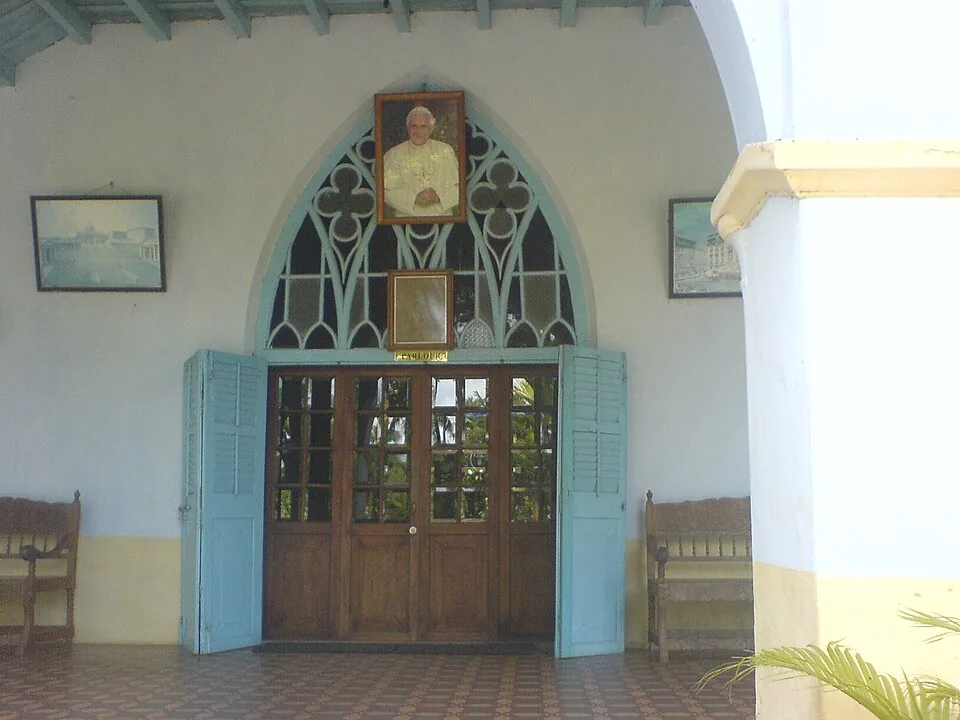
Most people walk into the Indo-Portuguese Museum expecting a small colonial art gallery and leave having seen one. It is worth arriving with a different question: not what is this worth, but where was it before it was here, and why did it have to leave.
This is a diocesan rescue, not a curated collection
The museum was created by the Diocese of Cochin, in the garden of the Bishop’s House, on the initiative of the late Bishop Dr Joseph Kureethara, and opened in 2000. What went into it was gathered from parish churches across the diocese — not bought, not donated from abroad, and not selected because it made an elegant survey of a style.
It was gathered because it was vulnerable. These were working liturgical objects standing in churches that could no longer guarantee their safety or their upkeep. Every case in the building represents a decision, taken parish by parish, that an object had a better chance behind glass in Fort Kochi than in the church it was made for.
The provenances are startlingly local
The teak altar in the Altar section is a sixteenth-century piece from the Church of Our Lady of Hope at Vypeen — across the water, twenty minutes away, still a functioning parish.
The processional cross, silver and wood, is seventeenth-century and came from Santa Cruz, a few hundred metres down the road, along with a chasuble from the same church. There is a monstrance, chalices and ciboria, vestments, coins and wooden and marble statuary, and much of it comes from the same short list of nearby buildings.
That proximity is the thing to sit with. You can walk from the display case to the church the object came out of in under ten minutes, and find a congregation there this Sunday, doing what it has always done, without the cross that used to be carried at the front of it.
- 16th-century teak altar — Church of Our Lady of Hope, Vypeen.
- 17th-century silver-and-wood processional cross — Santa Cruz, Fort Kochi.
- A chasuble — also from Santa Cruz.
- A monstrance, chalices and ciboria, vestments and cassocks, coins, wooden and marble statues.
- The basement: excavated remains of Fort Immanuel, begun 1503, which gave Fort Kochi its name.
The five sections are functions, not styles
The collection is arranged as Altar, Treasure, Procession, Civil Life and Cathedral. Read as art-historical categories those headings look odd. Read as functions they are exact: what stood at the front of the church, what was locked away, what was carried through the streets, what people had at home, and what belonged to the cathedral.
That is a liturgical arrangement rather than a curatorial one, and it is the single most useful thing about the display. It tells you how these objects were understood by the people who used them, which is not as art at all.
Who paid for it
The museum was built with support from the Calouste Gulbenkian Foundation of Lisbon. A Portuguese foundation, five centuries after the ships arrived, funded the building that houses the material evidence of the Portuguese presence in Kochi.
We do not offer that as an accusation. The objects needed somewhere to go and this is where they went, and the alternative was continued decay in unguarded parishes. But it is worth noticing in a museum whose entire subject is what happens when one culture underwrites the making of another’s sacred objects — the funding arrangement rhymes with the collection.
And the fort under the floor
The basement holds the excavated remains of Fort Immanuel, the Portuguese stronghold begun in 1503 beside the harbour and later named for King Dom Manuel I. Visitors are routinely told the fort is gone. It is mostly gone — the Dutch and then the British took the fortifications down — but part of it is here, under a garden, and some stonework survives on the seafront.
So the town is named after a building people believe has vanished, and you can stand on it while looking at the objects the same regime’s patronage produced. For a museum of about an hour, that is a very high density of argument.
How to visit it well
Allow forty-five minutes to an hour. It is generally open Tuesday to Sunday, closed Mondays and often on public holidays, with a small entry ticket and usually a separate camera charge — confirm locally, because diocesan timings change and are not published like a state museum’s. It is a keeping-place, not a working church; for Mass, Santa Cruz Basilica and St Francis Church are minutes away.
And take the walk. See the processional cross here, then go and stand in Santa Cruz, and the collection stops being a display and becomes what it actually is: an inventory of what the churches around you have had to give up in order to keep it.
Frequently asked questions
Who created the Indo-Portuguese Museum and when?
The Diocese of Cochin, on the initiative of the late Bishop Dr Joseph Kureethara, with support from Lisbon’s Calouste Gulbenkian Foundation. It opened in 2000, in the garden of the Bishop’s House at Fort Kochi.
Where did the objects come from?
From parish churches across the Cochin diocese. The sixteenth-century teak altar came from the Church of Our Lady of Hope at Vypeen; a seventeenth-century silver-and-wood processional cross and a chasuble came from Santa Cruz, a few hundred metres away. They were brought in because they were unguarded and deteriorating where they stood.
What are the five sections?
Altar, Treasure, Procession, Civil Life and Cathedral. They are functions rather than styles — what stood at the front of a church, what was locked away, what was carried in procession, what people kept at home, and what belonged to the cathedral.
Is there really a fort in the basement?
Yes. The basement preserves excavated remains of Fort Immanuel, the Portuguese fort begun in 1503 beside the harbour and named for King Dom Manuel I — the fort that gave Fort Kochi its name. Most of the fortifications were dismantled by the Dutch and the British, but this section survives, and some stonework remains on the seafront.
Does “Indo-Portuguese” mean Portuguese objects brought to India?
No — almost the opposite. It means objects made in India, largely by Indian craftsmen, for Catholic use under Portuguese patronage. The interest is in the seam: European form and iconography executed in local teak and rosewood, by hands that had never seen a Lisbon workshop.
When is it open and how long should I allow?
Generally Tuesday to Sunday, closed on Mondays and often on public holidays, with a small entry ticket and usually a separate camera charge — confirm locally, as diocesan timings and fees change. Forty-five minutes to an hour covers the collection unhurried.