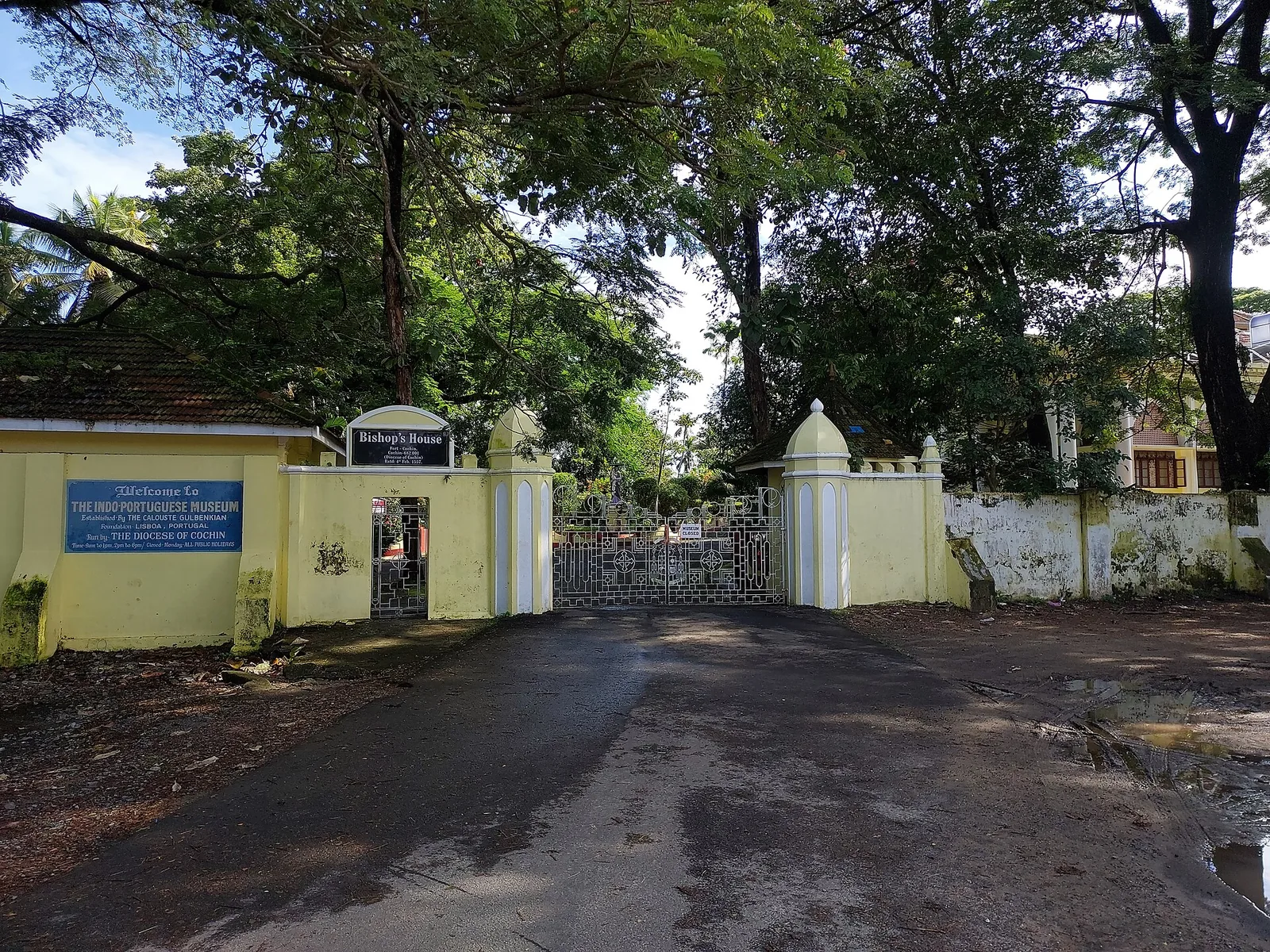
Most visitors read the name of the Indo-Portuguese Museum as a location — Portuguese things, in India. That is not what the term means, and the misunderstanding costs you the entire collection.
Indo-Portuguese describes a hybrid: objects made in India, mostly by Indian craftsmen, for Catholic use under Portuguese patronage. Not imports. Not copies. A genuine tradition produced by contact, in which two sets of habits had to be reconciled in the same piece of wood.
How to see the seam
Once you are looking for it, the seam is everywhere in these rooms.
A vestment carries Portuguese heraldic embroidery over cloth woven and stitched by Kerala hands. A wooden saint wears a European habit but is carved out of local teak or rosewood, in a rounded, slightly folk idiom that no Lisbon workshop would have produced. A marble figure imported from Portugal stands next to an altarpiece assembled by carpenters who had never left this coast, and the difference in how a face is handled is immediately visible when the two are in the same room.
That is the exercise: find the two objects nearest each other that were made four thousand miles apart, and look at what the local maker did differently. It is more rewarding than reading every label.
- Material — teak and rosewood say local workshop; marble usually says imported.
- Faces — European models are sharper and more anatomical; local carving tends rounder and more frontal.
- Silverwork — the Indo-Portuguese monstrance and the processional crosses are where craft and commission meet most obviously.
- A carved teak altar-piece said to have come from the Church of Our Lady of Hope in Vypeen.
- A silver-and-wood processional cross linked to Santa Cruz Cathedral.
Why these objects were scattered in the first place
Because they were not made as art. They were made as equipment: things to stand on an altar, to be carried through a street on a feast day, to be worn by a priest. Equipment lives in the building that uses it, which meant this material sat in parish churches across the Cochin diocese, largely uncatalogued, in varying states of care, and vulnerable both to neglect and to theft.
The museum is the response to that. Objects were gathered from parishes across the region under the Diocese of Cochin, on the initiative of the late Bishop Dr Joseph Kureethara, with support from the Calouste Gulbenkian Foundation of Lisbon, and the museum opened in 2000.
That origin is why the collection is arranged the way it is — Altar, Treasure, Procession, Civil Life, Cathedral. Those are not art-historical categories. They are the categories a working diocese uses, sorted by what an object is for.
The wider point
Fort Kochi is usually narrated as a sequence of arrivals: Portuguese, then Dutch, then British, each replacing the last. The objects in this small museum tell a less tidy and more accurate story, in which the arriving power supplied the commission and the demand, and local people supplied the hands, the wood and a good deal of the visual instinct — and the result belongs to neither side cleanly.
It takes forty-five minutes, it is quiet, it is in a garden, and it is the one place in the quarter where the colonial encounter is shown as an exchange rather than an imposition or a romance.
Frequently asked questions
What does “Indo-Portuguese” actually mean?
A hybrid tradition: objects made in India, largely by Indian craftsmen, for Catholic use under Portuguese patronage. It does not mean Portuguese objects that ended up in India. The interest is in what local makers did with a European commission using local materials and their own visual habits.
How do I tell a local piece from an imported one?
Material and handling. Teak and rosewood generally indicate a local workshop, while marble figures were usually imported. Locally carved faces tend to be rounder and more frontal; European models are sharper and more anatomical. Put two such objects side by side and the difference is immediate.
What are the highlights of the collection?
A carved teak altar-piece said to have come from the Church of Our Lady of Hope in Vypeen, an Indo-Portuguese monstrance in silver and gilt, a silver-and-wood processional cross linked to Santa Cruz Cathedral, and a range of vestments and wooden and marble saints across the five sections.
Why were the objects gathered into a museum?
Because they were made as working equipment for churches rather than as art, and so lived scattered across parish churches in the Cochin diocese, largely uncatalogued and vulnerable to neglect and theft. The Diocese of Cochin gathered them under Bishop Dr Joseph Kureethara, with support from Lisbon’s Calouste Gulbenkian Foundation, and the museum opened in 2000.
Why are the sections organised the way they are?
Altar, Treasure, Procession, Civil Life and Cathedral are not art-historical categories — they are the categories a working diocese uses, sorted by what an object is for. That reflects the museum’s origin as an act of custodianship by the community that owned the objects.
Is it worth visiting if I am not religious?
Yes. The interest here is craft and cultural contact rather than devotion — it is the one place in Fort Kochi where the colonial encounter is visible as an exchange, in wood and silver, rather than as a sequence of arrivals. It takes about forty-five minutes and it is the quietest corner of the quarter.