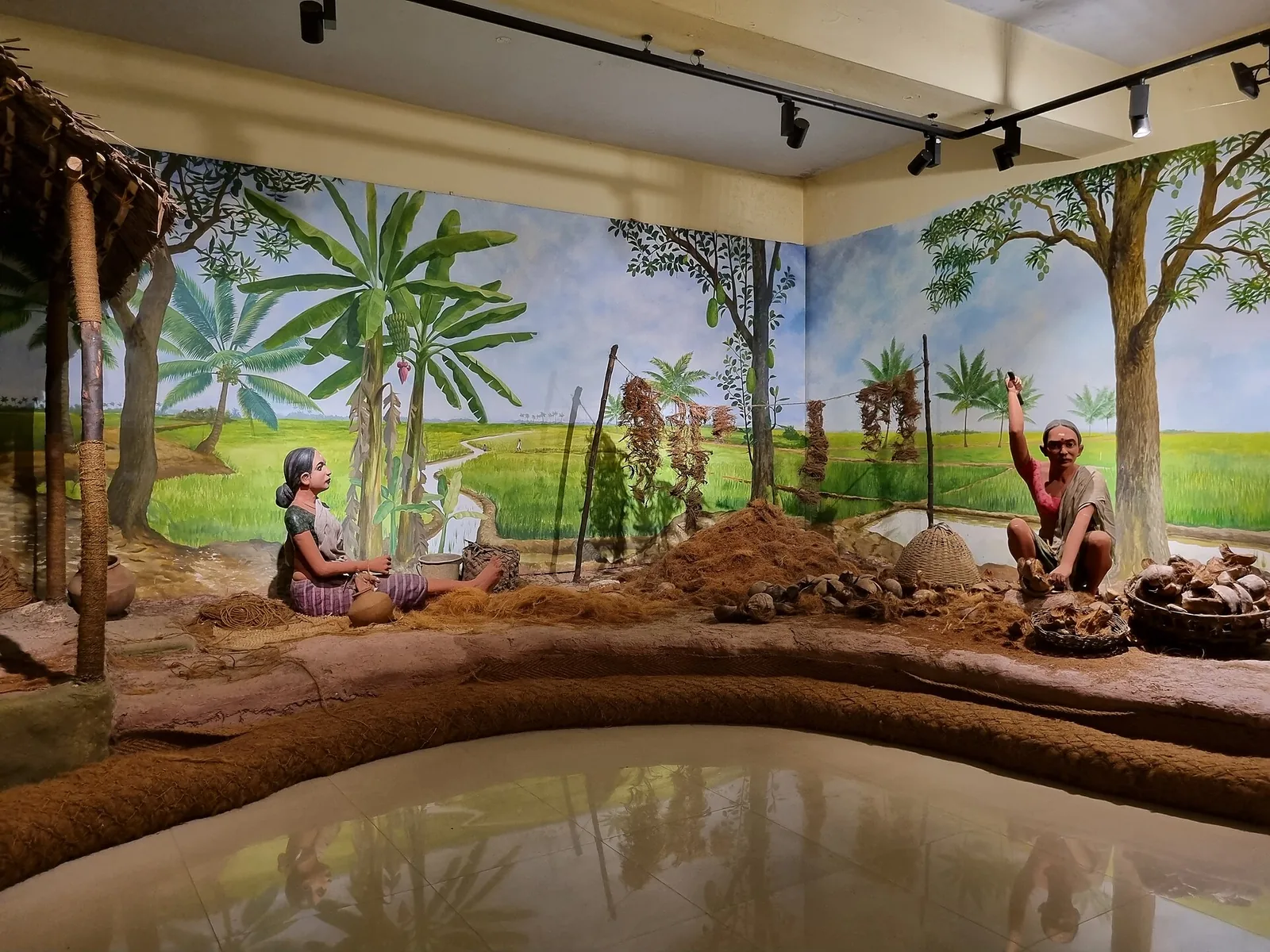
Coir is not harvested. It is released — by drowning coconut husks until the tissue holding the fibre together rots away. The museum at Kalavoor sets out the process on a panel headed History of Retting, and the numbers on it explain why an entire industry settled on one lagoon.
The process
Green husks are sunk in brackish backwater under weights and left there for eight to eleven months. In that time anaerobic bacteria dissolve the pectin that binds the fibre to the pith. The softened husks are then hauled out and beaten with wooden mallets until the fibre separates.
Eight to eleven months. That is not a production step, it is a season and then some — closer to leaving a field fallow than to a factory process, and it means the raw material of an export industry spent most of a year sitting underwater before anyone could spin it.
The sentence that explains the geography
The panel then makes the observation that everything else rests on: fibre quality is superior where the water has both tide and flow.
Read that as a location requirement and the map of the industry falls out of it. You need water that is brackish — where fresh river water and tidal salt water mix — and you need it moving, tidally and by river discharge, rather than sitting still. That is a precise description of the Vembanad backwaters, fed by ten rivers and opening to the sea, with Kuttanad’s channels behind them.
India has coconuts almost everywhere along its coasts. It has far fewer places with that particular chemistry at that particular scale. The coir industry did not choose Alappuzha because of the palms. It chose it because of the water.
What the museum admits
A second panel, The Place of Retting, does something you would not require of a museum funded by the industry’s own statutory board. It prints the case against the process.
Traditional retting is a significant source of greenhouse gases — months of anaerobic decomposition in standing water is, chemically, a methane operation. And the panel is explicit that the dipping and hauling of husks was women’s work, carried out at a cost to their health.
That is on the wall, in a building that also displays coir sculptures and celebrates the coir capital of the world. Museums are not generally good at this. It is worth noticing when one is.
And then it stopped
Retting has now largely disappeared from Kerala — for the ecological reasons the panel names, for the social ones, and because the economics stopped working. Automated defibring displaced the traditional stages. Handloom production has effectively vanished. Most of the old factories are closed and much of the trade has migrated to neighbouring states.
Kerala’s coir industry now depends substantially on Tamil Nadu for its raw fibre — a shift we have written about at length in our Kollam coir-villages series rather than re-arguing it here, along with what decades of retting did to the oxygen in the water.
Coir still employs something like half a million people in Kerala, around 80% of them women. But the thing the museum reconstructs — husks under brackish water, a woman working them at the channel edge — is now most reliably found in the diorama at the top of this article. That is a strange fate for a process that decided where a city would be.
Frequently asked questions
What is retting and how long does it take?
Sinking green coconut husks in brackish backwater under weights for eight to eleven months, during which anaerobic bacteria dissolve the pectin binding the fibre to the pith. The husks are then beaten with wooden mallets to separate the fibre.
Why was coir made in Alappuzha specifically?
Because of the water rather than the palms. The museum’s panel states that fibre quality is superior where the water has both tide and flow — a description of the brackish, tidal, river-fed Vembanad lagoon. Coconuts grow all along India’s coasts; that particular mixing zone is much rarer.
Is retting still done in Kerala?
Very little. It has largely disappeared for ecological and social reasons and because automated defibring displaced the traditional stages, and Kerala’s mills now depend substantially on Tamil Nadu for raw fibre.
What are the drawbacks of traditional retting?
The museum’s own “Place of Retting” panel names two: it is a significant emitter of greenhouse gases, being months of anaerobic decomposition in standing water, and the dipping and hauling of husks was women’s work carried out at a cost to their health.