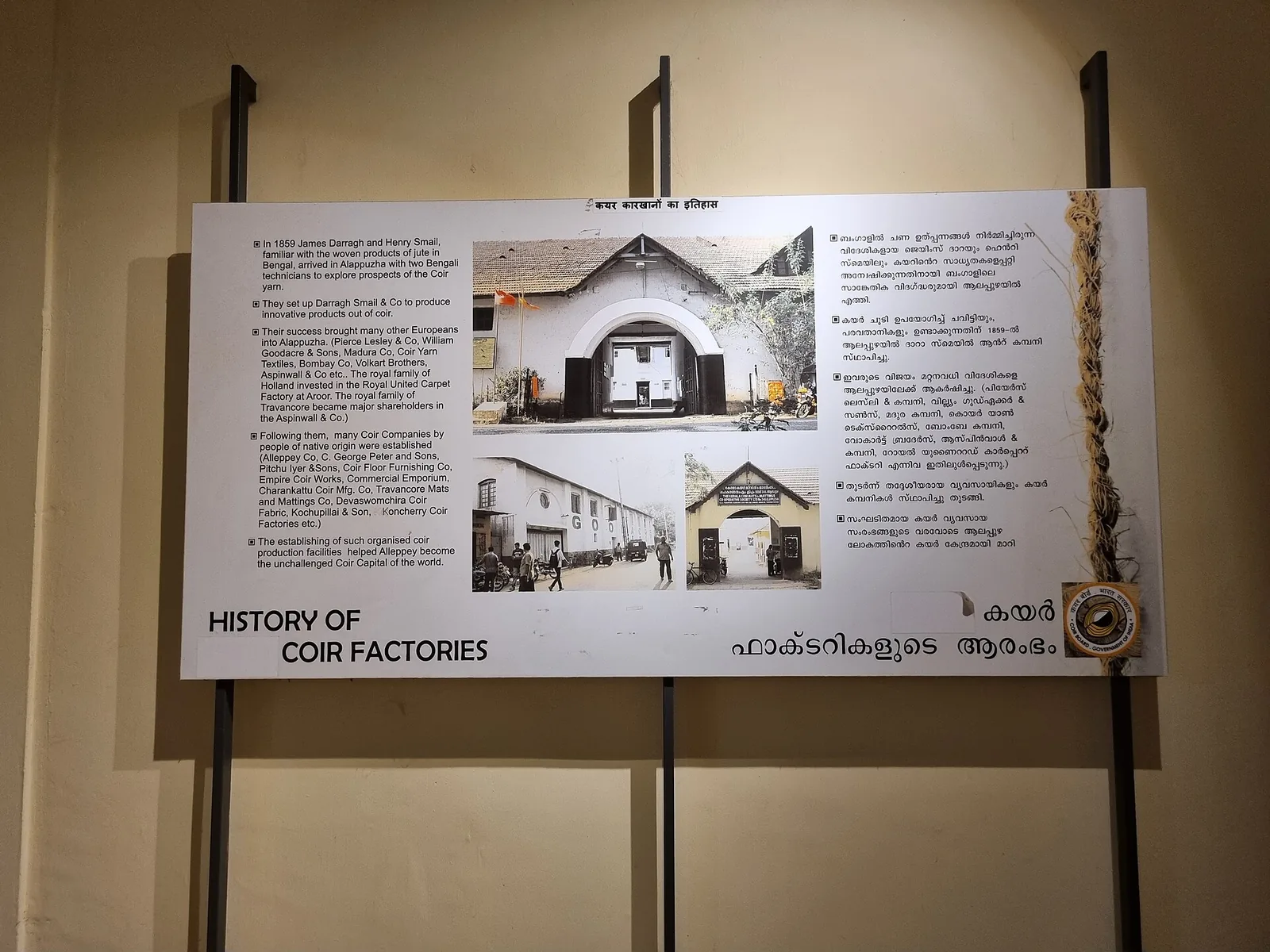
On a wall of the International Coir Museum at Kalavoor there is a bilingual panel headed History of Coir Factories, hung with period photographs of factory gates. It is not much to look at. It is also the single best primary source on how Alappuzha became what it was, and we have transcribed it from the photograph rather than take anyone else’s word for it.
What the panel says
It opens: “In 1859 James Darragh and Henry Smail, familiar with the woven products of jute in Bengal, arrived in Alappuzha with two Bengali technicians to explore prospects of the Coir yarn.” They set up Darragh Smail & Co “to produce innovative products out of coir”.
Then the consequence. “Their success brought many other Europeans into Alappuzha” — and it lists them: Pierce Lesley & Co, William Goodacre & Sons, Madura Co, Coir Yarn Textiles, Bombay Co, Volkart Brothers, Aspinwall & Co.
Two sentences in that block are easy to walk past and shouldn’t be. The royal family of Travancore became major shareholders in Aspinwall & Co. And the royal family of Holland invested in the Royal United Carpet Factory at Aroor. This was not a colonial enterprise operating on top of an indifferent local elite; the ruling house had money in it.
The panel then lists the firms founded by people of native origin that followed: Alleppey Co, C. George Peter and Sons, Pithu Iyer & Sons, Coir Floor Furnishing Co, Empire Coir Works, Commercial Emporium, Charankattu Coir Mfg. Co, Travancore Mats and Mattings Co, Devaswomchira Coir Fabric, Kochupillai & Son, Koncherry Coir Factories. It concludes that this concentration of organised production “helped Alleppey become the unchallenged Coir Capital of the world”.
The decision underneath it
What Darragh actually changed is easy to state and easy to underrate. Before him, coir in Kerala was principally rope and netting, and the yarn that was exported went out raw, to be woven into mats and matting in Europe and America.
Darragh moved the weaving onto Kerala soil. That is the whole innovation, and it is the reason Alappuzha acquired factories, warehouses, a pier, a European commercial presence and eventually an industrial workforce — instead of remaining a place that shipped a raw material to somewhere that added the value.
The man
The American press of the period fills in the person. Darragh was born at Lurgan in County Armagh in 1827, emigrated to America as a boy, and worked in New York’s coir-mat trade — which is where he would have learned what a finished coir product was worth. He sailed for India in 1855, aged twenty-eight, after a failed venture in Calcutta, and settled at Alleppey.
Darragh, Smail & Co was founded in 1859 — the first coir factory in Alappuzha and the first American firm in the region, with a head office at 177 Water Street, New York. Henry Smail began as Darragh’s manager and became his partner after marrying Darragh’s daughter Mary. Employment reached 1,081 and at its peak more than 1,170. Darragh also built a cotton spinning mill at Quilon, now Kollam, at a cost of $350,000, employing around 1,500.
He died at Cairo in December 1889, aged sixty-two, on his way home to New York. Smail ran the firm through the 1890s and moved permanently to New York in 1895. The baling department passed to Vakkan & Sons in 1957.
A conflict we are not resolving
The museum panel and the American record do not quite agree, and both are worth having. The panel says Darragh and Smail arrived in Alappuzha in 1859, out of the Bengal jute trade, with two Bengali technicians. The US primary sources have Darragh arriving in 1855 from New York after failing in Calcutta, with no jute-in-Bengal background at all, and founding the firm in 1859.
The panel is the on-site authority and the one a visitor will read. The American press is the earlier record and closer to the man. We print both rather than picking, and note that the founding year — 1859 — is the one thing every source agrees on.
(One small thing worth flagging: Wikipedia spells the founder “Durragh”. It is Darragh.)
Frequently asked questions
Who founded the first coir factory in Alappuzha?
James Darragh, born in Lurgan, County Armagh in 1827 and raised in America, with Henry Smail — the firm of Darragh, Smail & Co, founded in 1859. It was the first coir factory in Alappuzha and the first American firm in the region.
What did Darragh actually change?
He moved the weaving to Kerala. Before 1859 coir yarn was exported raw and woven into mats and matting in Europe and America; making the finished product locally is what gave Alappuzha its factories, warehouses and workforce.
Which firms followed him into Alappuzha?
The museum panel names Pierce Lesley & Co, William Goodacre & Sons, Madura Co, Coir Yarn Textiles, Bombay Co, Volkart Brothers and Aspinwall & Co among the Europeans, and Alleppey Co, C. George Peter and Sons, Pithu Iyer & Sons, Coir Floor Furnishing Co, Empire Coir Works, Commercial Emporium, Charankattu Coir Mfg. Co, Travancore Mats and Mattings Co, Devaswomchira Coir Fabric, Kochupillai & Son and Koncherry Coir Factories among firms of native origin.
Did the Travancore royal family invest in the coir trade?
Yes — the museum’s own panel states that the royal family of Travancore became major shareholders in Aspinwall & Co, and that the royal family of Holland invested in the Royal United Carpet Factory at Aroor.