Most museums are arranged by chronology or by material. The International Coir Museum is arranged by an argument, and once you see it the building becomes much more interesting.
The sequence
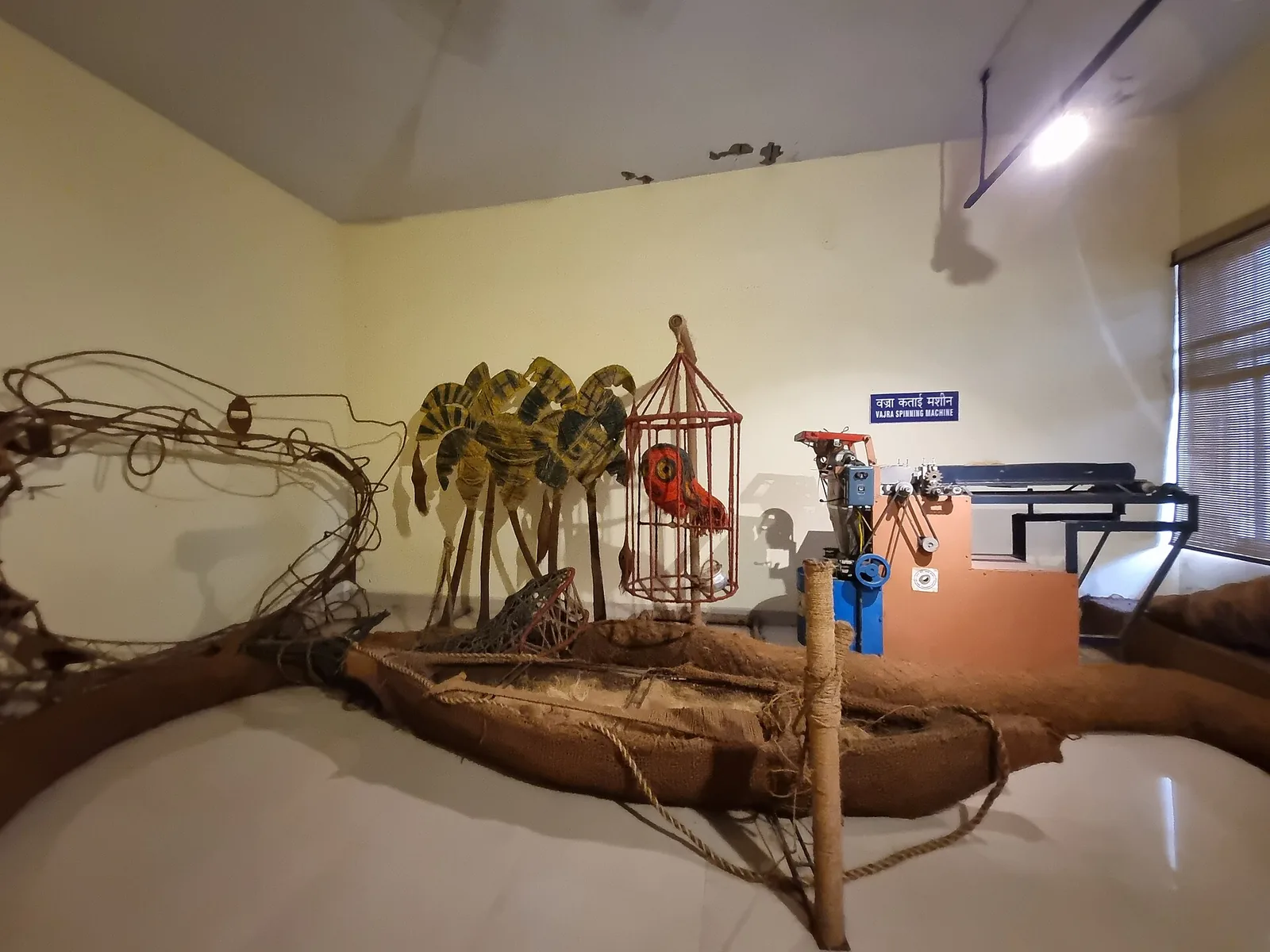
You move from the husking spike — the pointed iron stake a worker drives a coconut down onto to strip the husk — to the ratt, the hand-and-foot-driven wheel that twists loose fibre into two-ply yarn, to a labelled Vajra spinning machine standing a few metres away doing the same job faster.
Around them the room holds a full-size country boat clad in coir, a coir fishing net, coir-wrapped palm props, geo-textiles and pith briquettes. Hand tools and machines are placed in the same eyeline rather than in separate rooms, which is a choice, and it is the argument.
What it cost
The museum does not present mechanisation as an unambiguous triumph, and the evidence for that is on the panels rather than in the labels.
Handloom coir production has effectively disappeared. Automated defibring displaced the workers who had done the traditional stages by hand. The photographs of factory gates on the History of Coir Factories panel are, in a good many cases, photographs of premises that are now shut. Much of the trade moved to neighbouring states, and the raw fibre now largely comes from Tamil Nadu.
And the workforce that remains is not evenly distributed. Coir still employs on the order of half a million people in Kerala, and roughly 80% of them are women — which means that when this industry contracts, or mechanises, or relocates, the people it happens to are overwhelmingly women.
Where the fibre went instead
The other half of the argument is reinvention, and it is real. Coir turns up in the museum as geo-textile — erosion-control matting for slopes and embankments — as compressed pith briquettes for horticulture, as rubberised mattress filling, and as garden and nursery products. These are not romantic uses. They are, however, uses with growing markets and a genuine environmental case, which mats and mattings no longer had.
The room nobody expects
Then there is the last register, and it catches most visitors off guard. A gallery of coir as an art material.
Portraits of Gandhi and of Mother Teresa woven in fibre. A life-size coir lion in a village-hut diorama. Coir bulls, horses, spiders and crabs on plinths. Bird-nest “wood houses”. A nettipattam — the great gold caparison that fronts a temple elephant — executed in coir and brass. A coir Ganesha, a coir Buddha head, a coir houseboat. A rope spiral several metres across mounted flat on a wall.
It is easy to be superior about this, and we would rather not be. A craft whose industrial market has contracted does one of two things: it disappears, or it starts making objects whose value is in the skill rather than in the function. The coir lion is not a serious answer to the collapse of handloom matting. But it is what the skill does when the industry stops needing it, and putting it in the same building as the Vajra machine is a more honest ending than the museum had to give itself.
Frequently asked questions
What is a ratt?
The traditional hand-and-foot-driven spinning wheel that twists loose coir fibre into two-ply yarn. The museum displays it a few metres from the mechanised Vajra spinning machine that does the same job.
What is the Vajra spinning machine?
A mechanised coir spinning machine, displayed and labelled in the museum’s mechanisation gallery alongside the hand ratt, a full-size coir-clad country boat and a coir fishing net.
What is coir used for now?
Increasingly for geo-textiles used in erosion control, compressed pith briquettes for horticulture, rubberised mattress filling and garden products — rather than the handloom mats and mattings that built the industry, which have effectively vanished.
Why are there coir sculptures in the museum?
The museum devotes a gallery to coir as an art material — woven portraits of Gandhi and Mother Teresa, a life-size coir lion, animals, a coir-and-brass nettipattam and a large rope spiral. It is what the craft skill turned to as the industrial market for handloom coir contracted.