The oldest thing at Iringal is not the crafts village
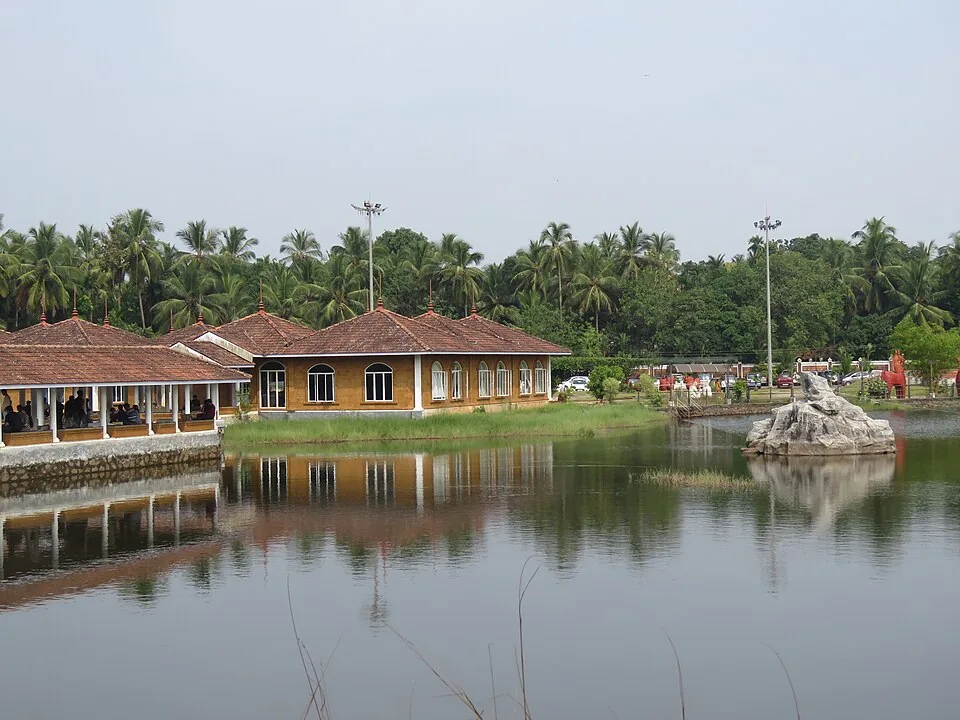
Sargaalaya opened in February 2011. That makes it, by a comfortable margin, the least historic thing on this stretch of the Moorad. Walk a kilometre from its gate, towards Kottakkal, and you reach a fragment of a house that the Kerala State Department of Archaeology has protected as a monument since 1976 — what survives of the base of the Kunjali Marakkars, the Muslim admirals who ran the Zamorin of Calicut’s navy against the Portuguese through the sixteenth century. The crafts village makes very little of this. Its signage is about pottery and screwpine. The most consequential ground in the district is a ten-minute walk away and largely unannounced.
That is worth correcting because the two sites explain each other. Sargaalaya exists because Kerala Tourism wanted a destination in the Vadakara belt. The reason there is a road, a rail halt and a highway junction at a village of some 25,894 people in the first place is that this river mouth has mattered to whoever controlled the Malabar coast for a very long time — and the Marakkars are why.
A sea war fought from this river
The outline is this. From the 1520s the Portuguese attempted to convert their trading foothold on the Malabar coast into control of the pepper trade itself, which meant controlling who could sail and who could not. The Zamorin’s answer was a naval command handed to a seafaring merchant family — the Marakkars — who fought a running campaign of raids, escorts and denial for roughly three-quarters of a century, from about 1524 to 1600. Four men held the title of Kunjali Marakkar in succession. The Portuguese chronicles record a string of fortified ports held under the Zamorin’s patronage, fortified on the seaward side and granted to the family; one of them, which they called Badara, is this shore.
It ended badly, and not only at Portuguese hands. Relations between the fourth Kunjali and the Zamorin broke down, and in 1600 the admiral surrendered to a combined force. The base at Kottakkal was reduced. What is left of the house at Iringal is a fragment of a considerably larger complex, which is why the museum occupies part of a house that remained intact rather than a building entire.
What is in the museum
The Archaeology Department opened the surviving portion as the Kunjali Marakkar Memorial Museum in 2004. It is small, and the collection is specific rather than comprehensive: cannon and swords recovered from the surrounding area, a model of the fort as it is understood to have stood, historical documents, megalithic-period pottery and Neolithic stone tools from nearby sites, and coins — including silver Veerarayan issues the department itself unearthed. Entry runs around ₹10 for adults and ₹5 for children, with a camera charge; hours are 09:00 to 17:00 with ticket sales stopping at 16:45, closed on Mondays and national holidays.
About 500 metres further on stands the Kottakkal Valiya Juma’ath Mosque, which holds objects that tradition identifies as taken by the Kunjali Marakkar from the Portuguese, a throne and a sword among them. Whether the attribution survives strict scrutiny is another matter; the point is that this is a living community’s memory of the war, kept in its own mosque rather than in a state cabinet, and the two together are more interesting than either alone.
One claim to hold loosely
Kerala Tourism’s page for Iringal, and a great many pages that copy it, describe the village as the birthplace of Kunjali Marakkar IV. Treat that as a shorthand rather than a documented fact. The Marakkars are generally traced to a branch of Arab-descended seafaring merchants who had settled at Kochi and were trading — initially in co-operation with the Portuguese — before the relationship broke and they moved into the Zamorin’s service. The Iringal property is better described as the family’s fortified base and ancestral house on this coast, which is a strong enough claim without needing a birth certificate attached to it.
And while we are pruning: this coast is sometimes attached to the ancient Graeco-Roman ports named in the Periplus of the Erythraean Sea, Tyndis and Naura, as though the identification were settled. It is not. No archaeological evidence of Tyndis has ever been found; historians argue over Kadalundi, Ponnani and Panthalayini Kollam as candidates, and Naura is most commonly placed near Kannur. Nothing puts either at Iringal. The Marakkar history here is real, dated and physically present. It does not need a Roman prologue.
Walking it from the crafts village
The practical version is easy. Both sites are closed on Mondays, so the pairing does not work on a Monday at all — a trap worth knowing, since the two are usually recommended together. Do the museum first, in the morning when it is cooler and the light in those small rooms is better, then Sargaalaya afterwards and stay for the late afternoon on the lake. That order also gets the chronology right, which changes the crafts village: you arrive at the terracotta and the cane knowing that the ground under it was a naval base, and that the material culture on display here is what continued in this district after the fighting stopped.
There is a version of the visit that is just an hour of shopping beside a pretty lake, and it is a perfectly good hour. But Sargaalaya sits on a shore whose history is genuinely first-rank and almost entirely unmarked from inside its own gates. The kilometre to Kottakkal costs you thirty minutes and reframes the whole afternoon. It is the best-value walk in the district.
- Kunjali Marakkar Memorial Museum: about 1 km from Sargaalaya at Kottakkal; 09:00–17:00 (tickets to 16:45), closed Mondays and national holidays, around ₹10 adults / ₹5 children plus a camera fee.
- The Kottakkal Valiya Juma’ath Mosque is roughly 500 m beyond the museum; observe mosque etiquette and ask before entering or photographing.
- Both Sargaalaya and the museum close on Mondays — do not plan the pair for a Monday.
Frequently asked questions
How far is the Kunjali Marakkar museum from Sargaalaya?
About a kilometre, at Kottakkal in the same village of Iringal — comfortably walkable. It occupies the surviving part of the Marakkar family’s fortified house, protected as a monument by the Kerala State Department of Archaeology since 1976 and opened as a museum in 2004.
Was Kunjali Marakkar born at Iringal?
It is widely stated, including on official tourism pages, but should be held loosely. The Marakkars are generally traced to Arab-descended seafaring merchants settled at Kochi who later entered the Zamorin’s service; Iringal is best described as the family’s fortified base and ancestral house on this coast.
Was Iringal an ancient Roman-era port?
There is no evidence for it. The Periplus ports of Tyndis and Naura are both unlocated — no archaeological trace of Tyndis has ever been found, its candidates being Kadalundi, Ponnani and Panthalayini Kollam, while Naura is usually placed near Kannur. Iringal’s documented importance is sixteenth-century and naval.