Start at the water
Most people at Sargaalaya turn right at the entrance and go straight for the shops, which is the wrong way round. Go to the water first. The lake occupies the middle of the twenty-acre site and everything else is arranged around it, so five minutes on the bank gives you the whole plan of the place at a glance: craft huts along one shore, a long low veranda-fronted pavilion at the near end, the guest-house block standing tall on the far side, lawns and lamp posts between. Grey rock rises out of the water in three or four craggy islands, tufted with grass. It looks ancient and geological. It is neither.
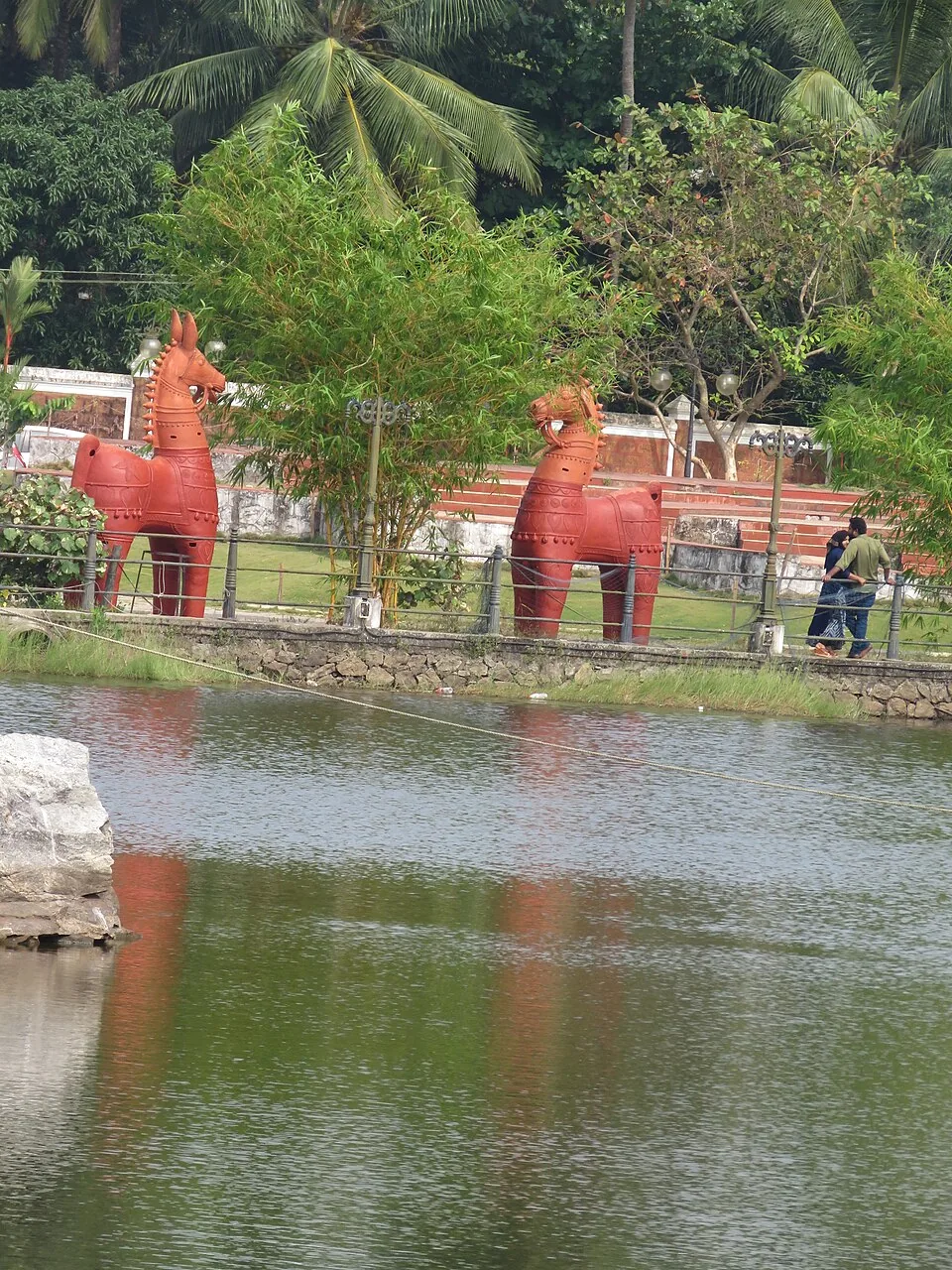
The lake is a quarry. When the site was developed, a disused laterite working was flooded and landscaped, and the rock stacks standing in it are the pillars and faces the cutting left behind. This is documented in Kerala Tourism’s own material on the site, and it is the single fact that makes the campus legible. The laterite that came out of this ground is the laterite the buildings are made of — you are looking at the hole and the house at the same time. Once you have seen that, the reflections stop being merely pretty and start being a record of what happened here.
The huts, and what to look for in them
The craft huts run along the water in a low ochre-and-tile row. Sargaalaya names fifteen traditions in residence: terracotta, metal embossing, mural art, herbarium work, pooram craft, coconut-stem nirapara, sculpture, kora grass, coconut-shell jewellery, coco craft, vetiver, screwpine, bamboo craft, seed ornaments and cane furniture. Around sixty stalls occupy the cottages across the site. Not every hut is staffed every day — this is a working campus and the artisans have lives, orders and off-days — so calibrate expectations and treat the list as a range rather than a schedule.
The ones worth slowing down for are the ones where the process is visible. Cane furniture is the best theatre on site: the frame is steamed and bent in front of you and the whole logic of the chair reveals itself in about ninety seconds. Screwpine and kora grass are the opposite — nothing dramatic happens, but the speed at which a mat comes off the weaver’s knee is genuinely difficult to believe until you have watched it. Coconut shell is the one that changes how you look at your own kitchen bin: an object most households discard, cut and polished into jewellery you would happily pay for. Metal embossing and mural art are the two where you should simply stand and watch the hand rather than the object.
The horses
Above the bank, behind a low railing, stand two large terracotta horses — heads up, ears pricked, bodies incised with the beaded and looped ornament that North Malabar has been pressing into votive clay animals for a very long time. They are the picture everyone takes at Sargaalaya, and rightly. Set against bamboo and coconut palm with their own reflections wobbling in the quarry water below them, they do more for the campus than any signboard: they place it in a specific regional tradition rather than a generic Indian-crafts one. Terracotta is the first craft on Sargaalaya’s own list, and the horses are the reason.
Elsewhere the sculpture is scattered without ceremony. There is no trail, no numbering, and very little labelling, which is a real omission — a good many visitors leave without knowing what they have looked at. Treat it as a hunt instead. The lawns and the walkways between the buildings hold pieces in stone, wood and fired clay, and the pleasure of the campus is that you find them at your own pace rather than being marched past them.
Boats, buildings and the rest
Rowing and pedal boats work the lake during opening hours, and the short circuit they make is the only way to see the rock islands from the water rather than across it. It is a ten-minute thing, not an expedition, and children love it. Beyond that the campus carries the standard apparatus — a cafeteria, a children’s play area, an aquarium, covered halls used for functions and for classical and folk performances, and a multi-storey guest house across the water whose laterite-and-tile stack is the tallest thing on site. The Kerala State Tourism awards have been held here.
The architecture is worth a paragraph of attention on its own, because it is unusually consistent. Everything is laterite — that soft ochre-red block that cuts like cheese when quarried and hardens in the air — under Mangalore-tiled pitched roofs with small finials, deep verandas and columned walkways. It is a vernacular idiom applied at institutional scale, and because a construction co-operative built it rather than an architect chasing a statement, it is uniform in a way Indian tourism campuses very rarely are. Nothing on the site is trying to be the photograph. The result is that all of it photographs well.
Time it right
Two hours covers Sargaalaya comfortably; three if you intend to buy properly, and buying properly is much of the point. Mid-morning on a weekday gives you the best odds of finding artisans actually at work. Late afternoon gives you the light, and the light here is exceptional: in the last hour the quarry water goes flat, the rock stacks double themselves, the sky turns that Malabar rose-and-ash, and the campus becomes a considerably more romantic place than its ticket price suggests. If you can only have one, take the afternoon and accept fewer working hands.
The campus is open year-round and closed on Mondays — a detail that catches out a surprising number of people combining it with the Kunjali Marakkar museum a kilometre away, which is also closed on Mondays. Sargaalaya’s own site quotes 09:30 to 18:30 and entry at ₹50 for adults, ₹40 for children and ₹30 for senior citizens, though other sources quote different hours and it has changed over the years; confirm on the day. And if you happen to be in North Malabar across the turn of the year, the international crafts festival turns these same twenty acres into something four times louder and about ten times larger. The rest of the district is on the Kozhikode hub.
- Closed Mondays — as is the Kunjali Marakkar museum a kilometre away, so do not plan the pair for a Monday.
- Hours and entry per the official site: 09:30–18:30, ₹50 adults / ₹40 children / ₹30 seniors; boating extra.
- Best light is the last hour before closing; best chance of artisans at work is mid-morning on a weekday.
Frequently asked questions
How long do you need at Sargaalaya?
About two hours for the craft huts, the sculpture and a walk round the lake; three if you plan to shop seriously. The campus is twenty acres but compact enough to see properly on foot, and there is no set route — the pleasure of it is drifting.
Can you take a boat on the lake?
Yes — rowing and pedal boats operate during opening hours, charged separately from entry. It is a short circuit of ten minutes or so, and the only way to see the quarry rock stacks from the water.
Why does everything look the same colour?
Because the whole campus is built of laterite, the ochre-red block quarried across Malabar, under Mangalore-tiled roofs. The lake at the centre is the disused quarry the material came from, which is why the buildings and the rock islands are the same stone.