What the gate does not tell you
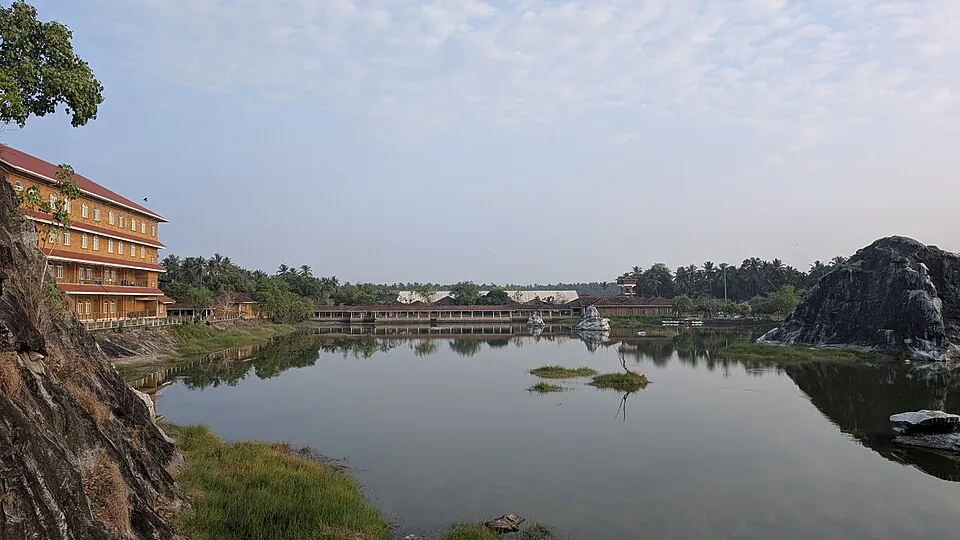
The entrance to Sargaalaya gives away nothing. You pay ₹50, walk through, and find a wide sheet of water with rock islands in it, a row of laterite pavilions with tiled roofs, lawns, lamp posts and a potter working under a veranda. The obvious inference — the one nearly every visitor makes, and the one most guidebooks encourage — is that you have arrived at a village of craftspeople who live and work here, and that the state has helpfully put a ticket counter in front of it. That is not what this is. Sargaalaya is a twenty-acre facility built by the Kerala Tourism Department at a cost of around ₹15 crore, opened in February 2011, and handed to a contractor to operate. The craftspeople came afterwards, by invitation.
Which raises the question of who the contractor is, and this is where a fairly ordinary tourism project becomes one of the more interesting things in North Malabar. Sargaalaya is managed by the Uralungal Labour Contract Co-operative Society, universally abbreviated to ULCCS. It has no particular history in handicrafts. It builds roads, bridges, campuses and IT parks. It is a construction outfit — and it is owned by the people who do the construction.
Fourteen men, 1925
ULCCS was founded on 13 February 1925 by fourteen labourers in a hamlet of what was then the British Malabar district. They were followers of Vayaleri Kunhikannan Gurukkal, the reformer known as Vagbhatananda, whose Atmavidya Sangham attacked caste hierarchy, ritual superstition and the economic arrangements that kept labouring communities poor. One of those arrangements was the labour contractor: the middleman who took the work, hired the men, and kept the margin. The society’s founding idea was simple and, for 1925, radical — that the workers should take the contract themselves and divide what it earned.
It survived, which is the remarkable part. Co-operatives founded in the enthusiasm of the reform movements mostly did not. ULCCS went from village roads to district roads to state infrastructure, and a century later it employs more than 13,500 people and is recognised as the oldest workers’ co-operative in India and the largest in Asia. It marked its centenary in 2025. Its home ground is a few kilometres from the gate you just walked through.
Why a road-builder was given a crafts village
The logic is less strange than it first appears. Sargaalaya was conceived under Kerala’s responsible-tourism policy, which set out to build destinations that put money into local hands rather than extracting it, and ULCCS was already the state’s proof that such a thing could be run at scale without collapsing. The society was given the construction and then a ten-year management contract from the 2011 opening. Whether and how that contract was renewed after the first decade is not something we have been able to establish from public sources, and we would rather say so than guess.
You can see the builder’s hand everywhere on the site once you know to look. The campus is laterite — walls, plinths, retaining edges, the lot — which is why twenty acres of separate buildings read as one architectural family rather than a collection. The lake at the centre is a disused quarry, flooded and landscaped; the craggy rock islands standing in the water are what the cutters left. That is an infrastructure solution to a landscape problem, applied to a tourism site. A designer might have filled the quarry. A construction co-operative made it the best thing on the property.
What it means for the people at the wheel
The arrangement matters to the craftspeople in a specific way. Sargaalaya lists fifteen traditions on site — terracotta, metal embossing, mural art, herbarium, pooram craft, coconut-stem nirapara, sculpture, kora grass, coconut-shell jewellery, coco craft, vetiver, screwpine, bamboo, seed ornaments, cane furniture — and around sixty stalls in cottages. The practitioners work here, demonstrate here and sell here, at a site whose whole point is that no trader stands between the maker and the buyer. The campus also holds a Crafts Design and Technology Development Centre, set up to train craftspeople in modern production and design technique.
That last piece is the least photogenic thing on the property and probably the most important. Kerala’s traditional crafts have rarely had a skill problem. What they have had is a design, costing and market-access problem — beautiful work, made slowly, priced either too low to live on or too high to move, and sold through people who kept most of the difference. A training centre attached to a retail campus attached to a festival is a serious attempt at that problem, and it is exactly the kind of thing a co-operative founded to abolish middlemen would build.
And what it does not mean
None of this makes Sargaalaya an artisans’ co-operative, and it is worth being honest about the difference. The craftspeople here are not owners of the enterprise the way ULCCS’s construction workers own theirs; they are participants in a state scheme, operating from allotted units on a campus owned by the Tourism Department and run by somebody else. That is a good deal better than the alternative most of them had. It is not the same as the thing the phrase crafts village conjures, and the site’s own presentation does little to dispel the confusion.
The gap closes once a year. For roughly three weeks across the turn of the year the Sargaalaya International Arts & Crafts Festival fills the grounds — the thirteenth edition ran 23 December 2025 to 11 January 2026 — with close to 200 artisans from more than eighteen Indian states and fifteen-odd countries, over a hundred stalls, and a footfall above two lakh. For those weeks the campus genuinely is what it says on the board. The rest of the year it is quieter, smaller, and in some ways better: the artisans have time to talk, and the lake is yours.
- Open year-round, closed Mondays; the official site gives 09:30–18:30 and ₹50 adults, ₹40 children, ₹30 senior citizens.
- Iringal is about 45 km north of Kozhikode off the NH66; the nearest towns are Payyoli and Vadakara, and the campus’s own postal address is in Payyoli Municipality.
- Allow two hours, and prefer late afternoon — the light on the quarry lake is the best thing here.
Frequently asked questions
Who owns and runs Sargaalaya?
It is a Kerala Tourism Department project, opened in February 2011 at a cost of around ₹15 crore, and managed under contract by the Uralungal Labour Contract Co-operative Society (ULCCS) — a construction workers’ co-operative, not a crafts body. ULCCS was given a ten-year management contract from the opening; the position after that first decade is not clearly documented publicly.
What is ULCCS?
The Uralungal Labour Contract Co-operative Society, founded on 13 February 1925 by fourteen labourers in old Malabar district, followers of the reformer Vagbhatananda, to take construction contracts directly and cut out the labour middleman. It is India’s oldest and Asia’s largest workers’ co-operative, employs more than 13,500 people, and reached its centenary in 2025.
Do the artisans own their units?
No. They work, demonstrate and sell from units on a state-owned campus operated by a contractor. The model is designed to remove the trader between maker and buyer, and includes a Crafts Design and Technology Development Centre for training, but the craftspeople are participants in the scheme rather than owners of it.