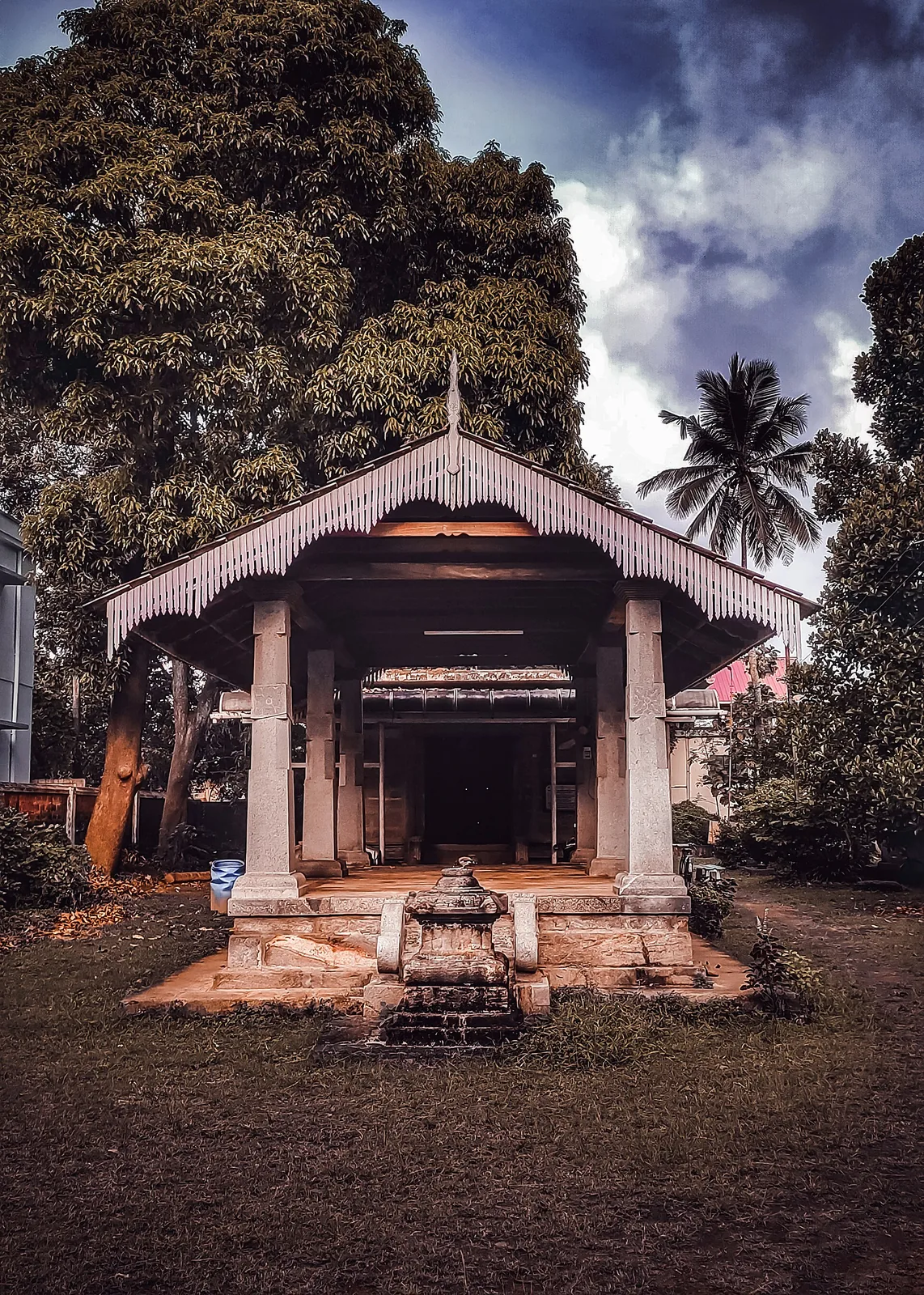
Kerala is a land of temples, churches and mosques — but of Jain temples, almost none remain. Which makes the plain granite shrine at Jainimedu, on the edge of Palakkad town, quietly remarkable: a fifteenth-century survivor of a faith that once flourished here and has since all but disappeared from the state.
The merchants who built it
The temple was raised in the fifteenth century, on the banks of the Kalpathy river, by a family of diamond merchants who had come south from Karnataka — its construction credited to a figure remembered as Inchana Satur. It is built plainly and solidly of granite, its walls and pillars carrying the restrained carvings of the Jain tradition, and enshrines Chandraprabha, the eighth of the twenty-four Tirthankaras, together with Padmavati, the guardian yakshi. There is no soaring gopuram, no gold; the beauty here is in the age and the austerity.
A community of four hundred families
It is easy, standing in the hush of the place, to forget how alive it once was. At its height, in the seventeenth and eighteenth centuries, the Jainimedu quarter — the name simply means “the mound of the Jains” — was home to more than four hundred Jain families, a thriving merchant community with its own trade, its own scholars, its own way of life woven into the fabric of Palakkad. This was not a relic then, but a living heart of Jain Kerala.
How a faith faded from a land
What happened to them is the quiet tragedy behind the temple’s calm. The community was scattered — its decline hastened, tradition holds, when the area was attacked during the invasions of Tipu Sultan in the eighteenth century, and the fragile Jain settlement never recovered. Families drifted away or dwindled over the generations, until the flourishing quarter of four hundred households became a memory, and the temple one of the last standing witnesses to a whole vanished world of Kerala Jainism.
Where a poet wrote of a fallen flower
The place has one more, gentler claim to fame. It was at a Jain house near here that Kumaran Asan — one of the towering figures of modern Malayalam poetry and a leading light of Kerala’s renaissance — is said to have written his early masterpiece Veena Poovu, “The Fallen Flower,” a meditation on beauty, decay and mortality. There is a fitting poetry in that: a poem about a flower fallen from its stem, composed beside a temple that was itself the last bloom of a faded community.
Visiting Jainimedu
The temple sits in the Jainimedu area on the western side of Palakkad town, an easy and unusual stop between the town’s fort and the Kalpathy heritage village. It is quiet, uncrowded and protected as a heritage site; come with a sense of what it represents, and the plain granite will speak. Details are on the Jainimedu place page; more of the district is on the Palakkad hub.
Frequently asked questions
How old is the Jainimedu Jain temple?
It dates from the 15th century, built of granite on the banks of the Kalpathy river by a family of diamond merchants from Karnataka. It is one of the few surviving ancient Jain temples in Kerala, enshrining the Tirthankara Chandraprabha and the yakshi Padmavati.
What happened to the Jain community of Jainimedu?
At its peak in the 17th and 18th centuries, Jainimedu was home to more than 400 Jain families. The community declined sharply — its fall hastened, by tradition, when the area was attacked during Tipu Sultan’s invasions — and Jainism has since all but vanished from the region.
Which poet is connected to Jainimedu?
The renowned Malayalam poet Kumaran Asan is said to have written his early masterpiece Veena Poovu (“The Fallen Flower”) at a Jain house near the Jainimedu temple.