Rajiv Anchal put the engineering problem in one sentence on his own site: "The very idea of building a sculpture on a 1000 ft rock and bringing construction equipments up the hill without any road facility posed a major challenge."
Set aside the thousand feet for a moment — we measured this hill against four independent global elevation models and they put the summit at about 180 m above sea level, roughly half what Wikipedia and the travel press print. The important half of that sentence is the end of it. There was no road. Every way of getting up this hill is something somebody had to invent, and there are now four of them, run by different people.
One: the ropeway
The operator describes "an array of Swiss-made cable cars, of the standards found nowhere else in Kerala". OpenStreetMap, surveyed on the ground, records it as a gondola with cabins seating eight, unheated, running about five hundred metres horizontally from a base station at the ticket building up to a top station near the sculpture, on four pylons stepping up the slope.
It is billed as Kerala's only cable car. That is the operator's and Wikipedia's wording rather than a certified fact, and it means a passenger ropeway of this kind — but nobody has produced a rival.
Two: the walkway
826 steps. The number is the operator's own, and so is the detail that makes it worth reading: the walkway was "made using around 60,000 stones chiselled to perfection".
Sixty thousand stones, cut and laid, on a hill with no road to bring them up. That is the actual scale of the undertaking here, and it is more impressive than the sculpture's dimensions.
Three: the temple's steps
And here is where the world's "1,000 steps" comes from.
On the eastern face of the same hill there is a completely different staircase, recorded in OpenStreetMap with a step count of 1,008, paved and handrailed, tagged as private access, belonging to the Jatayu Kodanda Rama Temple. A stone at its foot is tagged "First step to Jatayu Rama Temple".
One thousand and eight is a devotional number, not an engineering one. Two staircases, opposite sides of one hill, different owners, different purposes — and over the years the temple's round figure has migrated onto the park's walkway and been printed by nearly everybody, ourselves included. If you want the 1,008 steps you must climb to the temple, and the temple's stair is marked private.
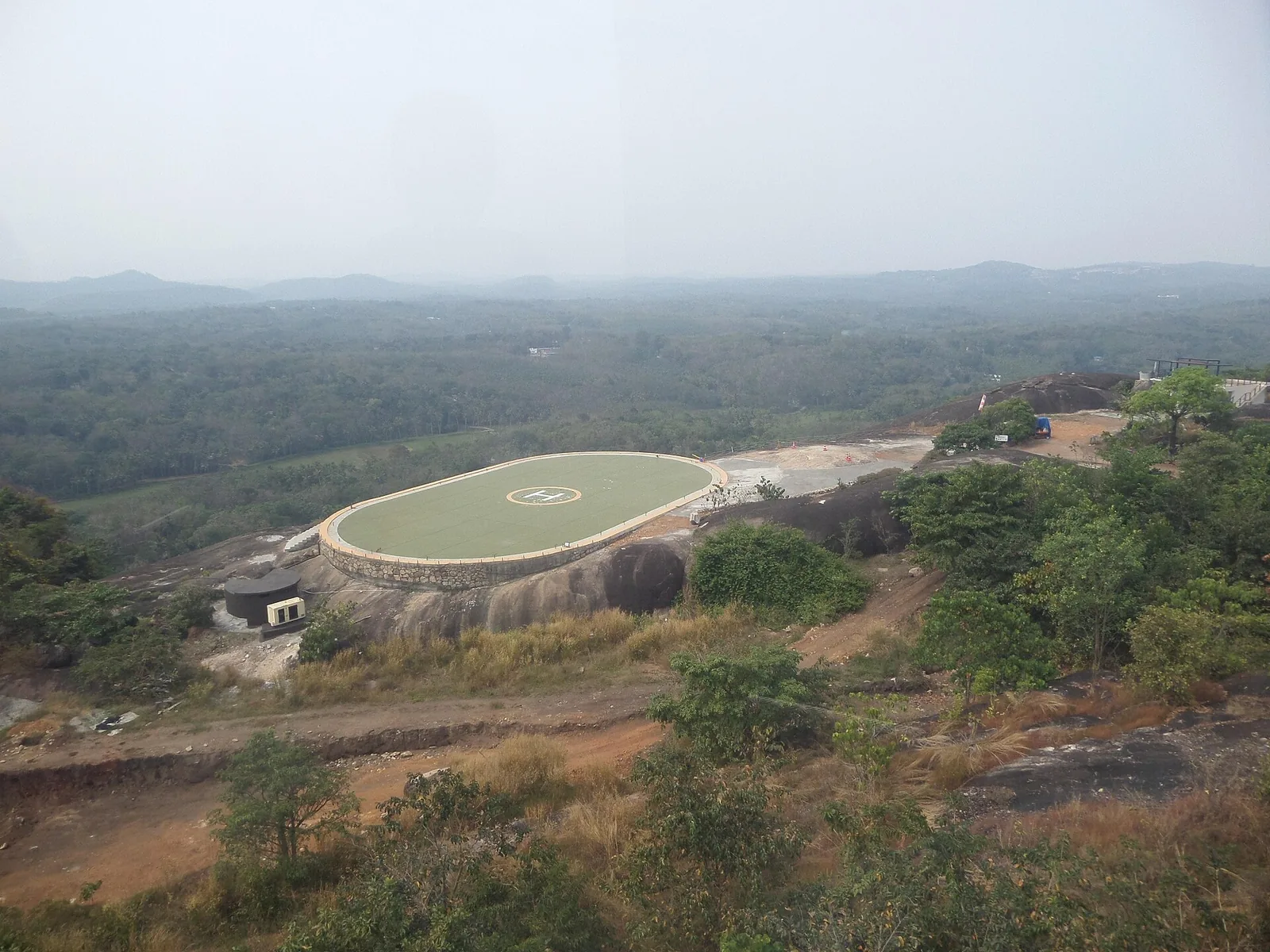
Four: you can fly
The park runs a helipad and a heli-taxi. There is a photograph of the pad on Wikimedia Commons, taken in August 2018.
It is easy to treat that as a curiosity, but it belongs in the sequence. This is a hill that had no approach at all thirty years ago and now has a gondola, a stone staircase, a temple stair and an aircraft landing site on it.
The bit that will save you money — or rather, won't
Almost every guide to this place, including ours until now, tells you that walking up is the cheaper option. It is not.
The operator's booking engine offers Cable Car, Walkway, and Walkway & Zipline as a choice of "mode of travel", all at the same ₹450 adult fare. It is a preference, not a price tier. The old claim that the cable car costs "about ₹300 return" traces back, on our page, to two web pages about Illikkal Kallu — a different mountain, 150 kilometres away, in Kottayam district.
The only genuinely free ascent of Jatayupara is the temple's, and it is tagged private. Choose your route for the experience: the gondola for the view and for anyone who cannot manage steps, the walkway for the sixty thousand stones under your feet.
Frequently asked questions
How many steps are there at Jatayu?
The park's walkway has 826 steps, built from around 60,000 chiselled stones, per the operator. The widely printed "1,000 steps" belongs to a different staircase — the Jatayu Kodanda Rama Temple's 1,008 steps on the eastern face of the same hill, which is marked private access.
Is the walkway cheaper than the cable car?
No. The operator charges one entry price and offers cable car, walkway, or walkway-plus-zipline as a free choice of route. The "about ₹300 return" cable-car fare that has circulated is unsupported — on this site it was sourced, in error, to pages about Illikkal Kallu in Kottayam district.
What is the cable car like?
A gondola described by the operator as Swiss-made, with cabins seating eight, running about 500 m horizontally from the base station to the top station on four pylons. It is billed as Kerala's only cable car of its kind.
Can you get to the top without climbing?
Yes — the cable car reaches the summit and avoids the steps entirely. The park also runs a helipad and heli-taxi.
How high is Jatayupara?
About 180 m above sea level, and about 125 m above the surrounding country. Published figures are much higher and disagree with each other — English Wikipedia and OpenStreetMap say 350 m, Malayalam Wikipedia says 1,200 ft, and the travel press says 1,000 ft. Four independent elevation models queried on 15 August 2026 give 184 m, 184 m, 170 m and 159 m at the summit against a town floor of 52–59 m. The sculptor's own "1000 ft rock" is in the same family of unmeasured numbers.