Most Kerala reservoirs you simply drive to. Kakkayam is different in a way that catches people out, and the difference is worth understanding before you set off rather than at a barrier: this is an operating power installation inside a notified wildlife sanctuary, and you enter it on someone else’s terms.
The road
From Kozhikode the route runs Balussery, then Estate Mukku, then Koorachundu — and the names are the history. Estate Mukku is plantation country; Koorachundu is one of the two revenue villages the sanctuary is notified over. The road climbs steadily out of the plains through the last of the plantation villages before the tar narrows.
Kerala Tourism prints about 66 kilometres from Kozhikode town; other sources give 62. Either way, do not plan on the driving time a distance like that suggests. The final section is single-track through plantation and forest, maintained for plant access rather than tourism, and two hours is a more honest allowance than one.
At Kakkayam Angadi there is a checkpoint. The dam site is a further fourteen kilometres beyond it — a figure two independent sources agree on exactly, which is more than can be said for most numbers attached to this place.
Two gates, two authorities, two tickets
This is the thing that confuses every published account of Kakkayam’s entry fee. There is not one ticket. There are two, sold by two organisations that do not coordinate.
KSEB controls the dam, the reservoir and the boating, and sells a dam-site ticket — commonly around ₹20 for Indian adults, ₹10 for children and ₹60 for foreign visitors. The Kerala Forest Department controls the sanctuary and the trekking programme, and sells its own ticket, commonly around ₹40, ₹20 and ₹60. That is why every guidebook quotes a range of ₹20 to ₹40 and none of them explains it: they have each seen one of the two counters.
Treat all of those figures as indicative and confirm at the counter. Prices have been revised, sources disagree, and the Forest Department’s online booking channel was not reachable when this page was researched.
Ten to five, and the gate means it
The dam site generally operates from about 10:00 to 17:00. The important part is not the opening time but the closing one. This is a forest road inside a sanctuary with elephants and gaur on it, ending at a power installation; there is no negotiating your way out after hours and no facility to stay.
Private vehicles reach a barrier near the dam and the last stretch is walked — about ten minutes. A Forest Department jeep is available, commonly around ₹250 for a seven-seat vehicle, but note that it covers a separate seven-kilometre forest route and is not the same thing as the short walk to Urakkuzhi. Blogs blur the two constantly.
What you actually see
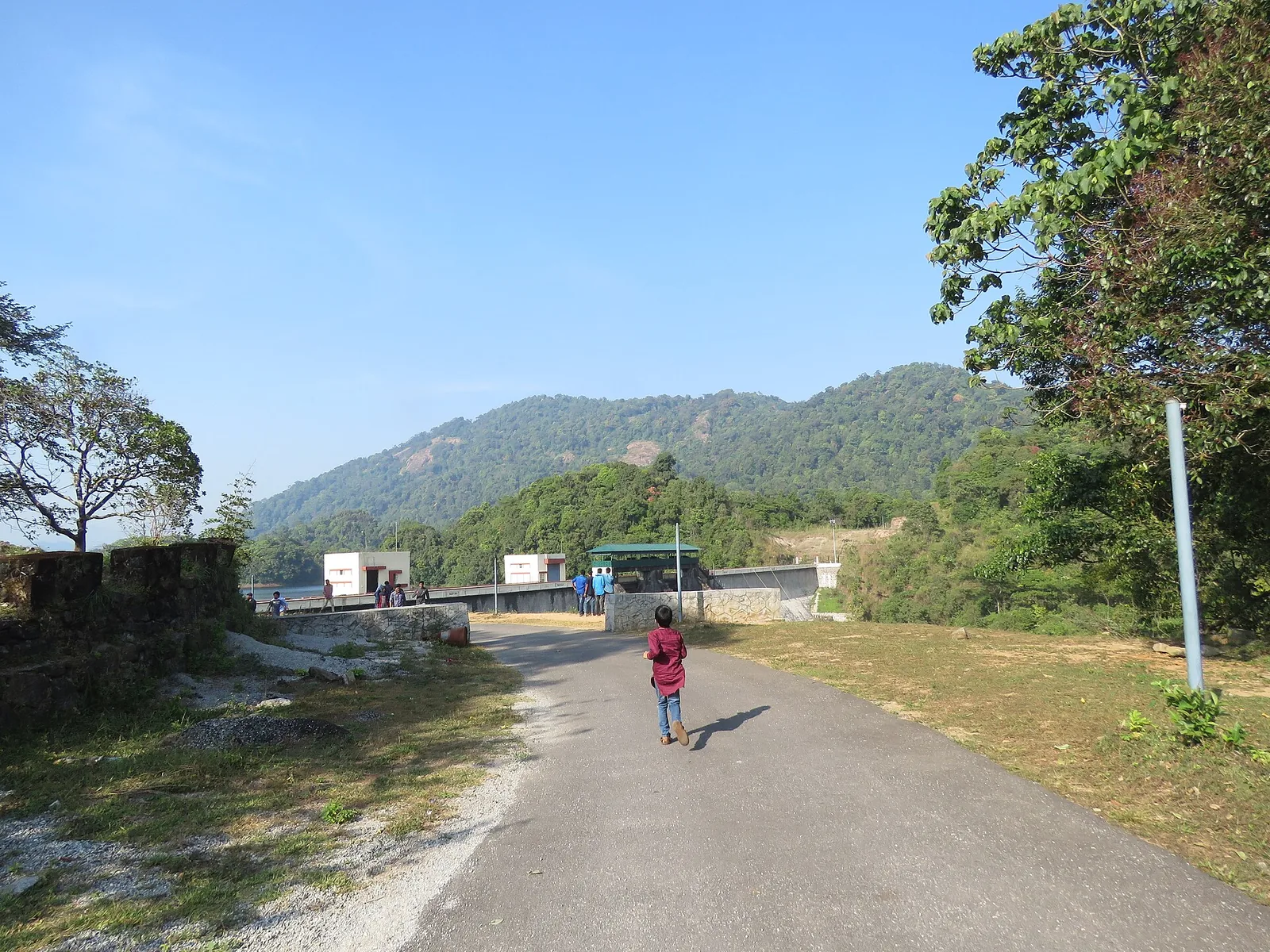
A long, dark masonry gravity wall, 228.60 metres along the crest, with a blue gantry crane riding above two radial gates. A plain concrete-and-white intake tower standing out of green water. A metalled road running the length of the top behind a low parapet, wide enough that families walk it and children run ahead. A green-roofed shelter over the gate gear.
And behind it, depending entirely on when you come, one of two different landscapes. The operating band runs from a full supply level of 758.05 metres down to a minimum draw-down of 737.62 — about twenty metres of vertical range across a year. Late in the dry season the reservoir shows a wide ring of bare red earth and its arms shrink back to a river. From July to October it is a full sheet of water with cloud pouring over the ridge. Photographs of Kakkayam taken in March and in September look like two different places, and both are accurate.
Around the dam
Urakkuzhi Falls is about 630 metres due south, on a road that maps name the Kakkayam Dam site–Urakkuzhi road. It is close, and the walk to it descends rather than climbs — but you arrive at the head of the falls and look down into them, not at them from below.
Kariyathumpara, which tourism copy often sells as a viewpoint you trek to from the dam, is in fact 3.4 kilometres south-west in a straight line and 16.6 by road, down at 57 metres where the river spreads over bedrock into the Peruvannamuzhi backwater. It is a ticketed bathing and picnic centre with a hamlet attached — church, primary school, telephone exchange. It is a separate drive, not a walk, and not a lookout.
Kakkayam village itself, near the powerhouse, is a small company town grown around a 1972 power station: a post office, a primary health centre, a police aid post and a KSEB generation office. There is no tourist infrastructure at the dam beyond the ticket counter — carry food and water.
Two cautions worth taking seriously
Leeches, in the marshy ground near Urakkuzhi during and after the monsoon. Carry salt or a lemon and make them let go rather than pulling them off.
And large animals, which are not a brochure promise here. In January 2024 a gaur entered the tourism centre and injured a visitor and her four-year-old daughter in the children’s park; in March a second gaur killed a local farmer. Both centres closed, and the trekking did not reopen until 11 May 2024, three and a half months later. Elephants cross regularly. Go with the guide, keep children close, and be off the trail well before dusk.
It adds up to a particular kind of visit — more managed than a beach, less packaged than a hill station. Every element of it, from the road surface to the closing hour, exists because of a machine hall 2.8 kilometres away and 658 metres below. You are a guest on an industrial estate that happens to be beautiful.
Frequently asked questions
What are the timings at Kakkayam Dam?
Generally about 10:00 to 17:00. The closing time is enforced — this is a forest road inside a wildlife sanctuary ending at a power installation, and there is no accommodation at the dam. Arrive with hours in hand rather than minutes.
How much does it cost to enter?
Expect two separate tickets. KSEB sells a dam-site ticket, commonly around ₹20 for Indian adults, ₹10 for children and ₹60 for foreign visitors; the Forest Department sells a separate sanctuary and trekking ticket, commonly around ₹40, ₹20 and ₹60. All figures are indicative — confirm at the counter.
Can I drive right up to the dam?
Almost. Private vehicles reach a barrier near the dam and the final stretch is about a ten-minute walk. A Forest Department jeep, around ₹250 for seven seats, is available but covers a separate 7 km forest route rather than the short walk to Urakkuzhi.
How far is Kakkayam Dam from Kozhikode?
About 60 to 70 km via Balussery, Estate Mukku and Koorachundu, with the dam site a further 14 km beyond the Kakkayam Angadi checkpoint. Allow around two hours rather than one — the last section is single-track.
When is the reservoir at its fullest?
Between roughly July and October. The reservoir operates between 758.05 m and 737.62 m, about twenty metres of range, so by late in the dry season it shows a wide ring of bare red earth and its arms shrink back towards a river channel.