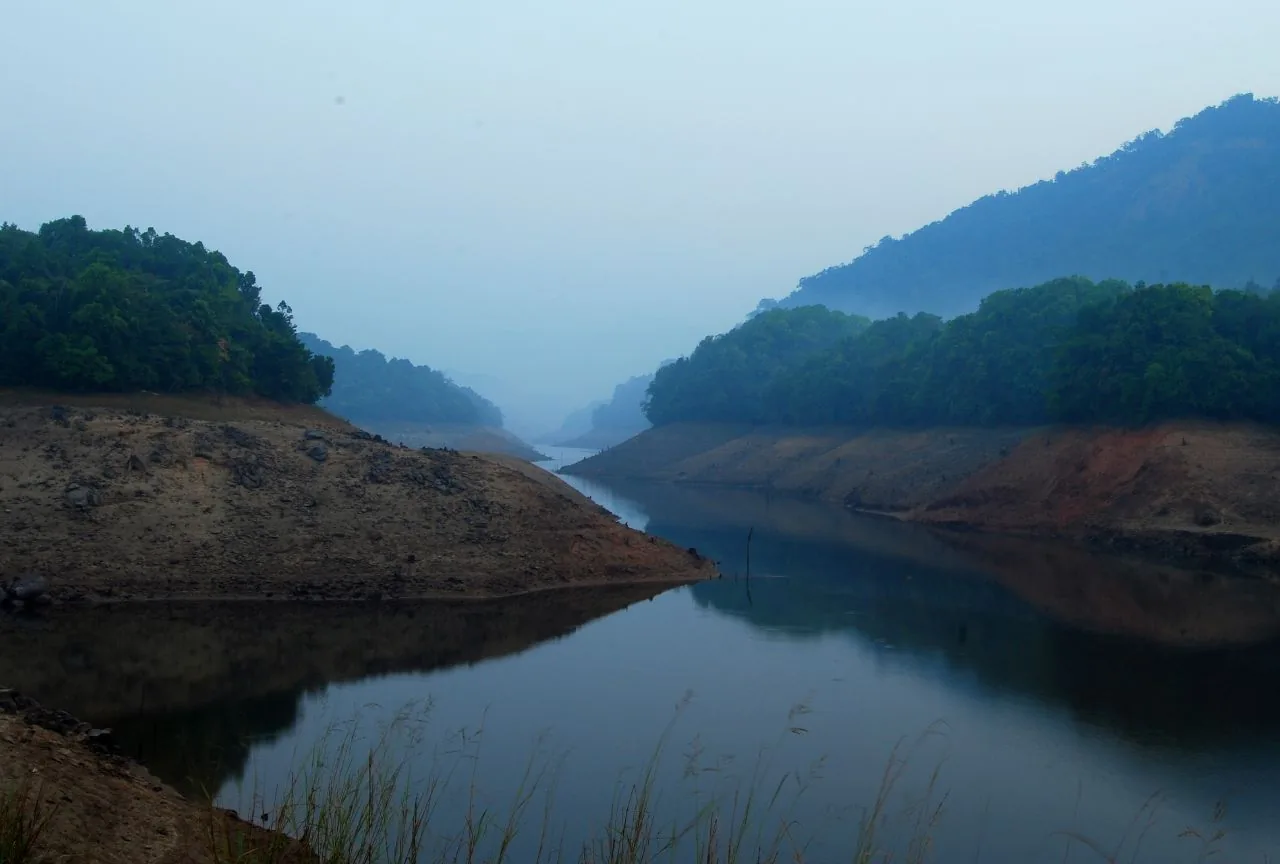
Almost every account of the Kakkayam camp places it vaguely — "deep in the forest", "a police camp in the hills". The vagueness matters, because the specific answer is the most striking fact in the whole story, and it is sitting in the memoir of the man who spent his life looking for it.
The camp was a building belonging to the Kerala State Electricity Board. A long shed, tin- or asbestos-roofed, put up to store electrical equipment for the Kuttiyadi hydro project, with a pond in front of it. T. V. Eachara Warrier, writing about the search for his son, describes it exactly that way: the asbestos-roofed building of the State Electricity Board, the shed on the hill by the pond.
The power station had been commissioned in September 1972. The camp operated in early 1976. Kerala’s most infamous site of custodial torture was, physically, a piece of this dam’s own infrastructure, less than four years old.
How it began
On 28 February 1976 a group attacked the Kayanna police station, injuring a head constable and three other officers and carrying off loaded firearms. The primary source disagrees on both the station and the date. K. Karunakaran’s second affidavit, quoted verbatim in the Supreme Court’s judgment in K. Karunakaran v. T. V. Eachara Warrier (16 November 1977), refers to “the attack by some persons on Kakkayam Police Station on 29-2-1976”. 1976 was a leap year, so that date exists. We give Kayanna and 28 February because that is what the general accounts say, but a signed affidavit in the law reports names a different station and a different day, and we are not going to pretend the point is settled. The police read it as a Naxalite action. The Emergency had been in force since June 1975; the ordinary constraints on investigation had been suspended along with a good deal else.
The investigation was handed to DIG Jayaram Padikkal, in charge of the northern range. He did not run it from a police station. He set up a camp deep inside the Kakkayam forest, roughly fifty kilometres from Kozhikode, and the reason given in accounts of the period is simply privacy and seclusion. A reservoir estate at the top of a controlled road, reached through a checkpost, with a Board shed available and no neighbours, answered that requirement precisely.
One day
On 1 March 1976, P. Rajan, a student at the Regional Engineering College, Calicut — now NIT Calicut — was taken into custody along with a fellow student, Joseph Chaaly, and brought to Kakkayam. He had no established connection to the Kayanna attack.
He died on 2 March 1976. One day after his arrest. The method was uruttal — the rolling of a heavy wooden log over a man’s body, applied by a group led by Sub-Inspector Pulikkodan Narayanan. It is a technique that destroys muscle tissue at scale and kills through the kidneys, and it leaves comparatively little to see on the surface.
Roughly two hundred people are estimated to have passed through the Kakkayam camp. Most had nothing to do with Kayanna.
Rajan’s body was never recovered. Two accounts have survived and they do not agree. One holds that it was weighted and put into the Kakkayam reservoir. The other holds that it was burnt and the ashes scattered at Urakkuzhi Falls. We record both because both are claims rather than findings — but note what they have in common. Every version of the disposal is set in the landscape a visitor now pays twenty rupees to walk into.
The father
Eachara Warrier was a retired professor. What he did next is the reason anyone knows any of this: he filed a habeas corpus petition asking the court to produce his son. The State’s position was that Rajan had never been in custody at all.
The High Court of Kerala delivered judgment on 13 April 1977, after the Emergency had been lifted. Its findings destroyed the State’s denial. A memo on Rajan’s whereabouts was filed on 19 April. On 25 April 1977 the Supreme Court rejected the appeal against the judgment.
The pursuit cost Warrier most of what he had. It also produced one of the foundational civil-liberties cases in independent India — the point at which a court established that the machinery of the Emergency had lied about a man it had killed.
One month as Chief Minister
K. Karunakaran had been Home Minister through the Emergency. He was sworn in as Chief Minister of Kerala on 25 March 1977. He resigned in late April 1977, around the day the Supreme Court closed off the appeal, over the court’s findings and the affidavit he had filed. The Supreme Court’s own judgment says “It appears that Shri Karunakaran resigned as Chief Minister after the judgment of the High Court in the habeas corpus petition on April 26, 1977”, and the sentence is ambiguous about which event 26 April attaches to. What is certain from that judgment is that the special leave petition was rejected on 25 April 1977. The former “exactly one month later, to the day” flourish has been dropped: it was doing work the evidence does not support.
One month is the detail worth carrying away, and it is frequently got wrong: several sources, including Wikipedia’s article on the case, date the resignation to 1978. It was 1977. Litigation connected to the case continued into the 1990s. Warrier’s memoir won the Kerala Sahitya Akademi award in 2004 and is available in English as Memories of a Father. The camp has since appeared in Malayalam cinema more than once.
What is there now
Nothing. There is no memorial at Kakkayam, no plaque, no marker of any kind. The dam has an interpretation of itself — a KSEB board listing its height, its storage and its installed capacity — and nothing at all about 1976.
That absence is worth noticing rather than complaining about. Kakkayam is an operating power installation inside a wildlife sanctuary, run by an engineering utility and a forest department, neither of which is in the business of commemoration. The reservoir is genuinely beautiful and the drive up is genuinely lovely, and both of those things remain true.
But if you walk the crest at Kakkayam you are walking through the estate that housed the camp, and the shed that held it was built to keep this dam’s spare parts dry. Knowing that costs nothing and changes the quality of the quiet.
Frequently asked questions
Where exactly was the Kakkayam camp?
In a Kerala State Electricity Board building at the Kakkayam dam site — a long tin- or asbestos-roofed shed originally built to store electrical equipment, with a pond in front of it. It is described that way both in contemporary accounts and in T. V. Eachara Warrier’s memoir.
When did P. Rajan die?
On 2 March 1976, one day after being taken into custody on 1 March. He was a student at the Regional Engineering College, Calicut, now NIT Calicut, and was detained in connection with the 28 February 1976 attack on the Kayanna police station.
Was Rajan’s body ever found?
No. Two accounts of the disposal circulate — that the body was weighted and put into the Kakkayam reservoir, or that it was burnt and the ashes scattered at Urakkuzhi Falls. Neither has been established, and they should be treated as competing claims.
Did the case bring down a Chief Minister?
K. Karunakaran, Home Minister during the Emergency, became Chief Minister on 25 March 1977 and resigned in late April 1977, following the Kerala High Court’s findings of 13 April 1977 and the rejection of the appeal on 25 April. Sources dating the resignation to 1978 are incorrect. The Supreme Court’s own judgment says “It appears that Shri Karunakaran resigned as Chief Minister after the judgment of the High Court in the habeas corpus petition on April 26, 1977”, and the sentence is ambiguous about which event 26 April attaches to. What is certain from that judgment is that the special leave petition was rejected on 25 April 1977. The former “exactly one month later, to the day” flourish has been dropped: it was doing work the evidence does not support.
Is there a memorial at the dam?
No. There is no memorial, plaque or marker at Kakkayam relating to the camp or the case.