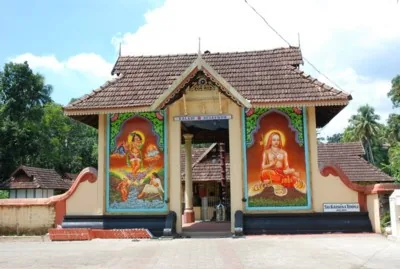
The Sree Krishna Temple at Kalady is small, and by the standards of Kerala’s great temples it is not old. What it is instead is specific: this is the shrine of Adi Shankara’s own family, standing at the point where the single most famous legend of his childhood is said to have taken place, in a village that had to be found again before any of it could be marked.
The legend that names the village
The story goes like this. Shankara’s father Sivaguru died young, leaving Aryamba a widow with a small son. The family’s daily bath was in the Purna — the river now called the Periyar — and the walk to the ghat was long. One day, on that walk, Aryamba fainted.
The boy prayed to Krishna, the family deity, for his mother. And the river, in the telling, moved. It changed its course to run past the house, so that Aryamba would never again have to make the walk. Krishna is said to have granted that the river would flow where the child’s feet marked the ground — and kaladi, in Malayalam and Tamil, means footprint. The village is named after the marks a boy is supposed to have left while asking a god to move a river for his mother.
You should hold that as devotional tradition rather than as history, and it is much better that way. It is also, structurally, a strikingly domestic miracle. Most founding legends involve kingdoms and armies. This one is about a tired woman and a long walk.
The temple you are actually standing in
The shrine sits west of the Sringeri Math birthplace complex, on the river side of the village. It is an active temple, plainly built, with the ordinary rhythm of Kerala temple worship rather than the scale of a pilgrimage centre — most of Kalady’s visitor traffic is next door at the memorial complex, which means this, the family shrine, is often the quietest place in the village.
- An active Hindu temple: entry to the inner areas is generally restricted to Hindus, as across Kerala.
- Modest, traditional dress; footwear removed before entering.
- Photography inside is not welcome. Treat it as a place of worship, not a monument.
- Twenty minutes here, and it pairs with the Keerthi Sthambha Mandapam and the ghat next door.
- No entry fee. Poojas and offerings are paid for at the temple counter.
Why 1910 matters
Here is the part that surprises people. Kalady’s identification as Adi Shankara’s birthplace is not an unbroken tradition running back twelve hundred years. The site was effectively lost, and was re-identified only in the late nineteenth century, largely through the efforts of the Sringeri Math. The temple complex marking the birthplace was consecrated in 1910.
So the buildings are young even though the ground is claimed to be ancient. That is not a scandal — it is how a great many pilgrimage sites work, and being open about it is more interesting than pretending otherwise. It does mean that when you stand here you are standing in an early-twentieth-century act of commemoration built on top of a nineteenth-century identification of an eighth-century event, and each of those layers is worth seeing separately.
What to see nearby, in the right order
Do the village as a sequence rather than a list. Start at this temple, the family shrine. Walk to the ghat on the Periyar where Aryamba was cremated and where the crocodile legend is set. Then take the Keerthi Sthambha Mandapam, the eight-storey memorial tower, which tells the philosophical story in murals. The Karthyayani Devi temple at Manickamangalam, where Shankara’s father is remembered as having served, is a short drive north.
Done that way, Kalady stops being a set of monuments and becomes what it is: a small river village where a family lived, and from which one of them left and changed Indian philosophy.
Frequently asked questions
What is the Sree Krishna Temple at Kalady?
Adi Shankara’s family temple, west of the Sringeri Math birthplace complex on the Periyar. Krishna was the family deity, and the shrine sits at the centre of the legend that gave the village its name.
Why is the village called Kalady?
Kaladi means footprint in Malayalam and Tamil. Tradition holds that when Shankara’s widowed mother Aryamba fainted on the long walk to the river, the boy prayed to Krishna, who granted that the river would flow where the child’s feet marked the ground — so the Purna changed course to run past their house.
How old is the temple complex at Kalady?
Younger than most visitors assume. The identification of Kalady as Shankara’s birthplace was effectively lost and re-established only in the late nineteenth century, largely through the Sringeri Math, and the birthplace temple complex was consecrated in 1910.
Can non-Hindus enter the Sree Krishna Temple?
As at most active Hindu temples in Kerala, entry to the inner areas is generally restricted to Hindus. The village, the ghat and the Keerthi Sthambha Mandapam nearby are open to everyone. Follow what staff tell you on the day.
Is there an entry fee?
No. It is an active Hindu temple with no ticket. Specific poojas and offerings are paid for at the temple counter.
How long do I need at Kalady?
Half a day covers it properly: the Sree Krishna temple, the cremation ghat on the Periyar, the eight-storey Keerthi Sthambha Mandapam and the Karthyayani Devi temple at Manickamangalam a short drive north. Two hours if you are only doing the main complex.