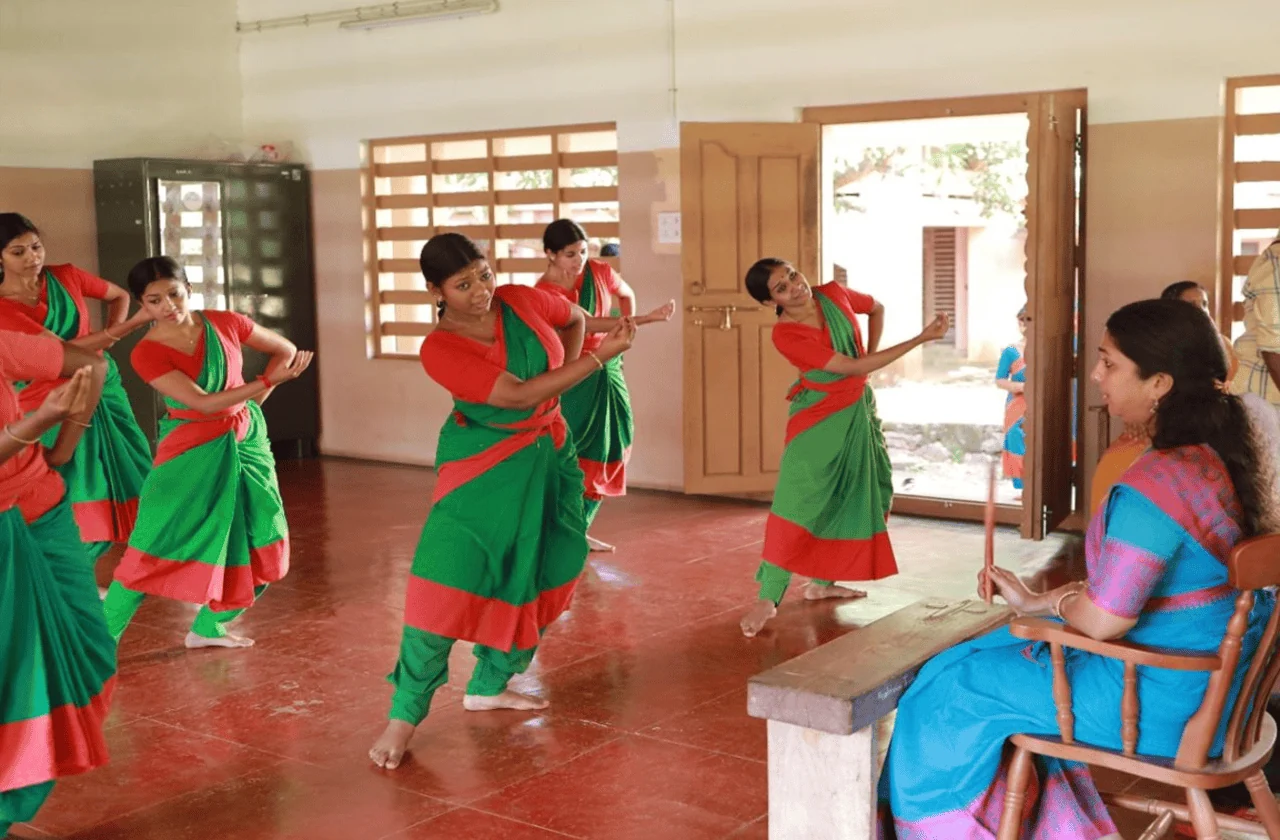
Students in green and red practise together while a seated teacher watches from the side. The institution’s photograph shows an ordinary relationship at the heart of Kerala Kalamandalam: learners repeating and refining movement under close attention. A visitor to a kalari enters that relationship briefly. The class does not become a performance staged on demand for the visitor.
Watch repetition as part of the art
A training passage may repeat several times with a small correction between attempts. To an unfamiliar observer, that can seem less immediately dramatic than a fully costumed stage scene. Yet it reveals how precision is built: through attention to position, timing and the coordination of the body.
Allow the teacher and students to continue without asking them to pause or pose. A useful question can be saved for the guide outside the active teaching moment. This keeps curiosity connected with the work rather than making the class serve a photographic schedule.
Notice how the group occupies the space. The relation between teacher, individual student and other learners can tell you as much about the training as a close view of one gesture. A wider, permitted observation is often more informative than moving closer to a face or pair of hands.
The kalari has its own boundaries
Kalamandalam’s visitor instructions include removing footwear before entering the kalaris and maintaining quiet during teaching. Follow the institution’s photography directions as well; being admitted to a class area is not automatic permission for every type of recording.
Keep bags and personal belongings out of the movement space. If the guide asks the group to stand in one place, that location is part of the arrangement allowing observation alongside normal work. Do not spread out because another angle appears visually stronger.
The campus contains different teaching activities, and a visit should not assume every art form will be in session simultaneously. The timetable, academic calendar and the actual day determine what is available. A short encounter with a working class can be substantial without promising a complete survey of Kerala performance traditions.
Plan around an institution, not a show reel
The Day with the Masters programme has a defined working-day schedule, with advance arrangements and a group structure. Academic breaks matter. A campus that is architecturally open may not offer the same teaching observation during a vacation period.
Choose the visit because learning itself is interesting. Watching a correction, listening to the guide explain a training discipline and recognising the purpose of repetition can change how a later stage performance is understood.
Read the institution’s Kalari Visit and guided-tour information together. The first explains the encounter with teaching; the second helps place it within the organised visit. Respectful observation gives both students and visitors room to get something worthwhile from the shared space.
Plan the visit: Kerala Kalamandalam.