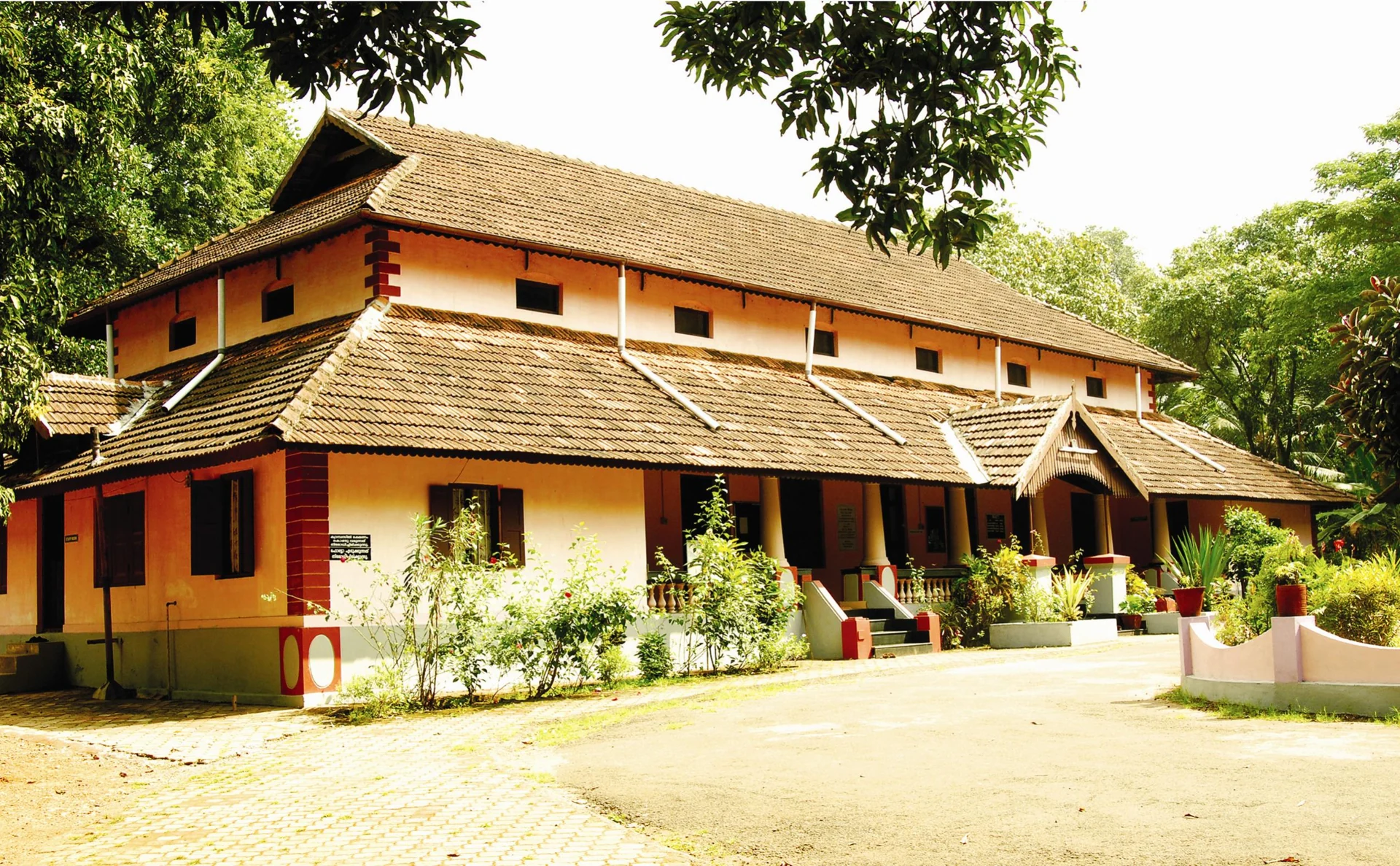
The older Nila-campus building has ochre walls, tiled roofs and a central entrance reached by steps. Its restrained exterior is a different scene from a costumed ensemble or a busy teaching pavilion. It belongs to the history of an institution that moved through several locations before establishing its enduring relationship with Cheruthuruthy.
The institution began before this building became its home
Kalamandalam’s own history places its foundation in 1930, through the work of Vallathol Narayana Menon and Mukunda Raja, with support from the Kakkad family. It first operated at Kunnamkulam and then Ambalapuram before moving to Cheruthuruthy in 1936.
That sequence matters when reading the campus. The institution’s founding date is not automatically the construction date of every building a visitor sees. A place can become important through what happened after an organisation arrived there, rather than by being its very first address.
At Cheruthuruthy, the Nila—or Bharathapuzha—provides a strong geographical reference. The older riverside setting and the later main campus are related parts of Kalamandalam’s story, but they are separate destinations within a visit. Keep their names distinct when organising transport.
The house museum is another kind of evidence
Vallathol’s former home, now a memorial museum, offers a different encounter with the founder. The institution describes manuscripts, personal possessions and other material associated with his life. These objects connect the public name of a cultural institution with the working life of a poet.
The museum’s history also has its own dates. Kalamandalam’s account describes the house he rented from 1935, its purchase for the memorial project in 1985 and the formal opening in April 1988. None of those dates should be substituted for the foundation of Kalamandalam itself.
Allow the guide to identify particular exhibits rather than treating every handwritten page as a famous poem or every costume as the founder’s possession. An object becomes more interesting when its actual role is understood, even if that role is modest.
Keep the sites connected in the itinerary
The guided visit describes an onward journey to the older campus, with visitors responsible for their own vehicle. That practical detail prevents the institutional history from becoming a transport misunderstanding: seeing one campus does not mean the other lies a few steps beyond the next pavilion.
Build enough time into the visit for that change of location. The main campus explains the continuing work of training; the older campus and museum add historical context. Together they show an institution that has developed through places and people while continuing to teach.
Read the institution’s history, Nila-campus account and Vallathol Museum description. Keep each site’s identity attached to its own part of the story.
Plan the visit: Kerala Kalamandalam.