The town gives the shore its context
Kerala Tourism describes Kanhangad as a commercial centre between Kannur and Mangalore. Its account also names several nearby cultural destinations, including Hosdurg Fort, Nithyananda Ashram and Anandashram. This makes a Kanhangad beach visit part of a town journey rather than an isolated resort excursion.
The practical advantage is straightforward: transport, meals and accommodation can be arranged around the town while the shore remains a distinct part of the day. A visitor need not assume that everything required for the outing exists directly on the sand.
Choose a second stop for a reason
Hosdurg Fort offers a look at surviving Nayaka-associated masonry, particularly its rounded bastion and ramp. The ashrams have their own spiritual histories and visitor arrangements. Choose among them according to the purpose of the trip rather than treating a list of names as an obligation to enter every place.
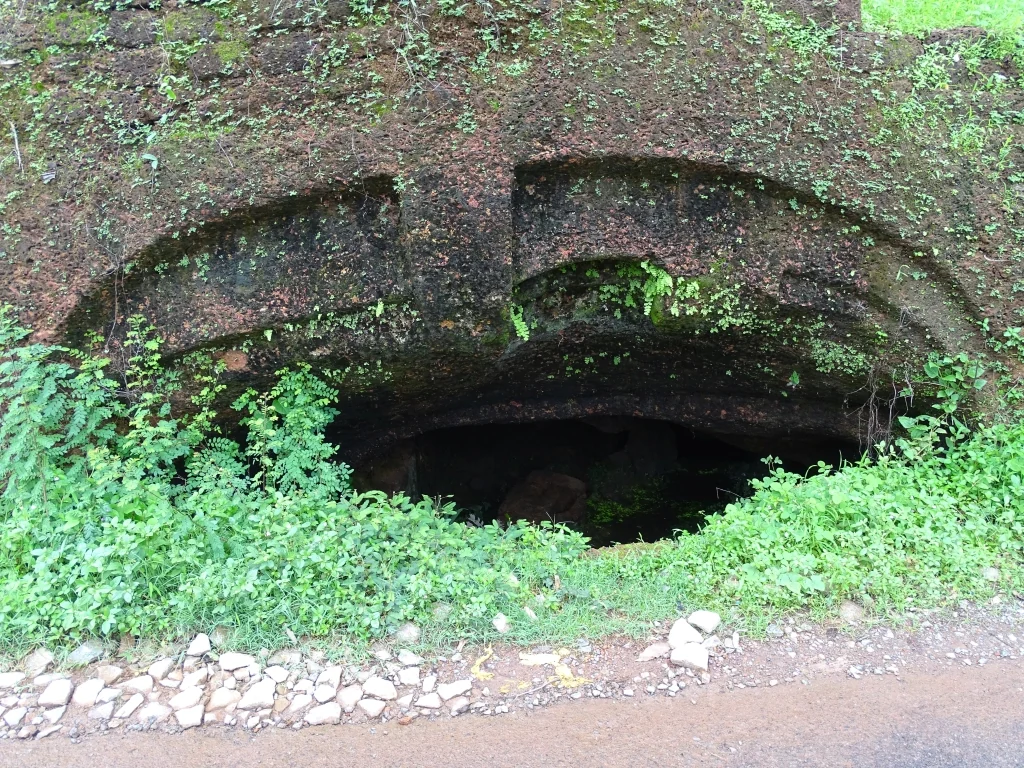
The photograph with this story comes from Kerala Tourism’s Kanhangad cave-fort entry. It shows a small opening in a laterite bank with ferns above. It is a town-context photograph, not a sea cave on Kanhangad Beach or evidence of a public tunnel route.
Keep that distinction when moving between the shore and the town. A fort, an ashram and a beach require different arrival instructions and different ways of using the space.
Kanhangad has a broader cultural geography
The state tourism account notes the town’s Malayalam, Tulu, Konkani and Kannada connections. These languages place Kanhangad within the cultural transition of northern Kerala and the neighbouring coast. They are part of the town’s setting, not a promise that every service encounter will take place in all four languages.
The same account follows the Arayi River through Kanhangad towards the Neeleshwar River. That river geography adds another landscape connection beyond the Arabian Sea frontage. A river outing, however, needs its own named access and cannot be inferred from the beach route.
Keep the day geographically clear
Arrange the town stop and the beach stop separately, with a clear meeting point for each. If the shore visit is planned towards evening, complete any timed institutional visit according to its own opening arrangements. Avoid assuming that a shrine or ashram follows the hours of an open beach.
A modest itinerary can therefore carry several distinct meanings: the town as a transport and commercial hub, a fort or spiritual institution as a cultural visit, and the beach as time with the coast. The connections make the day richer without merging the identities of the places.
Kanhangad’s shore is easier to appreciate when the town remains in view conceptually, even when it disappears behind the palms. The beach belongs to a lived-in locality with a history and daily life extending inland.
Sources: Kerala Tourism: Kanhangad Beach and Kanhangad town. Kerala Tourism: Kanhangad cave-fort image.
Plan the visit: Kanhangad Beach.