The beach belongs to a working coast
Kanhangad’s shoreline is part of a coastal landscape used for fishing as well as recreation. The state coastal-tourism study identifies the Hosdurg stretch as a fish-landing area, with a broad sandy shore and casuarina planting. Its accompanying photograph shows boats resting on the sand.
That account gives the beach a local livelihood context. A visitor may come for a walk and the sea horizon, while another person uses the same shore as part of a working day. The two uses call for attention to space and movement.
Local names are worth retaining
The Kerala Fisheries Handbook 2020 lists Hosdurg and Poonjakadappuram among fishing villages associated with Kanhangad. It records Ajanoor separately. These administrative names help explain why the wider coast should not be flattened into one interchangeable beach destination.
The Kanhangad Beach marker on this page identifies the visitor stop used in Kerala Tourism’s e-book. A description of the wider Hosdurg fishing coast adds context; it does not assert that every fish landing or every boat in the municipality is located at that exact marker.
When asking for directions or describing a visit, keep the name of the actual shore or settlement. This is particularly useful if an outing continues along the coast towards a neighbouring beach with a different road approach.
Leave room for the work taking place
Where boats or gear are present, keep clear of the route between them and the water. Do not sit on a boat, step across laid-out equipment or arrange a photograph that interrupts people moving a craft. Ask before taking a close portrait of someone at work.
A fishing-coast visit does not require a staged demonstration. Watching from a respectful distance can reveal the relationship between the sand, the stored gear and the sea without turning ordinary work into a performance for visitors.
The same care applies when the shore appears quiet. Equipment can remain in use even when no one stands beside it, and an apparently empty stretch may be needed for movement later in the day.
The horizon is only one layer
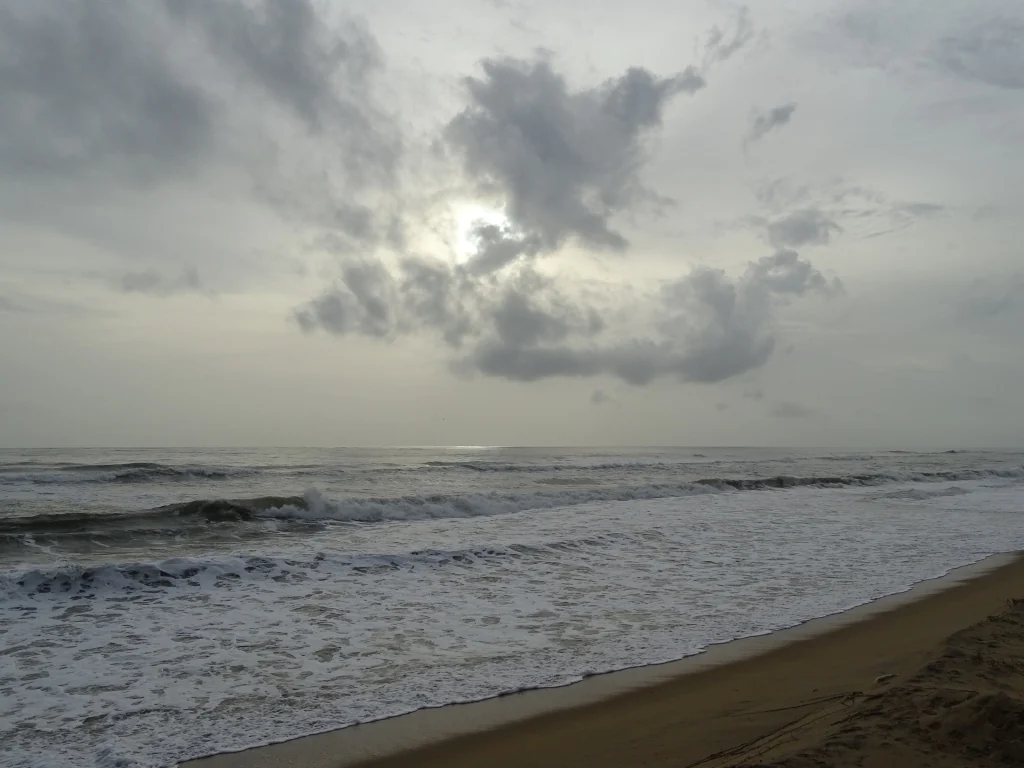
The story photograph shows the open shore under cloud, with the waterline providing a long horizontal edge. The coastal study’s boat photograph offers another scale: the sand as a place where craft and equipment rest. Together, these views describe a beach used in more than one way.
Keep that wider understanding with the walk. Kanhangad’s appeal includes the sea and open sand, but its coastal identity also belongs to named settlements and the people whose working lives connect land and water.
Sources: Kerala Tourism: Kanhangad Beach and Kanhangad town. Kerala coastal-tourism study, Hosdurg, page 127 and Kerala Fisheries Handbook 2020, fishing-village register.
Plan the visit: Kanhangad Beach.