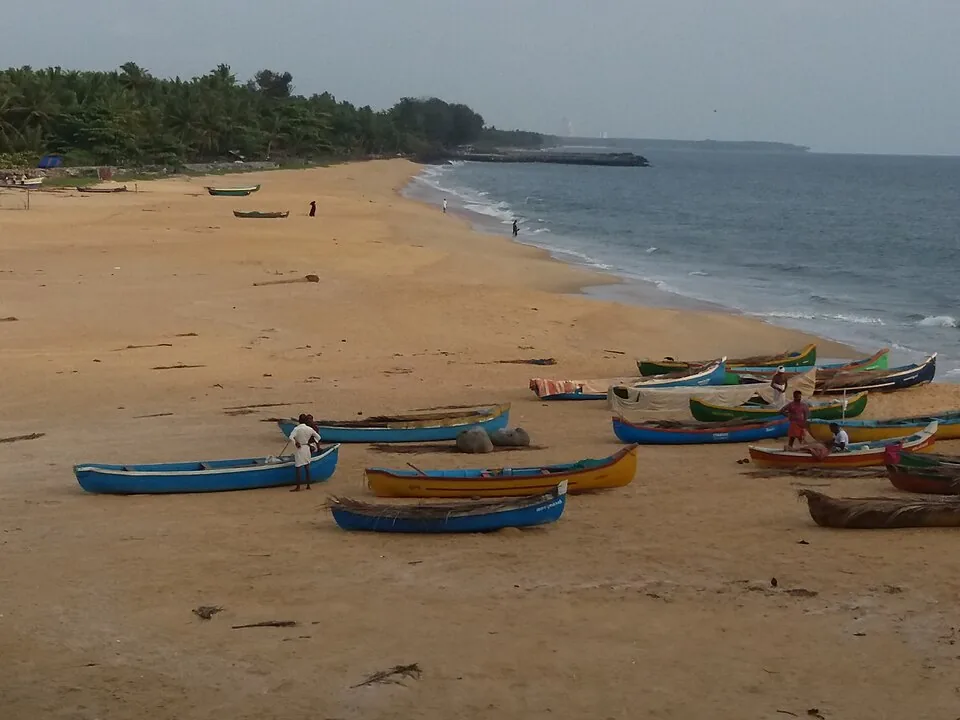
The history at Kappad gets all the words, and the beach itself is treated as scenery. But the thing a visitor actually walks on in 2026 is a substantially engineered object, most of it less than a decade old, and the numbers behind it are more concrete than anything in the Vasco da Gama file.
Two projects, and the small one gets the credit
Published accounts usually mention a beautification programme in the 2000s and leave it there. That was real: a ₹1.5 crore scheme launched in 2007, delivering a corniche, a park, restrooms and a restaurant. The promenade lamp standards photographed on Commons in 2011 are from that era.
The far bigger investment came in 2019 and 2020, for the Blue Flag build: ₹6 crore from the Union government and ₹1 crore from the Kerala government, ₹7 crore in all — nearly five times the earlier scheme. It bought walking paths and a jogging track, clean toilets and changing rooms, showers, seating, and fully disability-accessible restrooms.
What Blue Flag actually is
It is not a government of India label. The certification is issued by the Foundation for Environmental Education, based in Denmark, and assessed against thirty-three criteria grouped under four headings: environmental education and information; bathing water quality; environmental management; and conservation and safety services. The jury is international, drawn from UNEP, UNWTO, FEE and IUCN.
Two of those criteria matter directly to anyone getting in the water: lifeguard cover and a designated bathing zone are requirements, not extras. Neighbouring Chal in Kannur states a 300-metre monitored zone; no equivalent published figure for Kappad’s zone width could be found, so ask on the day rather than assuming.
The dates
Kappad was named on 11 October 2020 as one of India’s first eight Blue Flag beaches, alongside Shivrajpur, Ghoghla, Kasarkod, Padubidri, Rushikonda, Golden and Radhanagar. On Sunday 29 December 2020 it became the first of the eight to physically hoist the flag. The Transport Minister, A. K. Saseendran, marked the occasion by saying the certification meant they had succeeded in developing the beach as a global tourist spot.
There was a run-up. In September 2020 an eco-labelling campaign ran under the slogan “I am saving my beach”, with the Koyilandy MLA K. Dasan raising a Saving My Beach flag on the eve of International Coastal Cleanup Day.
The most useful fact about the certification is that it expires. Blue Flag is re-assessed annually, which means Kerala Tourism still listing Kappad as certified in its February 2025 newsletter is not a historical note — it is evidence that the standard has been held for four consecutive assessments. For most of that period Kappad was Kerala’s only Blue Flag beach, until Chal joined it.
Who runs it
At handover the beach was operated by a team of around forty staff employed by the infrastructure contractor, with revenue drawn from ticketing, jogging-track fees, a cafeteria and parking. That is worth knowing because it changes what the place is. A Blue Flag beach is a managed facility with an operating budget, not simply a shore that happens to be clean, and the cleanliness is a cost somebody is meeting.
It also raises a fair question that the promotional material does not: what a ticketed, managed beach means for the fishing hamlet that used the same sand for free, and what it gives back to them. Fishing canoes are still drawn up on the strand in recent photographs, so the two uses evidently coexist — but the arrangement is worth noticing rather than assuming.
What holds it up
Underneath all of it is coastal engineering. Four breakwaters run out from the southern half of the beach, spaced roughly 180 to 200 metres apart. Their job is to trap sand moving along the shore, and they are the reason there is still a strand wide enough to walk, jog and certify. Kerala’s draft coastal zone management plan for Kozhikode describes sea cliffs and rocky beaches near Quilandi, Elathur and Kappad — this is not a naturally generous coast.
And the rock that makes the groynes necessary is the same rock the Portuguese complained about in 1498, when their pilot told them the anchorage here was bad, with a stony bottom. Five centuries apart, two very different projects have run into the identical piece of geology.
The other residents
Olive Ridley turtles nest at Kappad, with protected nesting zones and organised clean-ups — one of the things a Blue Flag conservation criterion is for. The northern tideline draws migratory shorebirds, and in November 2024 a Great Knot, a Near Threatened long-distance migrant that breeds in north-eastern Siberia, was photographed here. If you are on the beach at first light with binoculars, the northern stretch is where to be.
Frequently asked questions
What does Blue Flag certification mean for visitors?
Bathing-water quality is monitored, lifeguard cover and a designated swimming zone are required, and facilities including toilets, changing rooms and accessible restrooms must be provided and maintained. It is assessed against 33 criteria by the Foundation for Environmental Education in Denmark, and it is re-assessed every year.
When did Kappad get Blue Flag status?
It was named on 11 October 2020 as one of India’s first eight Blue Flag beaches, and hoisted the flag on Sunday 29 December 2020 — the first of the eight to do so. It was still certified as of Kerala Tourism’s February 2025 newsletter.
Is there an entry fee?
The beach was handed over on an operating model funded by ticketing, jogging-track fees, a cafeteria and parking, run by a team of around forty staff. Charges change; confirm on the day.
Why are there stone breakwaters along the beach?
Four groynes, spaced roughly 180 to 200 metres apart along the southern half, trap sand moving along the shore. Without them this stretch would erode — an earlier East India Company monument here was washed away by the sea.