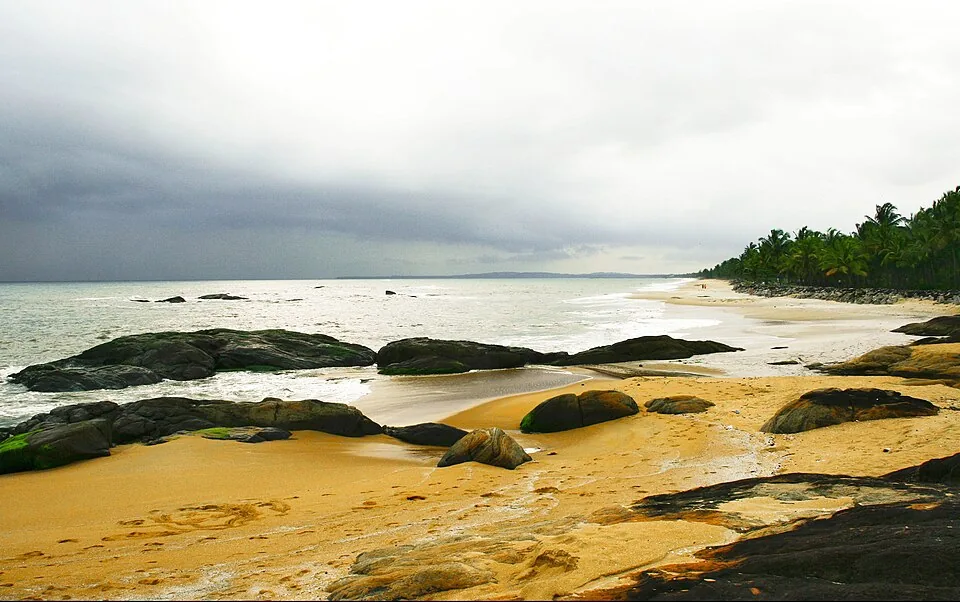
On 20 May 1498 three small Portuguese ships anchored off a stretch of the Malabar coast the locals called Kappakadavu — Kappad. They lay about two leagues out, some eleven kilometres of open water, and their captain, Vasco da Gama, stayed aboard for eight days. He was the first European to reach India by sea, and with that arrival the long-sought ocean route between Europe and the spice ports of the East was finally open. The going ashore, when it came, happened five kilometres up the coast; that part of the story is told on the Kappad Beach page.
The captain and the Zamorin
The ruler of Calicut was the Zamorin — the samoothiri, a title traditionally read as “lord of the sea” though modern scholarship derives it instead from svami and sri, giving “emperor” — whose port was then one of the richest spice markets on earth, its wealth built on pepper and cardamom and centuries of trade with the Arab world. Da Gama was received by the Zamorin, but the meeting was uneasy: the gifts the Portuguese offered were thought poor for so great a king, and the established Arab merchants of the port had no wish to see European rivals arrive. Da Gama sailed home with a cargo of spices that repaid his voyage many times over — and with the knowledge of how to return.
What the landing set in motion
Return the Portuguese did. When da Gama came back in 1502 with a war fleet, the earlier wariness had hardened into open conflict, and Calicut was bombarded. The century that followed brought forts, fleets and battles up and down the Malabar coast as European powers fought to control the spice trade the Zamorins had long commanded. A quiet beach had become the hinge of a new age — for better and for worse.
Kappad today
Kappad remains a calm, rocky-and-sandy beach about 16 km north of Kozhikode, and a simple stone pillar marks the arrival, its plaque reading “Vasco da Gama landed here, Kappakadavu, in the year 1498.” It is worth knowing what that pillar is: the Madras Government put it up in 1939, 441 years after the event, replacing an earlier East India Company marker the sea had taken, and the Kerala Department of Archaeology notified it as a protected monument in 1975. The historians who place the actual first footfall five kilometres up the coast at Panthalayini Kollam have the Portuguese chronicles on their side. Kappad is where the ships were, and it is a modest place for so large a turn in history.
- The Vasco da Gama monument is a small stone marker on the beach — the history is bigger than the memorial.
- Kappad is a clean, quiet beach and an Olive Ridley turtle-nesting coast; keep clear of nests and avoid bright lights after dark in season.
- It is about 16 km north of Kozhikode near Koyilandy; food and facilities are limited, so plan ahead.
Frequently asked questions
When and where did Vasco da Gama land in India?
His fleet made its landfall off Kappad (Kappakadavu), about 16 km north of Kozhikode, on 20 May 1498 — the first European to reach India by sea. He himself went ashore on 28 May, by which time the ships had moved about five kilometres north to Panthalayini Kollam, the pilot having told them the anchorage at Kappad was bad, with a stony bottom.
Who received Vasco da Gama at Calicut?
He was received by the Zamorin (samoothiri), the ruler of Calicut, whose port was one of the world’s great spice markets. The meeting was uneasy, and the established Arab merchants opposed the newcomers.
Is Kappad definitely where he landed?
It is where the fleet anchored, and it is the officially commemorated site. It is almost certainly not where da Gama stepped ashore: the fleet’s own journal records that the ships were moved north to Panthalayini Kollam because the anchorage at Kappad was bad, with a stony bottom, and da Gama went ashore there on 28 May 1498. M. G. S. Narayanan (1932–2025), P. T. Parthasarathi and the Portuguese chronicles all agree on this.