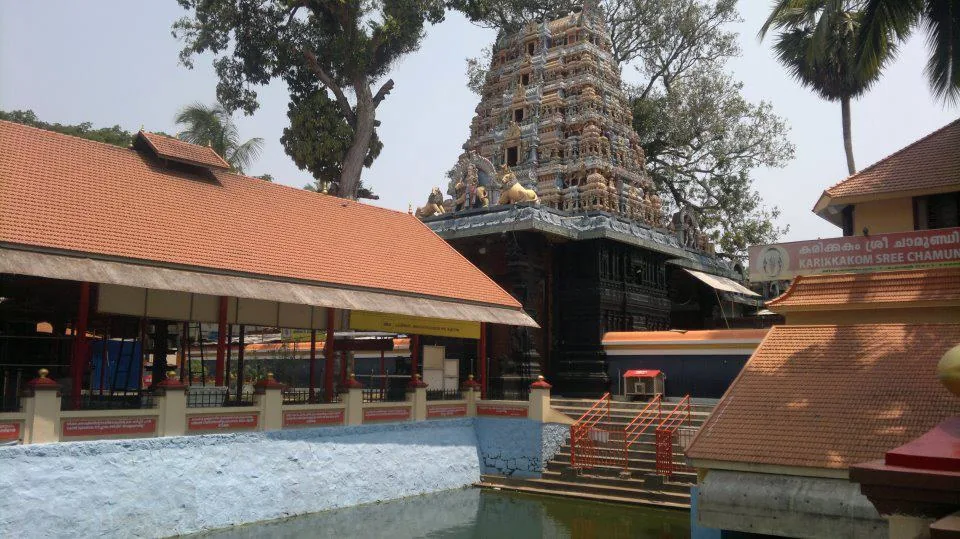
Every legal system runs into the same wall eventually: a case where the facts cannot be established and somebody still has to decide. Travancore had an answer to that, and it was a Devi temple on the western edge of its capital. At the Karikkakom Chamundi Temple, a person accused of an offence could be brought before Raktha Chamundi — the fierce form of the goddess — and required to declare their innocence to her face. The state did not have to prove anything. It only had to find out whether the accused was willing to stand there and lie.
Twenty-one coins at the nada
The procedure had a shape, and the details are consistent across the accounts that survive. The accused was brought to the shrine and deposited twenty-one panam — coins — at the nada, the shrine front, as part of taking the oath. Then they proclaimed their innocence before Raktha Chamundi. The understanding attached to the rite was straightforward and, in its way, symmetrical: the goddess would protect the one who told the truth, and punish the one who did not. There was no appeal built into it and no interval specified. What made it work was not any expectation of a visible verdict on the day, but the fact that in this city, before this deity, essentially nobody was prepared to take the chance.
Why this goddess, and not another
It matters that the oath was sworn before Raktha Chamundi specifically, and not before the calm central form of the goddess or at any of the many other shrines available in the capital. Chamundi is a fierce aspect of the Devi to begin with; Raktha Chamundi is the fiercest register of the three worshipped at Karikkakom. The temple’s standing has always rested on a reputation for potency rather than for gentleness — this is a shrine people bring problems to, not one they visit for calm — and a judicial ordeal needs exactly that. An oath is only as good as the fear behind it. Some descriptions of the compound add a further wrinkle: that Raktha Chamundi is present as wall painting rather than as an installed idol. If that is right, then what generations of accused men and women declined to lie in front of was an image on a wall, which says something about how little the physical form mattered next to the reputation.
A shrine inside the machinery of the state
It is worth resisting the temptation to file this under folklore. This is not a legend about a temple that was once used for justice; it is a documented practice of the Travancore administration, running under the Maharajas, with a procedure and a fee. For as long as it lasted, Karikkakom was not merely a religious site that the state respected — it was an instrument the state used, in the same practical sense as a court registry or a jail. The temple is still described locally as a seat of satyam, dharmam and neethi: truth, duty and justice. That is not a decorative epithet. It is a description of a former function.
What it left behind
The ordeal is long gone, but its residue is visible in who walks through the gate. A shrine with a centuries-old reputation as the place where the truth is compelled remains a natural destination for anyone carrying a dispute, an accusation, a matter they want settled — and that is a real and observable share of the traffic at Karikkakom today, alongside people bringing illness and family trouble. The temple is busy in a purposeful, transactional way that a visitor used to quieter shrines will notice immediately. People are here to get something resolved.
Standing there now
None of this is signposted, which is rather the point of writing it down. You arrive at a busy working temple behind a tall sculpted rajagopuram, on the western side of Thiruvananthapuram about seven kilometres out from East Fort, and unless you know the history you will read the fierceness of the deity as ordinary iconography. Knowing it changes the compound. The forecourt where you leave your shoes is where the accused waited. The shrine front where offerings are made is where the coins went down. It costs nothing to visit, it takes half an hour, and it is one of the few places in Kerala where you can stand inside a piece of pre-modern legal procedure that is still, in every other respect, in daily use. Timings, dress rules and access notes are on the Karikkakom Chamundi Temple page.
- This is an active Hindu temple, not a monument. Many Kerala temples restrict entry to Hindus — check at the gate rather than assuming.
- Dress conservatively, with legs covered; men are often expected to remove their shirt in the inner areas.
- Photography inside is generally not permitted.
- The temple is busiest during its seven-day festival in Meenam (around March), which culminates in its own Pongala.
Frequently asked questions
Was Karikkakom really used as a court?
In a functional sense, yes. Under the Travancore Maharajas a person accused of an offence could be brought to the temple and required to proclaim their innocence before the shrine of Raktha Chamundi, depositing twenty-one panam at the nada as part of the oath. It was a genuine judicial practice, not a legend about one.
What were the twenty-one panam?
Panam were coins. Depositing twenty-one of them at the nada — the shrine front — formed part of the oath-taking procedure that accompanied the declaration of innocence.
Why Raktha Chamundi in particular?
She is the fierce form among the three worshipped at Karikkakom, and the ordeal depended entirely on the deterrent power of the deity. An oath works only as far as the fear behind it, and Raktha Chamundi carried the strongest reputation of the three.
Does anything mark the practice at the temple today?
No. There is no signage or memorial, and the compound reads as an ordinary busy urban shrine unless you already know the history. The temple is still described locally as a seat of satyam, dharmam and neethi — truth, duty and justice.