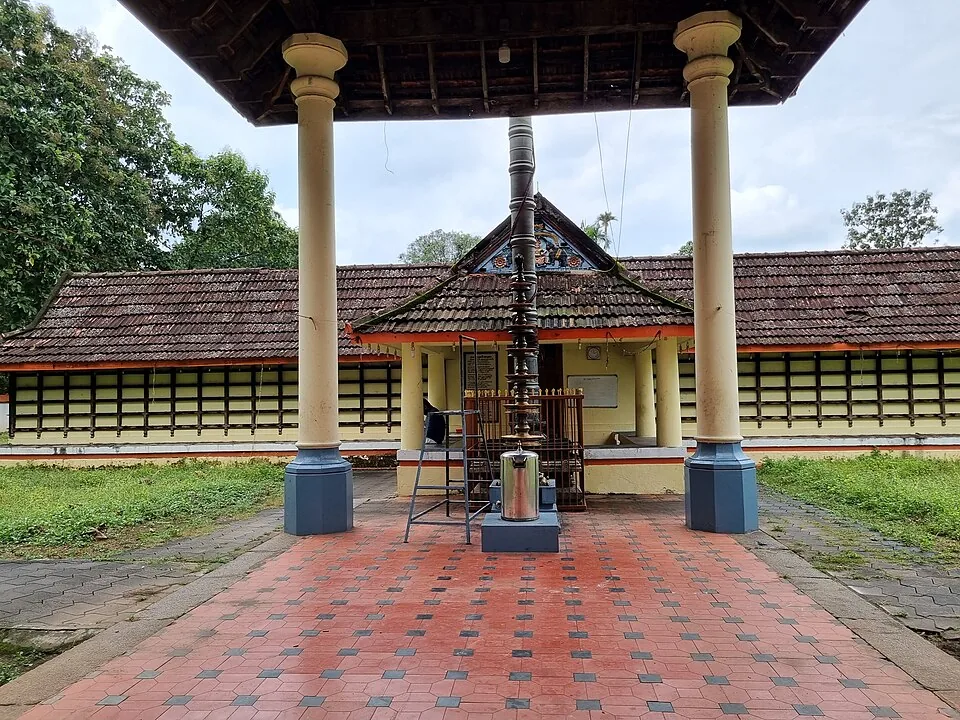
There is a particular kind of disappointment that comes from visiting a major pilgrimage site: the thing you came for turns out to be well organised. Kalady’s birthplace complex has parking, signage, a memorial tower with numbered floors and a steady flow of coaches. The Karthyayani Devi temple at Manickamangalam, a few kilometres north, has none of it — and is the better half of the day.
What a working Kerala temple looks like
The architecture is the regional idiom rather than anything grand: laterite, timber, a tiled roof over the sanctum, a compound wall, a flagstaff, lamps. The proportions are domestic. Nothing is trying to impress you, because the building was not put up for you.
The rhythm is the same. Morning and evening poojas, a priest who is also somebody’s neighbour, people arriving in ones and twos on the way to somewhere else, an annual festival that the surrounding houses organise. Karthyayani is a form of Durga, and the worship here is unremarkable in the specific sense that it has not been adapted for an audience.
How to be there properly
- Entry to the inner areas is generally restricted to Hindus, as across Kerala.
- Traditional, modest dress. Footwear off before entering the compound.
- No photography inside. Ask before photographing anything, including the exterior, if people are present.
- No entry fee. Offerings and poojas are paid for at the counter.
- Go at pooja time — early morning or around dusk — or there will be very little happening.
The last point is the one visitors get wrong. A temple like this is not an exhibit that is on display all day; it is a schedule. Turn up at two in the afternoon and you will find a closed sanctum and a quiet yard, and conclude there was nothing to see. Turn up at dusk and the lamps are lit.
Why it is on the Kalady circuit at all
Because of the family. Local tradition remembers this as the temple where Adi Shankara’s father Sivaguru served, and as the shrine associated with the vow that, in the legend, produced Shankara himself. That is the thread that connects a small village Devi temple to a pilgrimage site of national importance a few kilometres south.
It also usefully corrects a distortion. Kalady’s main complex, consecrated in 1910 after the birthplace was re-identified in the late nineteenth century, is a modern act of commemoration — deliberate, designed, national in ambition. Manickamangalam is what the religious landscape of the village actually looked like, and largely still does.
Fitting it in
A short drive north of Kalady, best with your own vehicle or an auto that will wait, since it is off the coach route and getting back can be slow. Twenty minutes is enough. Put it at the end of a Kalady half-day, after the Sree Krishna temple, the ghat and the Keerthi Sthambha Mandapam — and try to time the whole itinerary so that this one lands at dusk.
Frequently asked questions
What is the best time to visit the Karthyayani Devi temple?
Pooja time — early morning or around dusk. This is a working village temple rather than a monument, so outside worship hours you will find a closed sanctum and a quiet compound. Timing the visit for dusk is the single thing that makes it worthwhile.
How is it different from the main Kalady complex?
Completely. The birthplace complex is a managed pilgrimage site with parking, signage and coach traffic, consecrated in 1910 after the site was re-identified in the late nineteenth century. Manickamangalam is an ordinary working Kerala temple with no visitor infrastructure at all.
What is the dress code?
Traditional and modest, with footwear removed before entering the compound. As at most active Hindu temples in Kerala, men may be expected to remove upper garments in the inner areas — confirm at the door rather than assuming.
Is there an entry fee?
No. It is an active Hindu temple with no ticket. Offerings and specific poojas are paid for at the counter.
How do I get there from Kalady?
A short drive north. It is off the main visitor circuit, so your own vehicle or an autorickshaw willing to wait is the practical option — getting a return ride from the temple can be slow.
Why is this temple associated with Adi Shankara?
Local tradition remembers it as the shrine where his father Sivaguru served, and as the temple connected with the vow that the legend says led to Shankara’s birth. It is the start of the family narrative that the rest of Kalady commemorates.