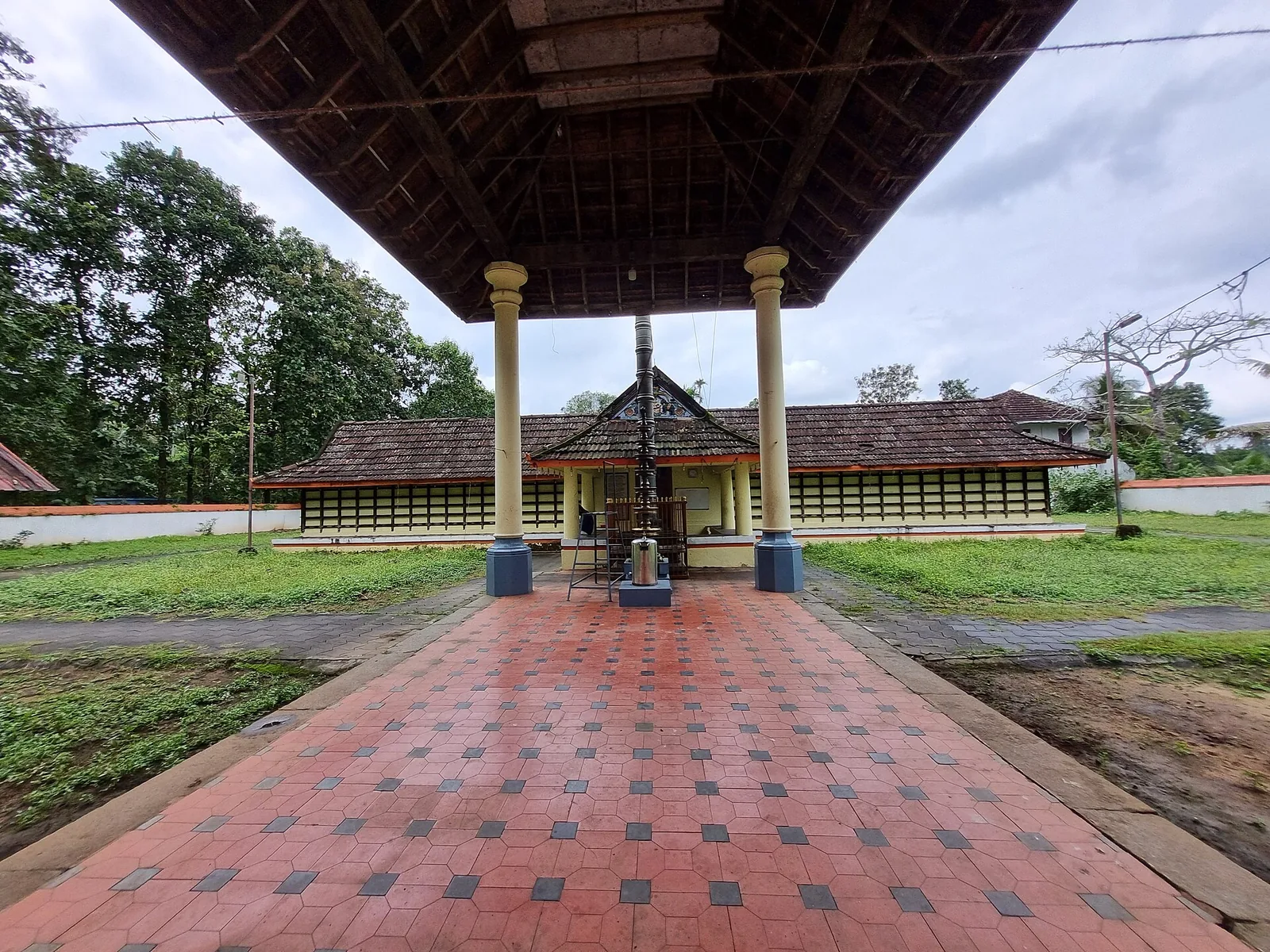
Most visitors to Kalady never make the short drive north to the Karthyayani Devi temple at Manickamangalam, which is a pity, because the family story that the whole of Kalady commemorates does not begin at the birthplace. It begins here, with a couple who could not have a child.
Sivaguru and Aryamba
Adi Shankara’s father, Sivaguru, is remembered in local tradition as having served at this temple, and the Devi here is treated as the family’s connection. He and Aryamba were, by every account, married for a long time without children — a serious matter in a Nambudiri household, where lineage and ritual obligation ran together.
What they did about it is the founding legend of Kalady, and it is worth telling in full because the shape of it is unusual.
The choice
The tradition holds that the couple undertook a long and severe vow, and that the deity eventually appeared to them and offered a choice rather than a gift: a son who would live an ordinary length of life and be unremarkable, or a son who would be extraordinary and would die young.
They chose the second. Shankara is traditionally said to have lived thirty-two years, in which he wrote commentaries that reorganised Indian philosophy, founded monastic centres at the four corners of the subcontinent, and argued Advaita Vedanta into the shape it has held ever since.
- It explains a short life as a price rather than a tragedy.
- It makes the parents complicit in the brilliance and in the loss.
- It sets up the mother’s later reluctance to let him renounce the world — she already knew what she had agreed to.
- And it is told at a Devi temple, which locates the whole story in a mother goddess before it reaches a mother.
Treat all of it as devotional tradition. The biographies of Shankara are hagiographies composed centuries after him and the mathas do not even agree on which century he lived in. But the story is doing real work — it is the reason the Kalady sites hang together as one narrative rather than as a set of separate shrines.
The temple now
Manickamangalam is a working Devi temple north of Kalady, not a monument. Karthyayani is a form of Durga, and the temple keeps the ordinary rhythm of Kerala temple worship — morning and evening poojas, an annual festival, and a local congregation rather than a pilgrim crowd.
That is precisely its value on a Kalady itinerary. The birthplace complex is managed, signposted and busy. This is the version without any of that: a village temple that happens to sit at the beginning of the story.
Visiting
It is a short drive north of Kalady and easiest with your own transport or an auto that will wait. As at most active Hindu temples in Kerala, entry to the inner areas is generally restricted to Hindus; dress traditionally, remove footwear, and do not photograph inside.
Fit it in after the main Kalady complex rather than before. The story reads better backwards here — see where he was born and where his mother was cremated first, then come and stand where his parents asked for him.
Frequently asked questions
What is the connection between the Karthyayani Devi temple and Adi Shankara?
Local tradition remembers it as the shrine where Shankara’s father Sivaguru served, and as the temple connected with the family. It is where the vow that tradition says produced Shankara is set.
What is the legend of the choice?
That Sivaguru and Aryamba, long childless, undertook a severe vow, and that the deity offered them a choice: an ordinary son with a long life, or an extraordinary son who would die young. They chose the second, and Shankara is traditionally held to have lived thirty-two years.
Where is the Karthyayani Devi temple?
At Manickamangalam, a short drive north of Kalady in Ernakulam district. It is easiest reached with your own transport or an autorickshaw that will wait — it is off the main Kalady visitor circuit.
Can non-Hindus enter?
As at most active Hindu temples in Kerala, entry to the inner areas is generally restricted to Hindus. The precinct can be walked. Dress traditionally, remove footwear and do not photograph inside.
Is it worth the detour from Kalady?
If you are interested in the story rather than only the monuments, yes. It is a working village temple with no visitor management at all, which makes it a very different experience from the birthplace complex — and it is where the family narrative actually starts.
Who is Karthyayani?
A form of the goddess Durga, worshipped widely across India and particularly associated with vows and with the granting of children — which is why the legend attached to this temple takes the shape it does.