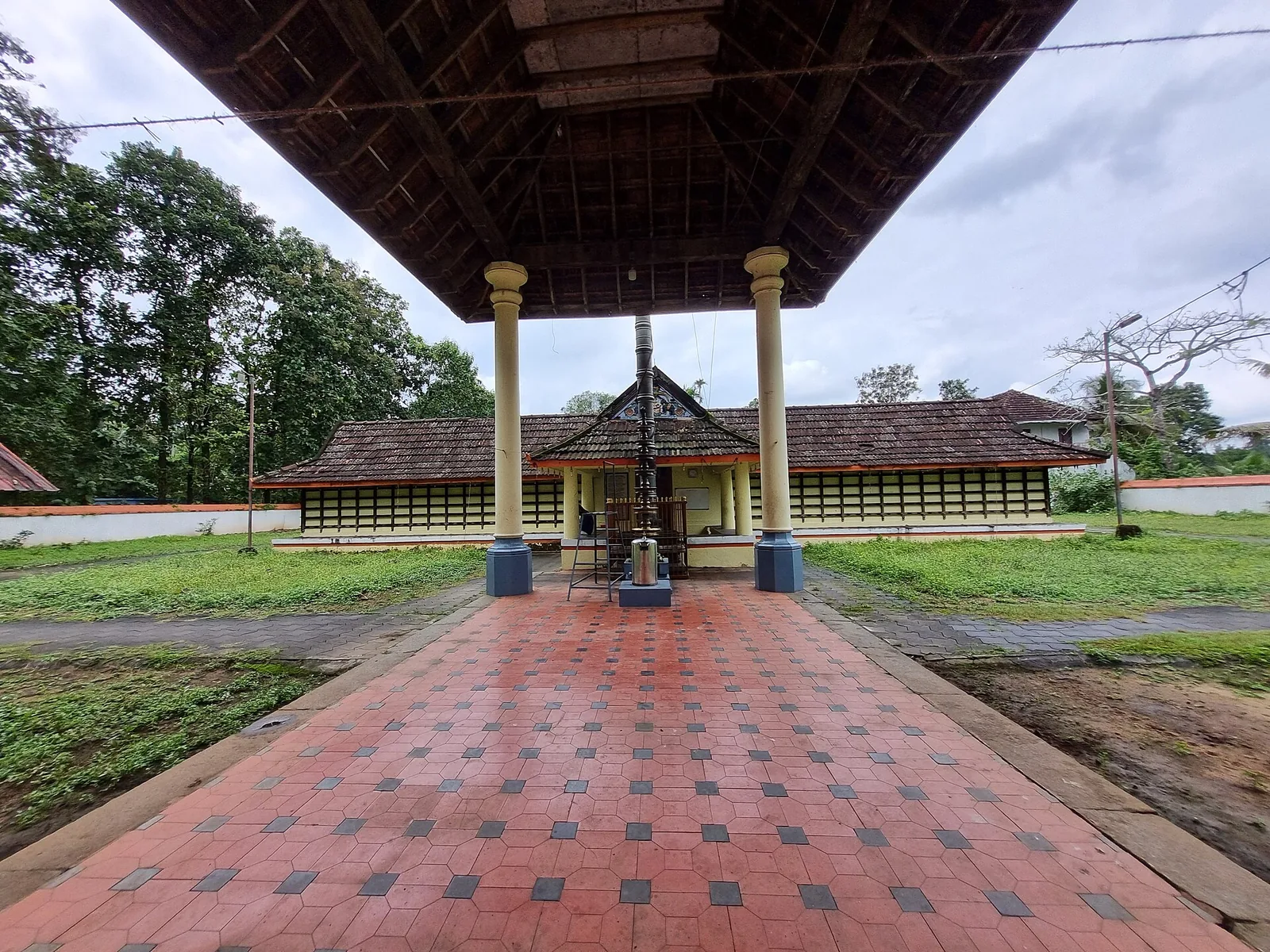
Almost everything written about the Karthyayani Devi temple at Manickamangalam arrives by way of Adi Shankara: his father Sivaguru served here as priest, the boy was sent with a measure of milk, the goddess drank it. It is a lovely story and it is the reason most visitors come.
It also means the temple is almost never described as itself. So here it is without the philosopher.
A place in a set of 108
Manickamangalam is counted among the 108 Durga temples of Kerala. That set is the counterpart of the much better-known 108 Shivalayas, and it belongs to the same Parasurama tradition — the founding narrative in which the axe-bearing avatar of Vishnu raised Kerala out of the sea and studded the new land with shrines.
Being one of the 108 is not a local distinction; it is membership of a statewide network. It is the reason worshippers come here who have no particular interest in Advaita, and it is the answer to the question a visitor from outside Kerala tends to ask — why this temple, of all the small Devi shrines in the district, has a festival on this scale.
What the building tells you
The sanctum is a vatta sreekovil: circular in plan, facing east. Kerala uses two classical sanctum forms, circular and rectangular, and the choice is not decorative — a round sreekovil reads and is circumambulated quite differently from the long rectangle you meet at, for instance, Thrikkariyoor. If you have been going round Kerala temples without noticing this, Manickamangalam is a good place to start.
The deity is Karthyayani in swayambhu sankalpam — the self-manifested conception. The distinction matters: the presence is held to have arisen of itself rather than to have been installed by a founder, which is a different kind of claim from the one made at a temple with a consecration date. The upa devatas, the subsidiary deities, are Shiva and Sastha.
Seven elephants in Meenam
The annual festival falls in the Malayalam month of Meenam and concludes on the Uthram nakshatra with the aarattu. The Pooram day is its centre, and it is a full-dress Kerala temple festival: Panchari Melam and Pandimelam, Thayambaka, Panjavadyam, and a procession of seven caparisoned elephants.
Seven elephants is a serious commitment for a village temple, and it is the clearest measure of what this shrine actually is in its own district — not an adjunct to the Kalady pilgrimage circuit but a substantial local institution with its own following.
Who holds it now
The shrine was formerly managed by Pazhoor Mana and is now administered by the NSS Karayogam. That transfer — from a Namboothiri illam to a community organisation — is one of the most common trajectories in twentieth-century Kerala, following the long unwinding of joint-family landholding, and it almost never appears on a board at the gate. Where a temple’s administration sits is usually the most recent chapter of its history and the least often told.
Going
It is about four kilometres from Kalady Junction, ten from Angamaly railway station and six from Cochin International Airport — which makes it one of the easiest genuinely local temples in Kerala to reach on a spare morning. It opens around 5:30am, with Nirmalya Darsanam, the viewing of the unadorned deity, shortly after, and it keeps the usual long midday closure.
Go early, and give the sanctum a slow circuit before you go looking for the spot where a four-year-old is said to have wept over a cup of milk. The story will still be there. So will the other nine centuries of the temple’s life, which nobody is going to tell you about.
Frequently asked questions
What are the 108 Durga temples of Kerala?
A traditional set of Devi shrines across the state, the counterpart of the better-known 108 Shivalayas and belonging to the same Parasurama tradition, in which the axe-bearing avatar is said to have raised Kerala from the sea and established shrines across it. Manickamangalam is counted among them.
What is a vatta sreekovil?
A circular sanctum. Kerala uses two classical sanctum plans, circular and rectangular; Manickamangalam’s is circular and faces east. The form changes how the shrine is approached and circumambulated, and it is one of the quickest ways to read a Kerala temple.
What does swayambhu sankalpam mean?
The self-manifested conception — the presence is held to have arisen of itself rather than been installed by a founder. It is a different sort of claim from a temple that records a consecration, and it is how the Devi is understood here.
When is the festival and what happens?
In Meenam, concluding on the Uthram nakshatra with the aarattu. The Pooram day carries Panchari Melam, Pandimelam, Thayambaka and Panjavadyam, with a procession of seven caparisoned elephants. Dates follow the Malayalam calendar and move each year, so confirm locally.
Who administers the temple?
The NSS Karayogam. It was formerly managed by Pazhoor Mana — a shift from a Namboothiri illam to a community organisation that is very common in twentieth-century Kerala and is rarely recorded on site.
How do I get there?
It is near the M.C. Road at Manickamangalam: about 4 km from Kalady Junction, 10 km from Angamaly railway station and 6 km from Cochin International Airport. It opens around 5:30am and keeps the usual long Kerala midday closure, so go early.