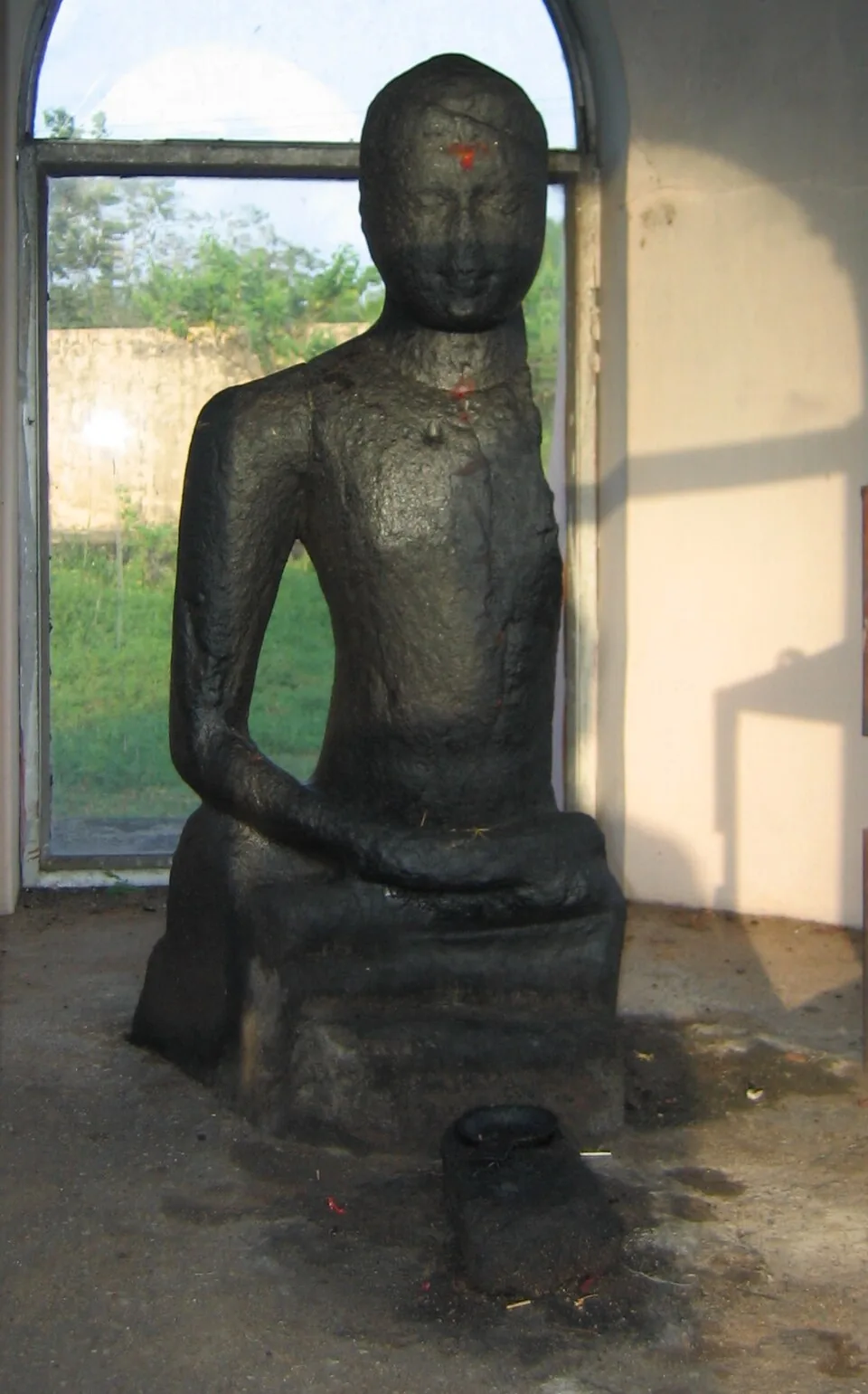
Malayalam Wikipedia lists four legends about the Karumadikuttan, in order. Three of them explain the statue as a person who was turned to stone. The fourth says that some people connect it with the Buddha.
It is worth taking them in the order the source gives them, because the order is part of the information.
One: the spirit
The brahmins of Chengannur, jealous of the rising fortunes of the Chembakassery king, sent evil spirits to destroy him and his people. One of those spirits was caught by the goddess at the Kamapuram temple and turned to stone. That stone is the Karumadikuttan.
Two: the touch
Vilwamangalam Swamiyar was passing this way when a Pulayan polluted him by touch. The sage cursed him, and the man became the stone you see.
Three: the vessel
During the festival at the Kamapuram temple a Pulayan stole an uruli — the temple’s cooking vessel — and the god turned him to stone for it.
Four: the Buddha
Some tell stories connecting it with the Buddha. That is the whole of the fourth entry.
What the list is doing
Read the four together and the shape is uncomfortable, and it should be.
Two of the four local explanations for this object are caste-punishment stories in which a Pulayan — a member of one of Kerala’s most severely excluded communities, historically barred from temple ground entirely — is petrified, once for polluting a brahmin sage by touch and once for theft. And the object being explained is, on the historical evidence, an image of the Buddha: from a tradition that rejected caste, and very probably broken and thrown into a canal during the brahminical ascendancy that displaced Buddhism from this coast.
So the folklore has absorbed a broken Buddha into the very system that broke it, and then accounted for the breakage as a punishment visited on a Dalit. The identification that every historian who has examined the object accepts is recorded as one opinion among four, and placed at the bottom of the list.
We are not going to tidy that into something more comfortable, or present the second and third legends as charming local colour. They are neither. They are evidence, and the irony in them is the most interesting thing at Karumadi.
Where the stories are anchored
Two of the four turn on the same shrine — Kamapuram — which tells you the folklore is not free-floating. In one telling the goddess of Kamapuram catches a spirit; in another the god of Kamapuram punishes a thief; and in both, the stone is what is left after an authority has been exercised. The Vilwamangalam story does the same work with a wandering sage in place of a temple. Three legends, one message, and the message is about who may approach what.
And yet
Alongside all of that runs a cult that nobody organised and nobody runs.
The Malayalam account records that people living nearby took to making offerings here in the belief that the Karumadikuttan could cure certain diseases in cattle and in children. That Christians and nuns lit candles at the spot. That some pilgrims on their way to Sabarimala stop and break a coconut. And that there is no puja and no daily observance — no priest, no rite, no calendar.
The photographs bear it out. One frame shows a split coconut on a banana leaf with loose flowers, a brass bowl, a stone lamp and scattered petals on the floor in front of the figure. Another shows kumkumam smeared on the forehead and the throat; another, turmeric-yellow marks on the brow and mouth.
And the name people actually use is not the Buddha. A Malayalam source records him as കരുമാടിക്കുട്ടൻ എന്ന വല്യച്ഛൻ — the grandfather. Kuttan means the boy, the little one. The name is diminutive and honorific at once: the little one, who is also the old man of the family.
Three legends say the stone is somebody being punished. The village leaves it coconuts and calls it grandfather. Both things are true at Karumadi, and neither cancels the other.
Frequently asked questions
What do local legends say the Karumadikuttan is?
Four stories are recorded. One: an evil spirit sent by the brahmins of Chengannur, caught and petrified by the goddess at Kamapuram. Two: a Pulayan who polluted Vilwamangalam Swamiyar by touch and was cursed into stone. Three: a Pulayan who stole the Kamapuram temple’s uruli and was turned to stone by the god. Four, last on the list: some connect it with the Buddha.
Why does that matter?
Because two of the four are caste-punishment stories about a Pulayan, attached to an object that is historically a Buddha — from a tradition that rejected caste — very probably broken and thrown into water during the brahminical ascendancy. The folklore absorbed the statue into the system that destroyed it and explained the damage as a punishment.
Is the statue worshipped?
Informally and constantly, with no priest and no rite. Neighbours have long made offerings believing it cures diseases in cattle and children; Christians and nuns have lit candles here; some Sabarimala pilgrims break a coconut. The Malayalam sources say plainly there is no puja and no daily observance.
What does the local name mean?
Kuttan means the boy or the little one, and a Malayalam source records him as “Karumadikkuttan, the grandfather”. The everyday name for a twelve-hundred-year-old Buddha is a household one — diminutive and honorific at the same time.