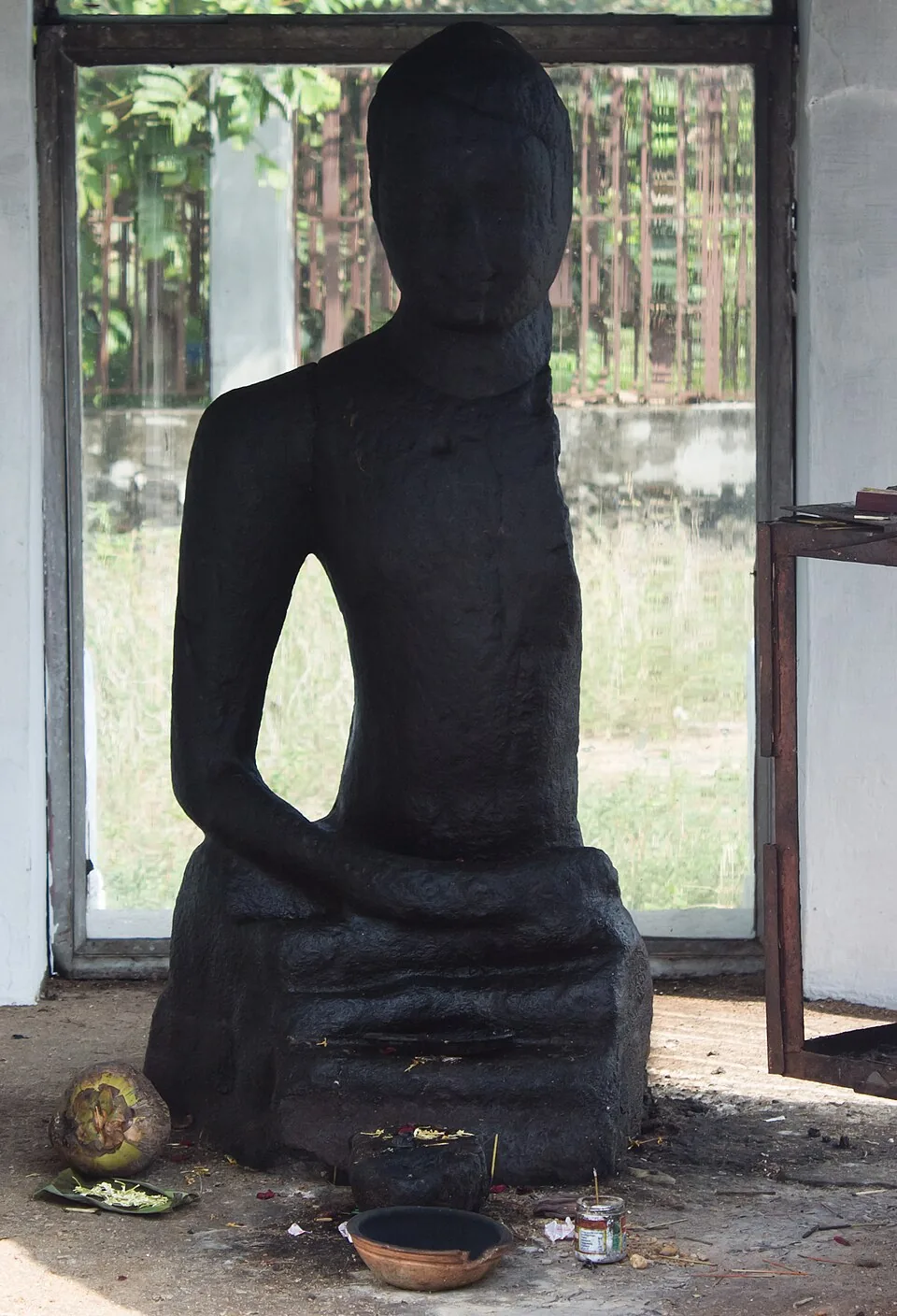
If you go looking for Buddhist Kerala you will not find a site. There is no stupa field, no rock-cut monastery, no ruined vihara on a hill. There is no surviving sangha and very little text.
What there is is a scatter of stone figures, and the interesting thing about them is not what they look like but where they were found.
Found in water
The Karumadikuttan came out of the Karumadi thodu — a canal. Others across the old Kuttanad and Karappuram country turned up in fields, in tanks, in ditches, under paddy. Very few came out of shrines, because by the time anybody was looking there were no shrines left for them to be in.
That pattern is itself the evidence. Statues do not migrate into canals. Objects that end up in water were put there, and a seated stone Buddha with an arm broken off, lying in a Kuttanad thodu, is not an accident of drainage.
The overwriting
The standard account is that Buddhism was a substantial presence on this coast in the first millennium and was displaced over several centuries by the brahminical revival, with its institutions absorbed, its sites reused and its images destroyed or discarded. The details are argued over — how substantial, how violent, how fast — and this page is not the place to settle them.
What can be said plainly is that the erasure was unusually complete. Elsewhere in India Buddhism left buildings that outlasted it. In Kerala it left almost nothing standing, which is why the surviving objects carry so much weight.
Two Buddhas, twenty-nine kilometres apart
Alappuzha district has two of the best-known ones, and they are constantly confused, so it is worth separating them.
The Karumadikuttan is the mutilated one: black granite, seated, the entire left arm and part of the left side sheared away, now housed in a small white stupa at Karumadi. The other is at Krishnapuram Palace, about 29 km south — a complete seated figure in grey lichen-stained stone, both hands in dhyana mudra in the lap, displayed in a mandapam against a carved timber backdrop.
They are not the same statue and should never be described as though they were. They are, however, connected by a specific event: in May 2014 a neighbour of the Karumadi monument handed the Archaeology Department a fragment of the broken arm that his family had kept for generations, and it was reported that the fragment would be kept at Krishnapuram.
What survives instead
There is a second kind of survival, less tangible and easier to miss. Kerala’s Buddhist centuries left traces in language, in place names, in some medical and educational traditions, and — arguably — in the shape of certain popular cults that continued around objects long after the doctrine attached to them was gone.
Karumadi is the clearest example anywhere. A Buddha nobody identifies as a Buddha, in a village that explains it with three stories about curses, receiving coconuts from Ayyappa pilgrims and candles from nuns, with no priest and no rite — and called, affectionately, grandfather. The doctrine went. The object stayed, and the habit of bringing it something stayed with it.
Frequently asked questions
What is left of Buddhism in Kerala?
Almost no architecture and no surviving sangha — what remains is chiefly a scatter of stone images, most of them recovered from canals, tanks and fields rather than from shrines, along with traces in language, place names and some popular traditions.
Why does it matter that these statues were found in water?
Because statues do not move themselves. A seated Buddha with a broken arm lying in a Kuttanad canal is evidence of deliberate disposal, which supports the account that Buddhist images were destroyed or discarded during the brahminical revival.
Is the Krishnapuram Buddha the same as the Karumadikuttan?
No, and they are often confused. The Karumadikuttan is the mutilated black granite figure at Karumadi with its left arm missing. The Krishnapuram Buddha is a complete seated figure in grey stone with both hands in dhyana mudra, displayed at Krishnapuram Palace about 29 km south.