The Karumadikuttan is a seated Buddha in black granite, in padmasana, the right hand laid over the left and the hands resting on the feet. The face is worn nearly smooth. The head carries the rounded ushnisha. And the entire left arm, from the shoulder down, along with part of the left flank and leg, is gone — sheared off on a rough diagonal that leaves raw broken stone.
It is generally dated to around AD 700, or to the late eighth century. So: twelve to thirteen hundred years old, from the period when Buddhism was still a living presence on the Kerala coast rather than a thing archaeologists argue about.
Found in a canal
It was not standing when it was found. It came out of the Karumadi thodu, the canal that runs through the village, and was set up on a plinth on the bank. The recovery is credited to Sir Robert Bristow, the British engineer who built the modern port of Cochin.
⚠ A small oddity worth flagging rather than quietly resolving: the Malayalam account names him twice and does not agree with itself — in a second passage he appears as “A. H. Bistro, a European chief engineer”. It is the same man and the same event. We mention it because a reader who checks the source should not think we misread it.
Buddha or Tirthankara?
What the object is has been argued for more than a century. The Travancore State Manual and the historian K. P. Padmanabha Menon identified it as a Jain Tirthankara. T. A. Gopinatha Rao, who headed the Travancore Archaeological Survey, argued that it is a Buddha.
Gopinatha Rao’s identification is the one that has held, and it is the one used now. But the disagreement is not embarrassing — it is a fair reflection of how little survives. A worn seated figure in padmasana with the hands in the lap can be either, and Kerala had both.
How it broke
Three explanations are on the record, and they are not equally comfortable.
The first is prosaic: the arm was broken while the statue was being lifted, using an elephant. The second attributes the damage to British attacks. The third — the one most often repeated locally — is that the figure was mutilated during the destruction of Buddhist and Jain images in the period of brahminical ascendancy, and then thrown into the water.
That third version has one strong piece of circumstantial support, which is simply where the statue was found. Kerala has almost no Buddhist architecture left, no surviving sangha and very little text. What it has is a scatter of stone figures — this one, the seated Buddha now at Krishnapuram Palace, and a handful of others across the old Kuttanad and Karappuram country — and a striking number of them were recovered from water or from fields rather than from shrines. Objects that end up in canals were put there.
The piece of the arm
There is a fragment of that arm, and it has a date and a name attached to it. On 14 May 2014, Rajappan Pilla — a neighbour of the monument — handed over to the Archaeology Department a piece of the broken arm which had been kept in his family and passed down for generations.
It was reported at the time that the fragment would be kept at Krishnapuram Palace, about 29 km south, which already holds its own seated Buddha. ⚠ That was the decision as reported in May 2014; we have not been able to confirm that the fragment is now on display there, so treat it as a decision taken rather than something you can go and see.
Sit with the first half of that, though. A family living next door to the statue kept a broken piece of it for generations — long enough that nobody involved remembered a time before — and then simply handed it to the state. Whatever else the Karumadikuttan is, it is an object people have looked after.
The stupa
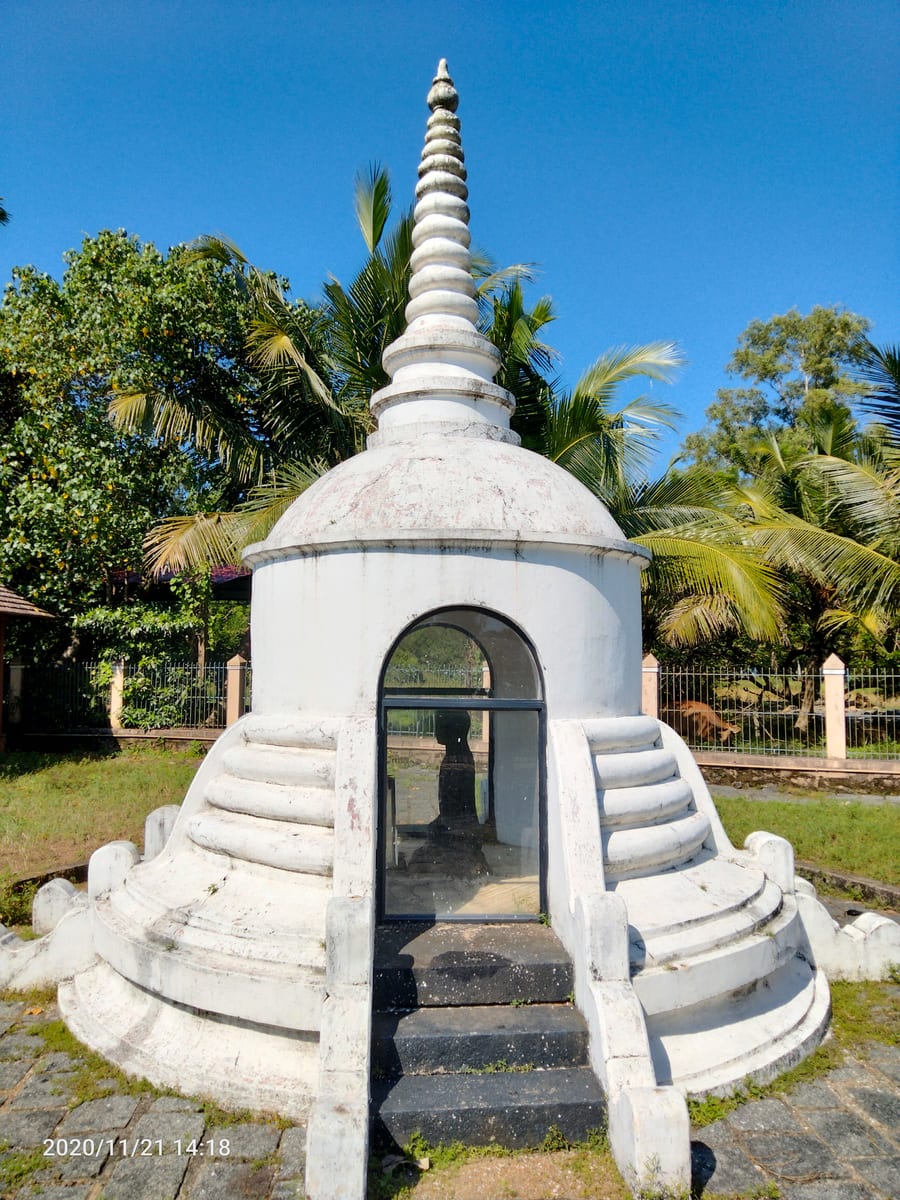
For most of the twentieth century the statue stood in the open on its plinth. It does not now. It sits inside a small white stupa — a dome with stepped rings rising to a finial, approached up two flights of steps, with a glass door through which the dark figure can be seen.
The form is Sinhalese Theravada, not Keralan, and the likeliest explanation is on the record: the Dalai Lama visited Karumadi and made arrangements for the statue’s protection. So an eighth-century Kerala Buddha now sits inside a twentieth-century Sri Lankan-style shrine, built at the suggestion of a Tibetan monk, in a village that explains the object with stories about curses.
Photographs bear out the care. Older frames show the stupa stained and cracked, standing in a rough yard beside a heap of broken white stone. Recent ones show it whitewashed, in a paved and fenced compound. Somebody has been keeping it up.
Frequently asked questions
How old is the Karumadikuttan?
It is dated to around AD 700 by Sreedhara Menon and to the late eighth century by Gopalakrishnan — roughly twelve to thirteen hundred years old.
Where was it found?
In the Karumadi thodu, the canal running through the village. It was recovered and set on a plinth on the bank, a recovery credited to Sir Robert Bristow, the engineer of the modern port of Cochin.
Is it definitely a Buddha?
The identification generally accepted now is T. A. Gopinatha Rao’s, that it is a Buddha. The Travancore State Manual and K. P. Padmanabha Menon had identified it as a Jain Tirthankara. A worn seated figure with the hands in the lap can be either, and Kerala had both traditions.
What happened to the missing arm?
Three explanations circulate: it broke while the statue was being lifted with an elephant; it was damaged in British attacks; or the figure was mutilated during the destruction of Buddhist and Jain images under brahminical ascendancy and thrown into the water. A fragment of the arm, kept in a neighbouring family for generations, was handed to the Archaeology Department on 14 May 2014 by Rajappan Pilla.