Keerippara makes sense only after discarding the usual mental picture of Silent Valley. It does not begin as an unrestricted path into the national-park core, and it does not end at the Sairandhri watchtower. It is a guided buffer-zone programme: a small party walks through changing forest country and stays above the Attappady ghat, where the view opens away from the deep Kunthipuzha valley.
A trail through the protective edge
The buffer is not a lesser forest waiting outside the “real” park. It is the managed protective belt around the 89.52-square-kilometre core, and it is where a walking programme can operate without turning the most sensitive rainforest into an open trail network. Kerala Tourism describes the route as about four hours on foot through a tangle of forest types. The small group and compulsory guide are part of the route’s meaning: access follows the forest’s conditions, not a walker’s wish to improvise a shortcut.
The visible ground changes on the way. Enclosed tree cover gives way in places to bamboo, tall grass and brighter slopes. Butterflies and birds are easier to notice at those edges, but the walk is not a wildlife checklist. Elephant or gaur movement may decide where the group pauses or whether a line is used at all. A guide changing course is evidence that this remains animal country, not a failed version of a fixed hiking itinerary.
Why the camp looks unexpectedly open
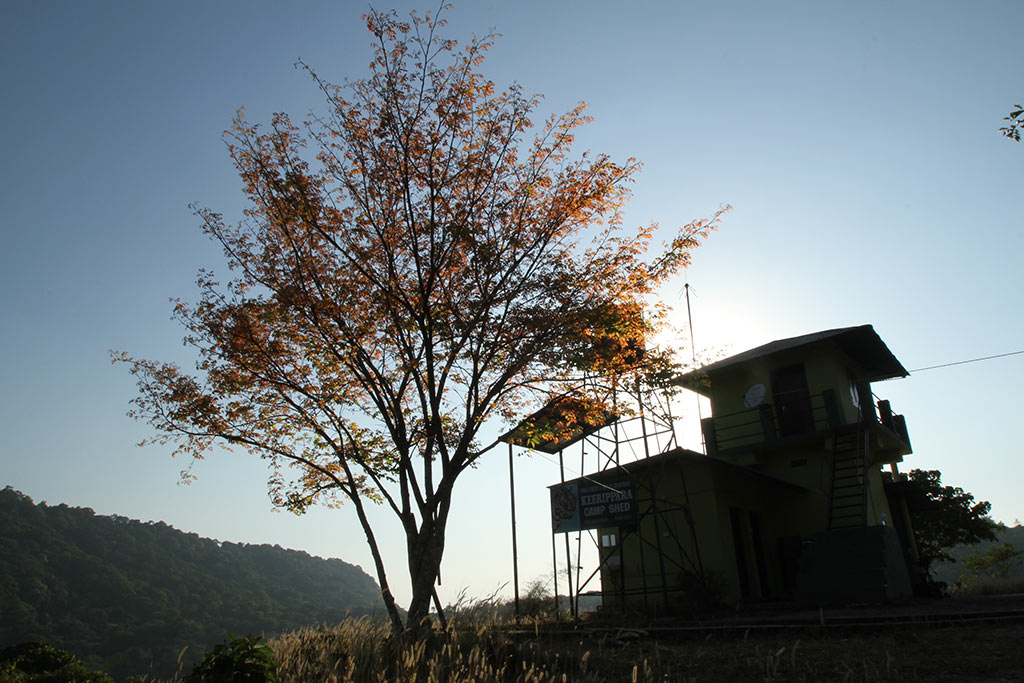
The official photographs are revealing. The camp shed is small beside a spreading tree, while nearby grass catches the low sun and ridges layer the horizon. That open, tawny frame can surprise anyone expecting wall-to-wall evergreen canopy. Keerippara sits above the Attappady side of the landscape; altitude, exposure and the meeting of forest types produce a broader outlook than the enclosed river gorge associated with the Silent Valley name.
The shed is best understood as a threshold. It supplies shelter and a place for the group to stop, but it does not isolate campers from the weather or reproduce a hotel room. Rain can erase a distant ridge, evening cool arrives quickly after the light falls, and phone coverage cannot be treated as dependable. The attraction is precisely that the camp stays small in the frame.
The overnight is the second half of the walk
A day outing is usually remembered as forward motion: start, viewpoint, return. Keerippara interrupts that rhythm. Once the walking stops, the same slope changes through sunset, darkness and first light. Calls that were lost under daytime movement become distinct; mist may close and reopen the hills; the guide’s reading of weather and animal signs matters more than the number of kilometres completed.
Morning also makes the camp’s position legible. The Attappady country lies on the other side of the watershed from the Kunthipuzha. Water in the national-park valley runs west towards the Bharathapuzha, while the Bhavani crosses Attappady eastwards towards the Kaveri. Keerippara’s outward-looking camp belongs to that meeting of landscapes, which is why its ridge view tells a different story from the closed rainforest seen on the Sairandhri road.
Not the road to Sairandhri
Sairandhri and Keerippara share the Mukkali reporting system, but little else about their pace. The former carries visitors mainly by Forest Development Agency vehicle towards the watchtower and Kunthipuzha landscape, returning the same day. Keerippara commits a small group to forest ground and holds it overnight. One reveals the scale of the protected valley from controlled stops; the other lets the buffer forest set the tempo.
- The shelter in the photograph is the scale to expect: simple, exposed to the weather and surrounded by working forest.
- The walk stays with its assigned guide; wildlife and fire or rain conditions can alter the planned line.
- The Attappady outlook is part of Keerippara’s identity, not evidence that the programme has entered the rainforest core.
Frequently asked questions
Does the Keerippara trek go to the Sairandhri watchtower?
No. They are different official programmes. Keerippara is a guided buffer-forest walk with an overnight camp; Sairandhri is primarily a vehicle-led day visit towards the watchtower and Kunthipuzha landscape.
Why does Keerippara look grassy rather than like dense rainforest?
The camp is above the Attappady ghat in transitional buffer country. Exposure and changing forest types create open grass and ridge views alongside wooded sections.
Is the overnight just accommodation added to a trek?
The overnight changes the experience: the group remains through evening, darkness and early morning, when weather, light and forest sounds give the same landscape a different character.