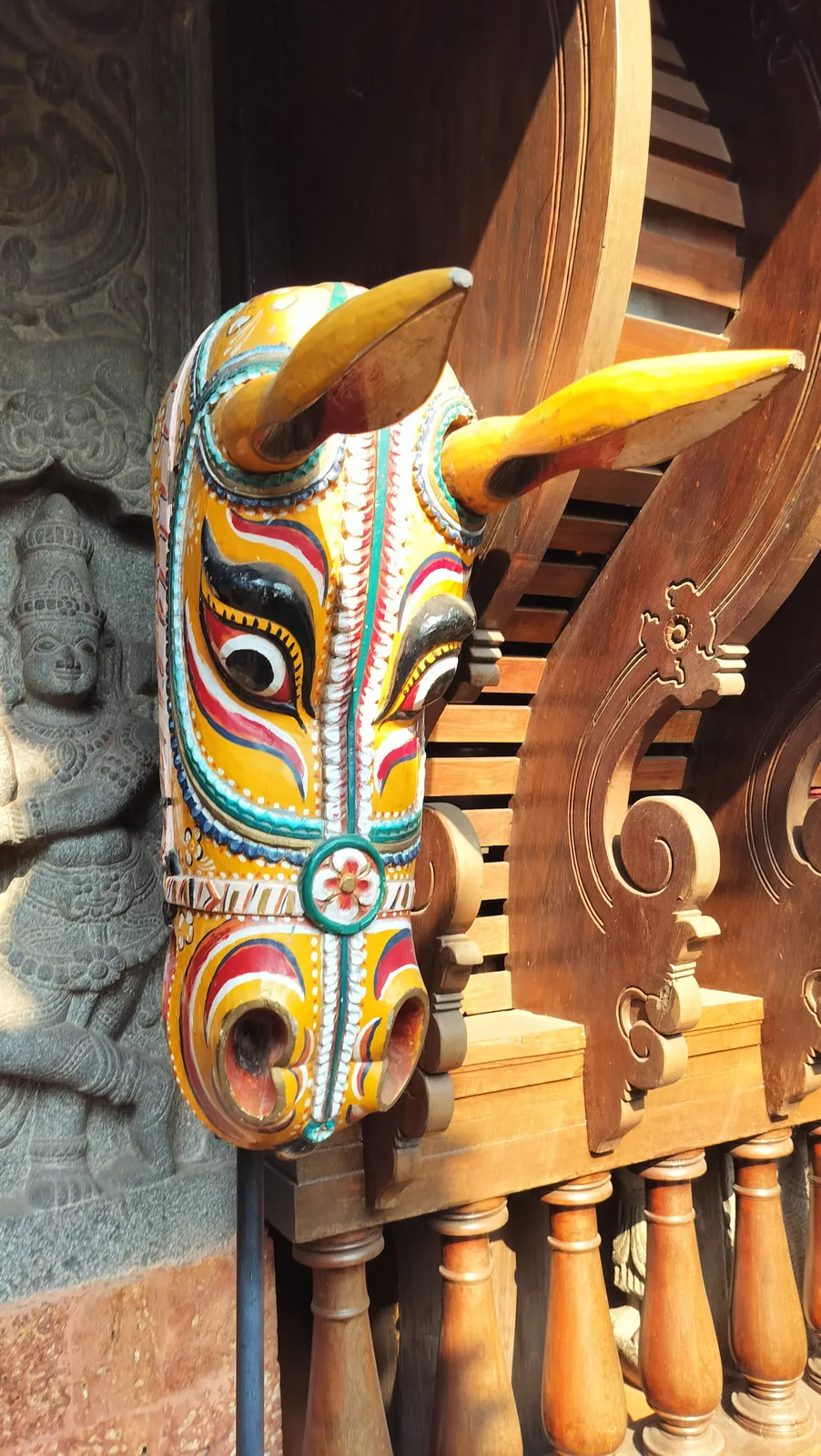
The single best reason to make the trip out to Thevara for the Kerala Folklore Museum is not the building, remarkable as the building is. It is the performance material: Theyyam and Kathakali costume, masks and headgear, standing still in daylight at arm’s length.
Why stillness changes it
You are supposed to meet these things in motion. Theyyam happens at night in a kavu — a sacred grove or shrine — in firelight, with drums, worn by a performer who is, for the duration, treated as the deity rather than as a man in a costume. Kathakali happens on a stage with the lamp in front and the face already transformed by three hours of make-up. In both cases the costume is doing its work inside an event that is designed to overwhelm you.
Take it out of the event and something else becomes visible: the making. The headdress that read as a blaze of divinity turns out to be a constructed object with joinery in it, mirror-work, pith, painted wood, cloth, metal — and a weight that will make you wonder how anyone dances in it for hours. The face-ornaments, seen unlit, are craft objects with tool marks.
That is not a reduction. It is the other half of the thing. Very few visitors to Kerala get to see it, because you cannot examine a Theyyam headdress at a Theyyam.
- Ritual masks, and Theyyam and Kathakali costume and headgear — the strongest holdings in the museum.
- Temple bronzes, oil lamps, terracotta, jewellery, manuscripts, musical instruments and everyday utensils.
- Material spanning Koodiyattam, Mohiniyattam and Ottamthullal alongside the two headline forms.
- Several thousand objects — sources give both “over 4,000” and “over 5,000”, so treat any precise figure as approximate.
- A koothambalam-style theatre on the top floor with regular evening performances, usually ticketed separately.
Finish upstairs
The top floor is a theatre built on the lines of a koothambalam, the temple performance hall, under a painted wooden ceiling. There are regularly scheduled evening performances of Kathakali and other classical forms.
If you can time the visit so it ends there, do. The building was designed to be finished that way, and the sequence is the whole argument: look at the costume at rest, understand what it is made of, and then watch it come back to life on a body forty minutes later. Almost nowhere else lets you do both in one afternoon.
Practicalities
It is at Thevara, south of the city centre and a long way from Fort Kochi, so it needs a deliberate trip rather than being something you pass. There is an entry charge, a separate camera charge, and the performance is usually ticketed separately. Give it two hours if you intend to look rather than walk.
And note that despite the name it is not a government museum. It is a private collection, assembled by a private dealer, which is exactly what makes both its ambition and its methods unusual.
Frequently asked questions
What is the best part of the Kerala Folklore Museum?
The performance material — Theyyam and Kathakali costume, masks and headgear. Seeing a headdress at rest, unlit and at arm’s length, shows you the joinery, mirror-work and sheer weight that are invisible when the same object is in motion at night.
Is there a performance at the museum?
Yes. The top floor holds a theatre built on the lines of a koothambalam, the temple performance hall, with regularly scheduled evening performances of Kathakali and other classical forms, usually ticketed separately from museum entry.
How many objects are in the collection?
Several thousand. Sources give both “over 4,000” and “over 5,000”, sometimes on the same page, so any precise figure you are told should be treated as approximate.
Is this a government museum?
No, despite the name. It is a private museum built from a private collection assembled by an antique dealer, which is a large part of what makes both its ambition and its methods unusual.
Where is it and how long should I allow?
At Thevara, south of the city centre and well away from Fort Kochi, so it needs a deliberate trip. Allow two hours to look properly, plus the evening performance if you can time it.
Are there entry and camera charges?
Yes — there is an entry charge and a separate camera charge, and the performance is usually ticketed separately. Confirm current rates on arrival.