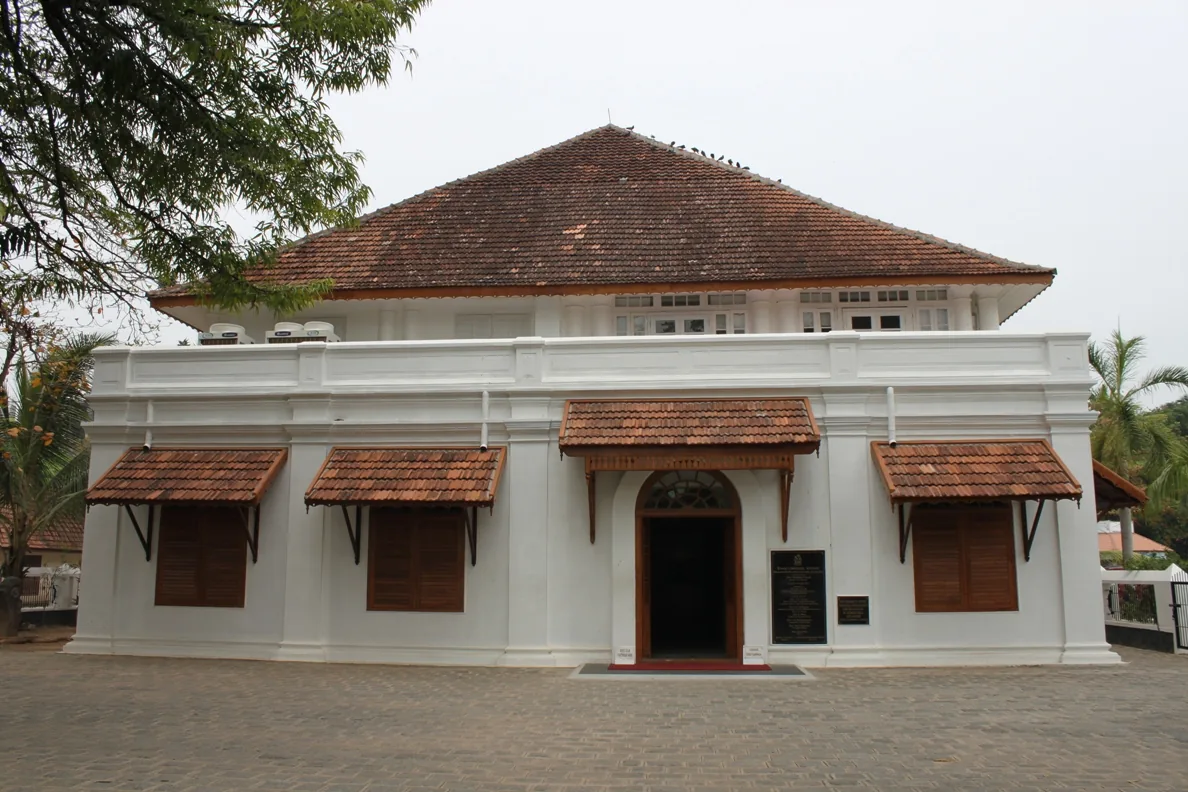
The Kochi-Muziris Biennale is usually described in terms of attention — visitor numbers, international press, the arrival of contemporary art on the Malabar coast. That is real, and it is also the easiest thing to measure. The more durable effect is physical, and one of the clearest places to see it is the Durbar Hall Art Centre in mainland Ernakulam.
Three lives of one room
The building began in the 1850s as the audience chamber of the Maharaja of Cochin — a durbar hall, which is a room for holding court rather than a residence. The public gathered on the ground outside; the ruler received them from inside.
Its second life began in 1989, when the first floor was handed to the Kerala Lalithakala Akademi, the state academy of fine arts. From that point the building’s principal function was exhibition space, showing national and international work alongside Kerala artists, free to the public. A room built so that people could be received by a king had become a room where the public was received by an arts academy.
Its third life is the one the Biennale gave it. The Kochi Biennale Foundation carried out an extensive renovation that turned a handsome but limited old hall into a museum-quality exhibition venue, and it has served as a Biennale site, including in the 2014 edition.
What “museum-grade” actually means
The phrase gets used loosely, so it is worth spelling out why it matters. An institution lending a valuable work overseas does not ask whether the receiving venue is attractive. It asks about specifics.
- Controlled lighting — intensity and UV, adjustable per work rather than whatever the room has.
- Wall surfaces that can be hung, patched and repainted without damaging a protected building.
- Climate handling — temperature and humidity within a range, in a hot, wet coastal city.
- Security and a building envelope that keeps weather and pests out.
Without those, a venue can host local shows and nothing else, because no serious lender will release work into it. With them, the same room becomes eligible for touring exhibitions. That is the practical difference the renovation made, and it is why the programme at Durbar Hall is genuinely national and international rather than a display of handicrafts for visitors.
Why this matters more than a single festival
A biennale is, by definition, intermittent. Infrastructure is not. The fit-out at Durbar Hall works in the years between editions and would keep working if the Biennale stopped tomorrow — which is a more useful legacy than any attendance figure, and a reasonable argument for why public money spent on art venues is spent on rooms rather than on events.
It also relocated something. Kochi’s art identity is popularly attached to Fort Kochi and the Biennale’s waterfront venues, but the best-equipped gallery space in the city sits on the mainland, beside a sports ground, near Ernakulam South station, in a building most visitors walk straight past. Entry is free.
Visiting it usefully
Check what is hanging before you travel. This is a changing-exhibition gallery with no permanent collection, so between shows there is genuinely nothing to see, and in Biennale years the programme is at its strongest. Twenty to forty minutes covers most exhibitions — it is a single principal space. Add ten minutes for the ground outside, which carries a separate and rather heavier history.
Frequently asked questions
Is the Durbar Hall Art Centre free to enter?
Yes. It is a public gallery run by the Kerala Lalithakala Akademi and the exhibitions are not ticketed, which is unusual for a space of this standard.
When did Durbar Hall become an art gallery?
In 1989, when the first floor was handed to the Kerala Lalithakala Akademi. The museum-grade fit-out came later, with the Kochi Biennale Foundation’s renovation.
What did the Kochi Biennale Foundation do to Durbar Hall?
It carried out an extensive renovation that upgraded the building into a museum-quality exhibition venue — controlled lighting, hangable wall surfaces and climate handling — and the hall has been used as a Biennale site, including in the 2014 edition. That upgrade is why it can now receive serious touring exhibitions.
What is on display at Durbar Hall Art Centre?
It changes constantly. There is no permanent collection: the programme runs national and international touring shows plus exhibitions by Kerala artists, with Biennale programming in Biennale years. Check the current show before making the trip.
Is Durbar Hall the Cochin royal palace?
No. A durbar hall is a court or audience chamber, not a residence. The Maharaja of Cochin built this in the 1850s to hold his durbar, with the public gathered on the ground outside. For a royal palace and its collections, go to Hill Palace at Tripunithura.
Where is Durbar Hall Art Centre?
On Durbar Hall Road in central Ernakulam, beside the Durbar Hall Ground and close to Ernakulam South railway station and Maharaja’s College metro. It is mainland Kochi, not Fort Kochi — no ferry needed.