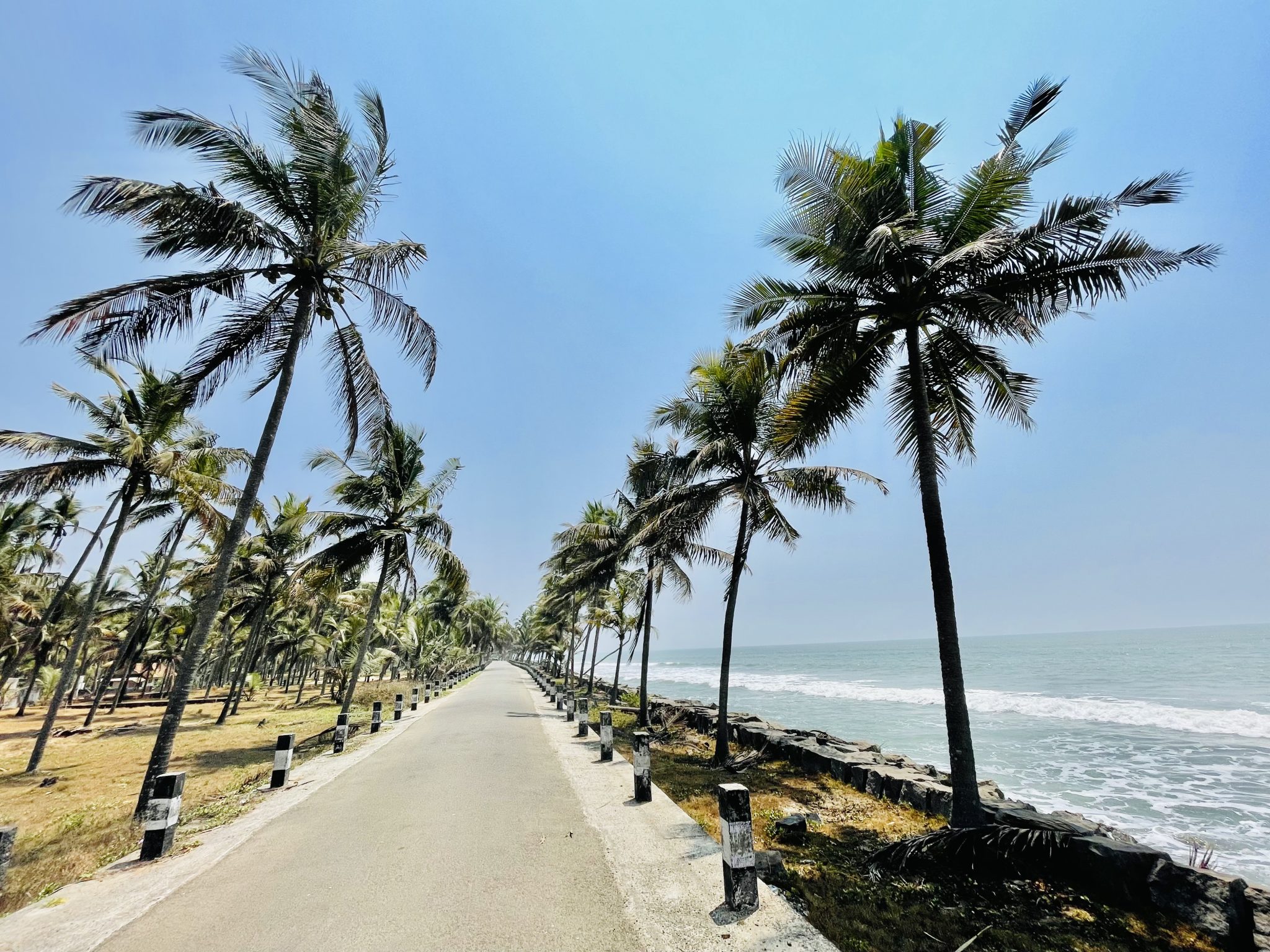
Every account of Kolavipalam tells you that sand mining destroyed the beach, and every account is right. It is just not the whole mechanism, and the missing half is the more uncomfortable one.
Where the sand came from
Kolavipalam’s sand is not made locally. It is carried down the Kottapuzha — the local name for the lower Kuttiyadi river — and deposited at the river’s mouth, from where the sea distributes it along the shore. A beach like this is not a place so much as a process, and the process runs on delivery.
Heavy sand mining in the estuary interrupted the delivery. Case-study material on the site calls it the primary existential threat, and describes the erosion that followed as severe. Other reporting records that the mining destroyed mangroves near the estuary and that scientists confirmed the sandy stretch had been denuded. Sand was taken from the sandbank by the tonne, for construction and for land-filling.
The scale of what went is easy to state and hard to picture. By 2003 the beach was reported to have narrowed from over a kilometre wide to a strip of about five hundred metres. The hatchery had to be relocated four times in two years because the shore it stood on kept retreating. In January 2001 the sea took it outright.
What the village did about it
Theeram took the mining to the Kerala High Court in the late 1990s — November 1998 by one account, 1999 by another — and obtained a restraining order. The court had the District Collector appoint a committee; the committee recommended restricted removal. Every source we have found agrees that enforcement was ineffective and that mining continued, and that the group later sought contempt proceedings.
We would like to give you the case number, the bench and the text of the order. There is no such record we could find anywhere, so we are not going to invent a citation to make the paragraph look better. It is also reported that members faced armed confrontation over this, including one being seized and assaulted, and that the order was obtained with considerable difficulty. No source names an assailant and no conviction is recorded, so neither do we.
The half that gets left out
Here is where the story stops being simple. Both peer-reviewed studies of this beach put seawalls, not sand mining, first among the current causes of the nesting collapse.
The 2018 paper — written by fisheries researchers together with two members of Theeram — records that seawall structures along the shore alter the turtle nesting area from sandy to rocky, and lists that alongside incidental capture in fishing gear and nest predation by feral animals as what drove the decline.
The 2025 paper puts armouring at the head of its list and explains the biology, which is worth understanding because it is not obvious. A female olive ridley wants the upper beach, above the reach of the waves. A seawall physically blocks her from getting there. So she nests low down instead, on the part of the beach the sea still reaches. And the nest drowns.
That paper also cites earlier work identifying Kolavipalam as highly susceptible to coastal erosion — which is, of course, exactly why the wall was built.
The honest version
The sand was mined away. The coast, no longer replenished, began to go. The state built a wall to hold what was left, which is what coastal engineering is for and what the people living behind it needed. And as far as the turtles are concerned, the wall finished what the mining started.
Nobody in that sequence set out to end the nesting. That is what makes it worth telling properly rather than as a morality play. The photograph at the top of this article is the whole argument in one frame: a road, a line of palms, a laterite revetment, and surf breaking directly against the rock with no beach at all in between. There is nowhere on that stretch for a turtle to go.
And the rest of the list
The published causes are cumulative rather than singular, and the 2025 study names more of them: tourism development and artificial lighting, changing rainfall, coconut plantations replacing natural coastal habitat, private road construction fragmenting the beach, and waste and plastic dumping.
It also records two things that complicate the local politics in ways travel writing tends to skip. The estuary has acquired the nickname Mini Goa. And roughly half the local population derives income from selling to visitors, and therefore supports tourism development here despite what it does to the shore. A conservation story with a clean cast of characters is usually one that has been simplified.
Members of Theeram are still naming the mining in 2025 and 2026 — unscientific sand mining has altered the beach structure itself, as the group’s vice-president put it. Recent reporting lists the causes together: uncontrolled sand mining, coastal erosion and seawall construction. All three, in that order, on the same shore.
Frequently asked questions
What destroyed the nesting beach at Kolavipalam?
Cumulatively several things, but both peer-reviewed studies of the site put seawalls first among current causes: armouring blocks turtles from the upper beach and forces them to nest low down, where waves drown the nests. Behind that sits the estuary sand mining that stopped the beach being replenished in the first place.
How much of the beach was lost?
By 2003 it was reported to have narrowed from over a kilometre wide to a strip of about 500 metres. Erosion forced the hatchery to be relocated four times in two years, and in January 2001 the sea destroyed it outright.
Did the courts stop the sand mining?
Theeram took it to the Kerala High Court in the late 1990s and obtained a restraining order; the District Collector was directed to appoint a committee, which recommended restricted removal. Every source reports that enforcement was ineffective. No case number, bench or order text could be found, so we print none.
Why would a seawall be bad for turtles?
Because a nesting female needs the upper beach, above the waves. A wall stops her reaching it, so she lays lower down, where the sea still comes in — and the nest is drowned. The 2018 paper puts it as armouring turning a sandy nesting area into a rocky one.
Is the sand mining still happening?
Members of Theeram were still naming unscientific sand mining as a live cause in 2025, and reporting in February 2026 lists it alongside coastal erosion and seawall construction. We name no individual, family or business: no source does, and no conviction is recorded.