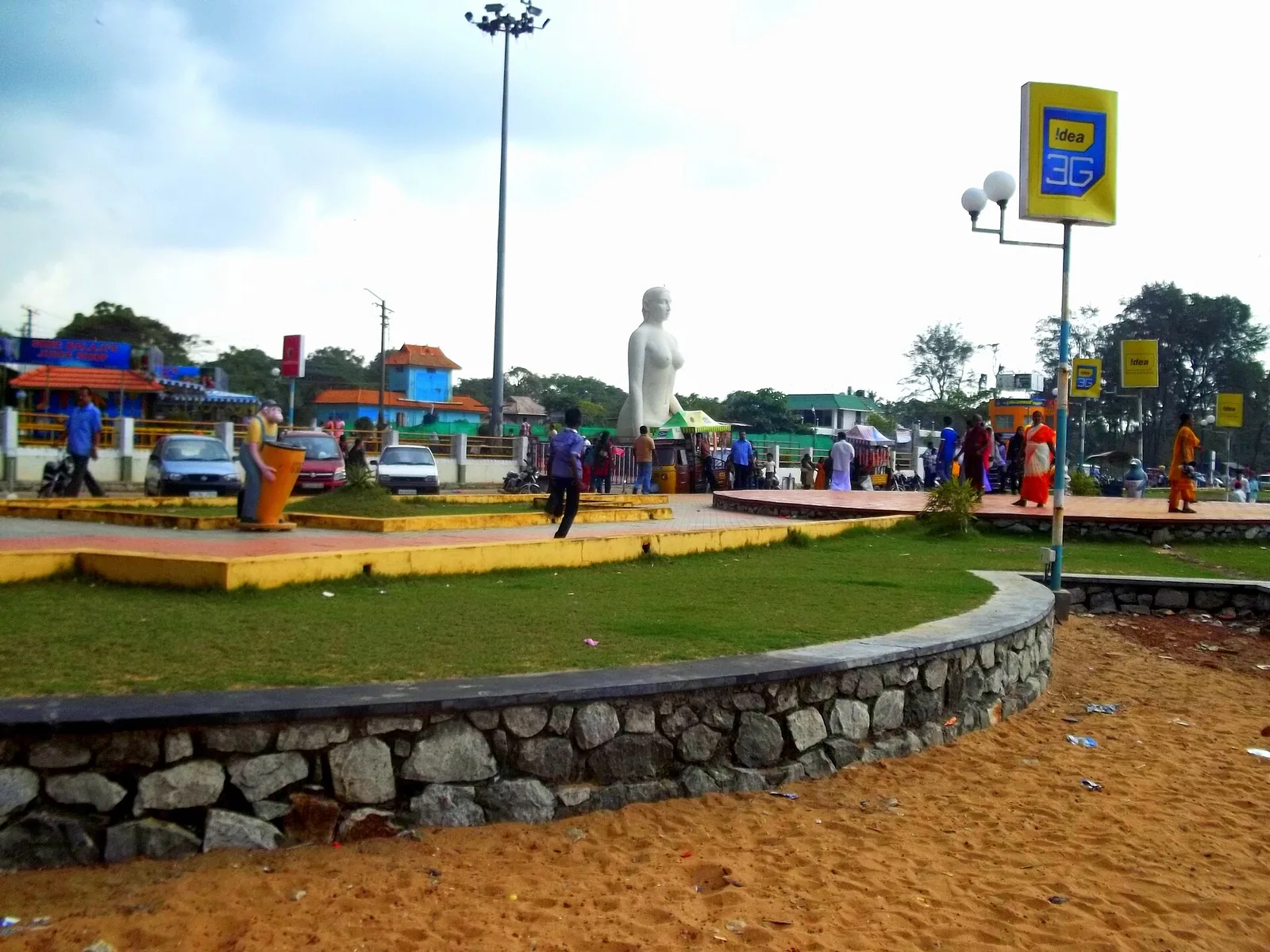
There is a photograph of Mahatma Gandhi Park taken in 2011 in which the mermaid stands over a lawn, a paved terrace and a car park, and the lawn ends in a low wall of rough stone. Below the wall is sand. That wall is not landscaping. It is the front line, and it is the most honest thing in the frame.
The numbers
Kollam Beach is about two kilometres long. It used to be about 150 metres wide. Reporting from October 2025 describes it losing roughly twenty metres of sand a year, and says that in places about six metres of usable beach remains.
Six metres is not a beach. It is a verge. And the stretch going fastest is the southern one, Vedikkunnu.
What makes the reporting unusually vivid is the instrument it uses. There is no gauge on this beach, no marked transect, no public monitoring station. What there is instead is the lifeguards’ safety rope, strung to mark the permitted bathing zone, and every season it gets moved landward. Journalists covering the erosion measure it by where the rope is now: nearly at the road.
Why it matters more here than on most eroding coasts
Because this is a lethal beach, and the erosion is making it worse in a specific mechanical way. Kollam Beach is steep: the bottom drops to about a metre and a half right at the water’s edge, and to more than three metres just two metres out. Scoured sand leaves pits. People who believe they are paddling go over an edge they cannot see.
A warning board on the beach records fifty-one lives lost in ten years. Reporters covering it think the real figure is above a hundred; an earlier official framing gave ninety-seven deaths in ten years and fifty-seven in seven. As the strand narrows, the deep water comes closer to where people stand.
Who is blamed, and by whom
This is the part to present honestly rather than to settle, because two groups of people looking at the same shore reach different conclusions and both are quoted in the same article.
The fishermen blame the structures. Kollam Port sits immediately south at Thangassery, and its fishery harbour is enclosed by two breakwaters — a main arm of 2,100 metres and a leeward arm of 550. A breakwater that long interrupts the sand travelling along the coast, and the beach downdrift of it starves. That is not a folk theory; it is the standard mechanism.
The experts quoted alongside them attribute the loss instead to monsoon winds and seasonal sea incursion — processes that would be happening whether or not the harbour existed.
We are not going to adjudicate that, and you should be suspicious of any travel page that does. What can be said is that the disagreement is not academic: one explanation implies a human cause with a possible engineering remedy, and the other implies something closer to weather.
The district context, which is bleak
Kollam district has around 46 kilometres of coast and is the most heavily armoured in Kerala — over ninety per cent of it sits behind seawalls and groynes. That armour is itself in poor shape. A survey found 27.8 kilometres of intact seawall, about seven kilometres partly damaged and about two kilometres fully collapsed, with only 39 of 86 groynes in good order.
More telling still: at Thanni, Thangassery and Alappad, little or no beach is forming even alongside the defences. The structures are holding the land; they are not making sand.
Kollam Beach itself has no proper seawall.
What has been promised
On 30 March 2022 a meeting was convened to do something about it, and the record of that meeting is unusually specific. The Kerala State Coastal Area Development Corporation and IIT Madras were tasked with producing a detailed project report within three months, funded by ₹15 lakh of study money, with the stated aim of turning Kollam Beach into an international tourist destination. The proposals under discussion included sinking a geo-tube offshore and reducing the near-shore depth — which would, incidentally, address the drop-off that kills people.
Those present included Prof. Sanyasraj of IIT Madras, the tourism deputy director D. Kamalamma, the KSCADC executive engineer I. G. Shilu, the DTPC secretary Ramya R. Kumar, the Mayor Prasanna Earnest, the MLA M. Mukesh and the KSCADC managing director P. A. Sheik Pareeth.
We could not establish whether the report was delivered or the geo-tube installed. The 2025 reporting describes no new structure, and describes a beach still losing twenty metres a year. Treat it as a plan on the record rather than as work done — and if you go and find a geo-tube out there, that is a better outcome than this page expects.
What to do with all of that as a visitor
Go, and go soon, because the thing is measurably going. Walk the promenade in the last hour of light with everyone else. Then look down at the wall below the lawn, and at where the rope is, and understand that you are reading a gauge.
And stay out of the water beyond ankle depth outside the guarded stretch. That is not a general caution. It is the specific consequence of everything above.
Frequently asked questions
How fast is Kollam Beach eroding?
Reporting from October 2025 puts it at roughly twenty metres of sand a year, from an original width of about 150 metres, with about six metres of usable beach remaining in places. The southern stretch, Vedikkunnu, is going fastest.
What is causing it?
Genuinely disputed. Fishermen point to Kollam Port and the Thangassery breakwaters — a main arm of 2,100 m and a leeward arm of 550 m — interrupting the sand moving along the coast. Experts quoted in the same reporting attribute it to monsoon winds and seasonal sea incursion instead.
Is anything being done?
A study was commissioned on 30 March 2022 from the Kerala State Coastal Area Development Corporation and IIT Madras, with ₹15 lakh of funding and proposals including an offshore geo-tube. We found no evidence that resulting works were built.
Does the erosion make the beach more dangerous?
Yes. The beach is steep — about 1.5 m deep at the edge and over 3 m just two metres out — and scoured sand leaves hidden pits. As the strand narrows, deep water comes closer to where people stand. A board on the beach records 51 deaths in ten years; reporters believe the true figure is higher.